Clanculus
Clanculus is a genus of sea snail, marine gastropod molluscs of the family Trochidae, the top shells.

H. Zell · CC BY-SA 3.0 · via Wikipedia/Commons. May be a photograph of a specimen, or an artist’s reconstruction — an interpretation of a skeleton, since colour and soft tissue are almost never preserved.
On record
Recorded, not inferred- Sits inside
- TrochinaePBDB
- Diet
- grazerPBDB, for Trochidae
- Life habit
- epifaunalPBDB, for Trochidae
- Motility
- actively mobilePBDB, for Trochidae
- Vision
- limitedPBDB, for Gastropoda
Time the record covers
At least 61 million years on record.
The record covers at least 61.66 Mya to 11.7 ka. No occurrence read is dated outside 66 Mya to 0 Mya.
88 occurrences of Clanculus on record, most of them in the Pleistocene. The Paleobiology Database records this as a living group. Bar height is expected occurrences, not a count: each fossil is spread across the span it is dated to, so a tall narrow bar means tight dating and a low wide one means loose.
When
88 occurrencesThese are dates about fossils, not the animal: the record can only begin after it arose and end before it died out, so either end may reach further. Shares are expected occurrences: a fossil dated to a span is counted partly in each period it straddles. More on what this infers.
Found in
21 formations
- Dry Creek Sands Formation4
- Tamala Limestone Formation2
- Ndalithoni Limestone Formation2
- Quilon Limestone Formation · Warkalli Group2
- Dayrell Formation · Herald Group2
- Panchina Formation2
Loading coastlines…
The named rock units Clanculus has been recovered from, largest first. Drawn where the rock is now, not where it formed. 59 occurrences have no formation on record, which is common for older literature.
Clanculus and its relatives
PleistoceneWhere Clanculus and its relatives were recorded in the Pleistocene.
Found in the same rock
1,591 taxa- Conus23 sites
- Vermetus16 sites
- Chlamys14 sites
- Lima lima14 sites
- Barbatia (Barbatia) barbata12 sites
- Nassarius12 sites
- Lithophaga lithophaga11 sites
- Spondylus11 sites
- Anadara10 sites
- Calliostoma10 sites
- Ctena decussata10 sites
- Cypraea10 sites
- Glycymeris10 sites
- Barbatia9 sites
- Diodora9 sites
- Haliotis tuberculata9 sites
- Talochlamys pusio9 sites
- Turbo9 sites
- Acar8 sites
- Cerithium (Thericium) vulgatum8 sites
- Chama gryphoides8 sites
- Gastrana fragilis8 sites
- Rissoa8 sites
- Turris8 sites
The Paleobiology Database records 40 sites for Clanculus, and this reads all of them. The number is how many of those sites it was catalogued from too. The 24 sharing the most are listed.
This is not a list of everything alive at the time. It is only what has come out of the same ground as this animal and been written down.
Entered from
47 references- The Early Pliocene Gastropoda (Mollusca) of Estepona, Southern Spain. Part 1: Vetigastropoda8
- Les formations recifales coralliennes du Miocene superieur d'Algerie et du Maroc [Upper Miocene coral reef formations from Algeria and Morocco]7
- Late Tertiary and Early Quaternary Fossil Mollusca for the Hondeklip Area, Cape Province, South Africa5
- Late Pleistocene molluscan assemblages from the coral reefs of the Kenya coast4
- The molluscan fauna of the Pliocene strata underlying the Adelaide Plains. Part III - Scaphopoda, Polyplacophora, Gastropoda (Haliotidae-Tornidae)4
- Stratigraphy and paleontology of Pleistocene submarine volcanic-sedimentary sequences at the northern Kermadec Islands3
- Skwarko, 19943
- Presenza di «Ospiti boreali» (Mollusca, Gastropoda) nel Pleistocene di Contrada Case Alte (Villa S. Giovanni)3
- Late Pleistocene gastropods from the raised reefal limestone of Jeddah, Saudi Arabia: taxonomic and palaeoenvironmental implications2
- The marine fossils malacofauna in a Plio-Pleistocene section from Vallin Buio (Livorno, Italy)2
- The paleoenvironment of an early Middle Miocene Paratethys sequence in NE Austria with special emphasis on mollusks and foraminifera2
- Tertiary molluscs from the western margin of Bengal Basin, India, with special reference to biostratigraphy and paleoenvironment2
Each of the 88 occurrences read was entered from one of these publications, ordered by how many each accounts for. This is not a search for papers mentioning the name. 35 further references are not listed. Entries link to doi.org where the Paleobiology Database holds an identifier, and to its own record where it does not. Relayed as the Paleobiology Database holds them, not checked against what they resolve to.
Media and terms
Media content1
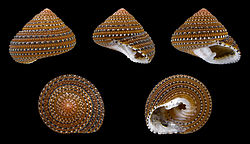
Picture of Clanculus
- Source
- Wikipedia/Commons
- Credit
- H. Zell
- Licence
- CC BY-SA 3.0
- Commercial use
- the licence allows it
No 3D scan of Clanculus was found in MorphoSource and Sketchfab.
Smithsonian Open Access was not reached for this taxon, so this list is what the others held rather than everything there is.
The description on this site
- Source
- Wikipedia, “Clanculus”
- Licence
- CC BY-SA 4.0
This is what the site found, which is not the same as what exists.
Keep going
What may have been alongside itTrochinae through timeFormations of the PleistoceneThe world it lived on
Occurrence data from the Paleobiology Database, CC BY 4.0. Monfort 1810