Champsosauridae
Neochoristodera is a lineage of specialised crocodile-like fully aquatic choristodere reptiles. Noted for their long jaws and large size, these animals were predominant across the Northern Hemisphere, occurring in freshwater and coastal environments across the Cretaceous and early Cenozoic.

D. Gordon E. Robertson · CC BY-SA 3.0 · via Wikipedia/Commons. May be a photograph of a specimen, or an artist’s reconstruction — an interpretation of a skeleton, since colour and soft tissue are almost never preserved.
On record
Recorded, not inferred- Also called
- champsosaurPBDB
- Sits inside
- NeochoristoderaPBDB
- Diet
- piscivorePBDB
- Life habit
- amphibiousPBDB
- Motility
- actively mobilePBDB, for Osteichthyes
- Environment
- terrestrialPBDB, for Amniota
Time the record covers
At least 66 million years on record.
The record covers at least 125.77 Mya to 59.24 Mya. No occurrence read is dated outside 137.05 Mya to 56 Mya.
30 occurrences of Champsosauridae on record, most of them in the Late Cretaceous. Bar height is expected occurrences, not a count: each fossil is spread across the span it is dated to, so a tall narrow bar means tight dating and a low wide one means loose.
When
30 occurrencesThese are dates about fossils, not the animal: the record can only begin after it arose and end before it died out, so either end may reach further. Shares are expected occurrences: a fossil dated to a span is counted partly in each period it straddles. More on what this infers.
Found in
16 formations
- Hell Creek Formation · Montana Group6
- Dinosaur Park Formation · Belly River Group5
- Paskapoo Formation2
- Horseshoe Canyon Formation · Edmonton Group2
- North Horn Formation1
- Lance Formation1
Loading coastlines…
The named rock units Champsosauridae has been recovered from, largest first. Drawn where the rock is now, not where it formed. 3 occurrences have no formation on record, which is common for older literature.
Champsosauridae and its relatives
Late CretaceousWhere Champsosauridae and its relatives were recorded in the Late Cretaceous.
Found in the same rock
270 taxa- Crocodylia17 sites
- Testudines13 sites
- Osteichthyes12 sites
- Lepisosteidae9 sites
- Theropoda9 sites
- Trionychidae9 sites
- Hadrosauridae8 sites
- Amiidae7 sites
- Ceratopsidae6 sites
- Mammalia6 sites
- Ceratopsia5 sites
- Ornithomimidae5 sites
- Pterosauria5 sites
- Squamata5 sites
- Tyrannosauridae5 sites
- Amphibia4 sites
- Ankylosauria4 sites
- Ankylosauridae4 sites
- Baenidae4 sites
- Basilemys4 sites
- Chelydridae4 sites
- Compsemys victa4 sites
- Crocodylidae4 sites
- Dromaeosauridae4 sites
The Paleobiology Database records 30 sites for Champsosauridae, and this reads all of them. The number is how many of those sites it was catalogued from too. The 24 sharing the most are listed.
This is not a list of everything alive at the time. It is only what has come out of the same ground as this animal and been written down.
Entered from
24 references- Fossil Vertebrate Collections4
- An unusual microsite from the Upper Cretaceous Horseshoe Canyon Formation of Alberta, Canada2
- New psittacosaur occurrences in Inner Mongolia2
- Notes on the Edmonton Formation of Alberta2
- First mammal from the Willow Creek Formation: a new early Paleocene ptilodontid (Mammalia, Multituberculata) from near Calgary, Alberta, Canada1
- Earliest Palaeocene purgatoriids and the initial radiation of stem primates1
- New cranial material of Gilmoremys lancensis (Testudines, Trionychidae) from the Hell Creek Formation of southeastern Montana, U.S.A1
- Hadrosaurid (Edmontosaurus) bonebeds from the Horseshoe Canyon Formation (Horsethief Member) at Drumheller, Alberta, Canada: geology, preliminary taphonomy, and significance1
- Occurrence and taphonomy of the first documented hadrosaurid bonebed from the Dinosaur Park Formation (Belly River Group, Campanian) at Dinosaur Provincial Park, Alberta, Canada1
- Non-trionychid turtles from the Paleocene of Alberta, Canada1
- Eberth and Evans, 20111
- A centrosaurine mega-bonebed from the Upper Cretaceous of southern Alberta: implications for behavior and death events1
Each of the 30 occurrences read was entered from one of these publications, ordered by how many each accounts for. This is not a search for papers mentioning the name. 12 further references are not listed. Entries link to doi.org where the Paleobiology Database holds an identifier, and to its own record where it does not. Relayed as the Paleobiology Database holds them, not checked against what they resolve to.
Media and terms
Media content1
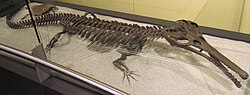
Picture of Champsosauridae
- Source
- Wikipedia/Commons
- Credit
- D. Gordon E. Robertson
- Licence
- CC BY-SA 3.0
- Commercial use
- the licence allows it
No 3D scan of Champsosauridae was found in Sketchfab.
Smithsonian Open Access and MorphoSource were not reached for this taxon, so this list is what the others held rather than everything there is.
The description on this site
- Licence
- CC BY-SA 4.0
This is what the site found, which is not the same as what exists.
Keep going
What may have been alongside itNeochoristodera through timeFormations of the Late CretaceousThe world it lived on
Occurrence data from the Paleobiology Database, CC BY 4.0. Cope 1876