Capra
Capra is a genus of mammals, the goats, comprising ten species, including the markhor and several species known as ibexes. The domestic goat is a domesticated species derived from the bezoar ibex, a subspecies of the wild goat. It is one of the oldest domesticated species of animal—according to archaeological evidence its earliest domestication occurred in Iran at 10,000 calibrated calendar years ago.

Andrija12345678 · CC BY-SA 4.0 · via Wikipedia/Commons. May be a photograph of a specimen, or an artist’s reconstruction — an interpretation of a skeleton, since colour and soft tissue are almost never preserved.
On record
Recorded, not inferred- Also called
- goatPBDB
- Sits inside
- CapriniPBDB
- Diet
- grazer, browserPBDB, for Bovidae
- Life habit
- ground dwellingPBDB, for Bovidae
- Motility
- actively mobilePBDB, for Osteichthyes
- Environment
- terrestrialPBDB, for Artiodactyla
Time the record covers
At least 7.2 million years on record.
The record covers at least 7.246 Mya to 11.7 ka. No occurrence read is dated outside 11.63 Mya to 0 Mya.
77 occurrences of Capra on record, most of them in the Pleistocene. The Paleobiology Database records this as a living group. Bar height is expected occurrences, not a count: each fossil is spread across the span it is dated to, so a tall narrow bar means tight dating and a low wide one means loose.
When
77 occurrences- Miocene3%
- Plioceneunder 1%
- Pleistocene64%
- Holocene33%
These are dates about fossils, not the animal: the record can only begin after it arose and end before it died out, so either end may reach further. Shares are expected occurrences: a fossil dated to a span is counted partly in each period it straddles. More on what this infers.
Found in
5 formations
- Nubia Formation2
- Nubia Formation1
- Benot Ya'aqov Formation1
- Guadix Formation1
- Piram Conglomerate Formation1
Loading coastlines…
The named rock units Capra has been recovered from, largest first. Drawn where the rock is now, not where it formed. 71 occurrences have no formation on record, which is common for older literature.
Capra and its relatives
PleistoceneWhere Capra and its relatives were recorded in the Pleistocene.
Found in the same rock
908 taxa- Sus scrofa24 sites
- Equus21 sites
- Cervus elaphus20 sites
- Vulpes vulpes19 sites
- Bos primigenius18 sites
- Capreolus capreolus17 sites
- Ovis aries16 sites
- Panthera pardus16 sites
- Bos taurus15 sites
- Lepus15 sites
- Bos13 sites
- Canis lupus13 sites
- Cervus13 sites
- Dama dama13 sites
- Aves11 sites
- Canis11 sites
- Crocuta crocuta11 sites
- Felis11 sites
- Ursus arctos11 sites
- Microtus10 sites
- Sus10 sites
- Arvicola9 sites
- Ursus9 sites
- Vulpes9 sites
The Paleobiology Database records 73 sites for Capra, and this reads all of them. The number is how many of those sites it was catalogued from too. The 24 sharing the most are listed.
This is not a list of everything alive at the time. It is only what has come out of the same ground as this animal and been written down.
Entered from
56 references- I giacimenti Quaternari di vertebrati fossili nell'Italia Nord-Orientale8
- Quaternary large mammals from the Apidima Caves (Lakonia, S. Peloponnese, Greece4
- Avian remains from new Upper Pleistocene and Holocene sites in the Spanish Pyrenees3
- The prehistory of vertebrates, especially birds, on Tinian, Aguiguan, and Rota, Northern Mariana Islands3
- Subfossil lemur discoveries from the Beanka Protected Area in western Madagascar2
- The Kor & Bot collection revisited, with a biostratigraphic interpretation of the Early Pleistocene Oosterschelde Fauna (Oosterschelde Estuary, the Netherlands)2
- Cave bears and paleolithic artifacts in Yarimburgaz Cave, Turkey: Dissecting a palimpsest2
- Faunal Evidence for Early Stockkeeping in the Central Rift Valley of Kenya: Preliminary Findings2
- Asprochaliko and Kastritsa: Further Investigations of Palaeolithic Settlement and Economy in Epirus (North-West Greece)2
- The Stone Age of Mount Carmel, Vol. 12
- La grotte de l'Observatoire à Monaco2
- Une faune tres diversifee du Pleistocene inferieur de la Sierra de Quibas (province de Murcia, Espagne)1
Each of the 77 occurrences read was entered from one of these publications, ordered by how many each accounts for. This is not a search for papers mentioning the name. 44 further references are not listed. Entries link to doi.org where the Paleobiology Database holds an identifier, and to its own record where it does not. Relayed as the Paleobiology Database holds them, not checked against what they resolve to.
Media and terms
Media content3

Picture of Capra
- Source
- Wikipedia/Commons
- Credit
- Andrija12345678
- Licence
- CC BY-SA 4.0
- Commercial use
- the licence allows it
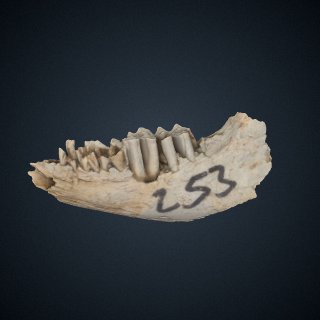
3D scan
- Source
- Smithsonian
- Licence
- CC0 — this site’s default, not the record’s
- Commercial use
- the licence allows it
- Specimen
- Capra hircus Linnaeus
CT scan
- Source
- MorphoSource
- Licence
- In Copyright
- Commercial use
- cannot be read from the licence given — check the record
- Specimen
- Capra hircus · NMBE:mamm:1124117
The description on this site
- Licence
- CC BY-SA 4.0
This is what the site found, which is not the same as what exists.
Keep going
What may have been alongside itCaprini through timeFormations of the PleistoceneThe world it lived on
Occurrence data from the Paleobiology Database, CC BY 4.0. Linnaeus 1758