Bos
Bos is a genus of bovines, which includes, among others, wild and domestic cattle.

Daniel Schwen · CC BY-SA 3.0 · via Wikipedia/Commons. May be a photograph of a specimen, or an artist’s reconstruction — an interpretation of a skeleton, since colour and soft tissue are almost never preserved.
On record
Recorded, not inferred- Also called
- oxPBDB
- Sits inside
- BoviniPBDB
- Diet
- grazer, browserPBDB, for Bovidae
- Life habit
- ground dwellingPBDB, for Bovidae
- Motility
- actively mobilePBDB, for Osteichthyes
- Environment
- terrestrialPBDB, for Artiodactyla
Time the record covers
At least 2.5 million years on record.
The record covers at least 2.58 Mya to 11.7 ka. No occurrence read is dated outside 23.04 Mya to 0 Mya.
278 occurrences of Bos on record, most of them in the Pleistocene. The Paleobiology Database records this as a living group. Bar height is expected occurrences, not a count: each fossil is spread across the span it is dated to, so a tall narrow bar means tight dating and a low wide one means loose.
When
278 occurrences- Miocene1%
- Pliocene1%
- Pleistocene79%
- Holocene19%
These are dates about fossils, not the animal: the record can only begin after it arose and end before it died out, so either end may reach further. Shares are expected occurrences: a fossil dated to a span is counted partly in each period it straddles. More on what this infers.
Found in
18 formations
- Gebel Silsila-YCS Formation11
- Gabal Silsila Formation8
- Nubia Formation3
- Unterer Travertin Formation2
- Matadero Saldungaray Formation2
- Babladanga Formation1
Loading coastlines…
The named rock units Bos has been recovered from, largest first. Drawn where the rock is now, not where it formed. 239 occurrences have no formation on record, which is common for older literature.
Bos and its relatives
PleistoceneWhere Bos and its relatives were recorded in the Pleistocene.
Found in the same rock
1,344 taxa- Equus74 sites
- Alcelaphus buselaphus51 sites
- Hippopotamus amphibius49 sites
- Cervus elaphus48 sites
- Cervus45 sites
- Sus scrofa45 sites
- Canis lupus34 sites
- Panthera pardus31 sites
- Clarias30 sites
- Vulpes vulpes30 sites
- Sus28 sites
- Gazella dorcas26 sites
- Crocuta crocuta25 sites
- Palaeoloxodon antiquus25 sites
- Capreolus capreolus24 sites
- Dama24 sites
- Equus asinus24 sites
- Equus caballus24 sites
- Bovidae23 sites
- Canis23 sites
- Cervidae22 sites
- Lepus22 sites
- Panthera leo22 sites
- Ursus21 sites
The Paleobiology Database records 253 sites for Bos, and this reads 240 of them. The number is how many of those sites it was catalogued from too. The 24 sharing the most are listed.
This is not a list of everything alive at the time. It is only what has come out of the same ground as this animal and been written down.
Entered from
138 references- Large mammal fossil occurrences and associated archaeological evidence in Pleistocene contexts of peninsular India and Sri Lanka24
- Kom Ombo: Preliminary Report on the Fauna of Late Paleolithic Sites in Upper Egypt24
- From tortoises to elephants: the impact of elephants in the broad spectrum diet at Bolomor Cave (MIS 9–5 Spain)14
- Wendorf and Schild, 197611
- I giacimenti Quaternari di vertebrati fossili nell'Italia Nord-Orientale10
- Paleoenvironmental and Cultural Implications of Late Holocene Archaeological Faunas from the Orange Free State and North Central Cape Province, South Africa6
- Faunal Evidence for Early Stockkeeping in the Central Rift Valley of Kenya: Preliminary Findings5
- Mammal fauna with Elephas (Palaeoloxodon) antiquus from the lower levels of Ambrona (Soria, Spain)4
- The Late Neogene elephantoid-bearing faunas of Indonesia and their palaeozoogeographic implications. A study of the terrestrial faunal succession of Sulawesi, Flores and Java, including evidence for early hominid dispersal east of Wallace's Line4
- Implications of Late Quaternary mammalian fauna from Lukenya Hill (South-Central Kenya) for paleoenvironmental change and faunal extinctions4
- New Quaternary mammal localities in the upper Clark Fork River valley, western Montana4
- Die jungpleistozänen Säugetierfaunen aus dem Travertingebiet von Taubach-Weimar-Ehringsdorf (The Early Plestocene mammalian fauna from the travetin-area of Taubach-Weimar-Ehringsdorf)4
Each of the 278 occurrences read was entered from one of these publications, ordered by how many each accounts for. This is not a search for papers mentioning the name. 126 further references are not listed. Entries link to doi.org where the Paleobiology Database holds an identifier, and to its own record where it does not. Relayed as the Paleobiology Database holds them, not checked against what they resolve to.
Media and terms
Media content1
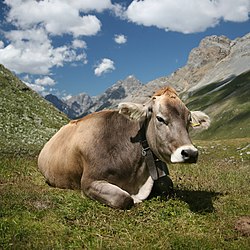
Picture of Bos
- Source
- Wikipedia/Commons
- Credit
- Daniel Schwen
- Licence
- CC BY-SA 3.0
- Commercial use
- the licence allows it
No repository was searched for a 3D scan: the genus name is too short to search on without matching most of the record.
The description on this site
- Source
- Wikipedia, “Bos”
- Licence
- CC BY-SA 4.0
This is what the site found, which is not the same as what exists.
Keep going
What may have been alongside itBovini through timeFormations of the PleistoceneThe world it lived on
Occurrence data from the Paleobiology Database, CC BY 4.0. Linnaeus 1758