Caelifera
The Caelifera are a suborder of orthopteran insects. They include the grasshoppers and grasshopper-like insects, as well as other superfamilies classified with them: the ground-hoppers (Tetrigoidea) and pygmy mole crickets (Tridactyloidea). The latter should not be confused with the mole crickets (Gryllotalpidae), which belong to the other Orthopteran suborder Ensifera.

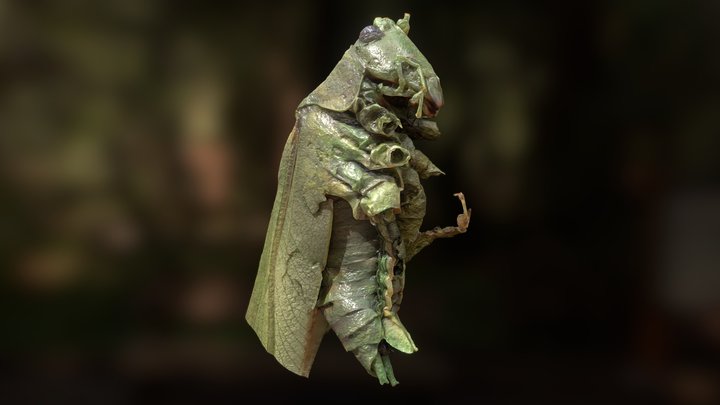
Dinesh Valke from Thane, India · CC BY-SA 2.0 · via Wikipedia/Commons. May be a photograph of a specimen, or an artist’s reconstruction — an interpretation of a skeleton, since colour and soft tissue are almost never preserved.
On record
Recorded, not inferred- Sits inside
- OrthopteraPBDB
- Diet
- grazer, herbivorePBDB
- Life habit
- ground dwelling, gregariousPBDB
- Motility
- fast-movingPBDB
- Vision
- well-developedPBDB
- Environment
- terrestrialPBDB
Time the record covers
At least 251 million years on record.
The record covers at least 251.902 Mya to 11.7 ka. No occurrence read is dated outside 254.14 Mya to 0 Mya.
356 occurrences of Caelifera on record, most of them in the Early Cretaceous. The Paleobiology Database records this as a living group. Bar height is expected occurrences, not a count: each fossil is spread across the span it is dated to, so a tall narrow bar means tight dating and a low wide one means loose.
When
356 occurrences- Permianunder 1%
- Middle Triassic6%
- Late Triassic3%
- Early Jurassic17%
- Middle Jurassic2%
- Late Jurassic3%
- Early Cretaceous18%
- Late Cretaceous8%
- Paleocene2%
- Eocene16%
- Oligocene4%
- Miocene16%
- Pliocene1%
- Pleistocene3%
- Holocene1%
These are dates about fossils, not the animal: the record can only begin after it arose and end before it died out, so either end may reach further. Shares are expected occurrences: a fossil dated to a span is counted partly in each period it straddles. More on what this infers.
Found in
48 formations
- Crato Formation · Santana Group42
- Green River Formation25
- Madygen Formation18
- Florissant Formation10
- Lilstock Formation · Penarth Group9
- Upper Freshwater-Molasse Formation8
Loading coastlines…
The named rock units Caelifera has been recovered from, largest first. Drawn where the rock is now, not where it formed. 24 further formations hold fewer occurrences each and are not listed. 145 occurrences have no formation on record, which is common for older literature.
Caelifera and its relatives
Early CretaceousWhere Caelifera and its relatives were recorded in the Early Cretaceous.
Found in the same rock
7,031 taxa- Acrididae26 sites
- Formicidae14 sites
- Coleoptera13 sites
- Eotetrix unicornis13 sites
- Eoerianthus eocaenicus10 sites
- Pteromogoplistes smithii10 sites
- Ichneumonidae9 sites
- Panorpidium minima9 sites
- Anisoptera8 sites
- Araneae8 sites
- Chironomidae8 sites
- Gryllinae8 sites
- Oedipodinae8 sites
- Gryllidae7 sites
- Lepidoptera7 sites
- Panorpidium geinitzi7 sites
- Pronemobius tertiarius7 sites
- Aeshnidae6 sites
- Bibio6 sites
- Bibionidae6 sites
- Braconidae6 sites
- Cratoelcana zessini6 sites
- Ditomoptera dubia6 sites
- Elateridae6 sites
The Paleobiology Database records 197 sites for Caelifera, and this reads all of them. Of that, one read hit the database's own return limit, so every count below is a floor rather than a total. The number is how many of those sites it was catalogued from too. The 24 sharing the most are listed.
This is not a list of everything alive at the time. It is only what has come out of the same ground as this animal and been written down.
Entered from
130 references- Eocene Orthoptera from Green River Formation of Wyoming (USA)23
- Filogeniya ortopteroidnykh nasekomykh16
- Systematics of the Caelifera (Insecta, Orthopteroidea) from the Santana Formation, Araripe Basin (Lower Cretaceous, northeast Brazil), with a description of new genera and species15
- Review of Triassic Orthoptera with Descriptions of New and Little Known Taxa: Part 214
- The fossil Acrididae (Orth. Salt. ) Part IV Acrididae incertae sedis and Addendum to Catantopinae10
- The Locustopsidae and the phylogeny of the Acridodea (Orthoptera)10
- Neue Saltatoria (Insecta) aus dem Oberlias Mitteleuropas9
- Revision der mesozoischen Familie Locustopsidae unter Berücksichtigung neuer Funde (Orthopteroida, Caelifera)9
- Grasshoppers and crickets (Insecta: Orthoptera) from the Lower Cretaceous of southern England8
- The Tertiary Insects of North America8
- Insekten aus dem oberen Lias von Grimmen (Vorpommern, Norddeutschland)7
- Neue Untersuchungen über die fossilen Insekten mit Ergänzungen und Nachträgen sowie Ausblicken auf phylogenetische, palaeogeographische und allgemein biologische Probleme. II Teil7
Each of the 356 occurrences read was entered from one of these publications, ordered by how many each accounts for. This is not a search for papers mentioning the name. 118 further references are not listed. Entries link to doi.org where the Paleobiology Database holds an identifier, and to its own record where it does not. Relayed as the Paleobiology Database holds them, not checked against what they resolve to.
Media and terms
Media content2

Picture of Caelifera
- Source
- Wikipedia/Commons
- Credit
- Dinesh Valke from Thane, India
- Licence
- CC BY-SA 2.0
- Commercial use
- the licence allows it
Smithsonian Open Access and MorphoSource were not reached for this taxon, so this list is what the others held rather than everything there is.
The description on this site
- Source
- Wikipedia, “Caelifera”
- Licence
- CC BY-SA 4.0
This is what the site found, which is not the same as what exists.
Keep going
What may have been alongside itOrthoptera through timeFormations of the Early CretaceousThe world it lived on
Occurrence data from the Paleobiology Database, CC BY 4.0. Ander 1936