Brachyura
Brachyura is an infraorder of decapod crustaceans comprising the true crabs. They typically have a very short projecting tail-like abdomen, usually hidden entirely under the thorax. Their exoskeleton is often thickened and hard. They generally have five pairs of legs, and the frontmost pair end in chelae, which function as pincers. They are present in all the world's oceans, in freshwater, and on land, often hiding themselves in small crevices or burrowing into sediment. True crabs are omnivores, feeding on a variety of food, including a significant proportion of algae, as well as detritus and other invertebrates. True crabs are widely consumed by humans as food, with over 1.5 million tonnes caught annually.

Biopics Dan Boone Honguyenseo Bernard Picton Biopics Philippe Boujon Splette Nosferattus Rushenb · CC BY-SA 4.0 · via Wikipedia/Commons. May be a photograph of a specimen, or an artist’s reconstruction — an interpretation of a skeleton, since colour and soft tissue are almost never preserved.
On record
Recorded, not inferred- Also called
- crabPBDB
- Sits inside
- MeiuraPBDB
- Diet
- carnivorePBDB, for Decapoda
- Life habit
- epifaunalPBDB, for Decapoda
- Motility
- actively mobilePBDB, for Malacostraca
- Vision
- well-developedPBDB, for Malacostraca
Time the record covers
At least 293 million years on record.
The record covers at least 293.52 Mya to 11.7 ka. No occurrence read is dated outside 298.9 Mya to 0 Mya.
5,471 occurrences of Brachyura on record, most of them in the Eocene. The Paleobiology Database records this as a living group. Bar height is expected occurrences, not a count: each fossil is spread across the span it is dated to, so a tall narrow bar means tight dating and a low wide one means loose.
When
5,471 occurrences- Permianunder 1%
- Late Triassicunder 1%
- Early Jurassicunder 1%
- Middle Jurassicunder 1%
- Late Jurassic3%
- Early Cretaceous5%
- Late Cretaceous11%
- Paleocene3%
- Eocene28%
- Oligocene6%
- Miocene24%
- Pliocene6%
- Pleistocene10%
- Holocene3%
These are dates about fossils, not the animal: the record can only begin after it arose and end before it died out, so either end may reach further. Shares are expected occurrences: a fossil dated to a span is counted partly in each period it straddles. More on what this infers.
Found in
639 formations
- Sandakan Formation112
- Cercado Formation · Yaque Group71
- Palos Verdes Sand Formation62
- Pirabas Formation60
- San Pedro Formation53
- Miri Formation · Belait Group43
Loading coastlines…
The named rock units Brachyura has been recovered from, largest first. Drawn where the rock is now, not where it formed. 615 further formations hold fewer occurrences each and are not listed. 2,319 occurrences have no formation on record, which is common for older literature.
Brachyura and its relatives
EoceneWhere Brachyura and its relatives were recorded in the Eocene.
Found in the same rock
3,419 taxa- Turritella25 sites
- Ostrea23 sites
- Chlamys20 sites
- Conus20 sites
- Callianassa14 sites
- Cypraea14 sites
- Lithophaga14 sites
- Bryozoa13 sites
- Dentalium13 sites
- Chama12 sites
- Daira speciosa12 sites
- Lithophaga lithophaga12 sites
- Crassatella11 sites
- Ficus11 sites
- Lima lima11 sites
- Modiolus11 sites
- Nucula11 sites
- Balanus10 sites
- Cardium10 sites
- Echinoidea10 sites
- Epitonium10 sites
- Natica10 sites
- Pitar10 sites
- Schizaster10 sites
The Paleobiology Database records at least 925 sites for Brachyura, and this reads 240 of them. The number is how many of those sites it was catalogued from too. The 24 sharing the most are listed.
This is not a list of everything alive at the time. It is only what has come out of the same ground as this animal and been written down.
Entered from
820 references- Fossil Crustacea of the Atlantic and Gulf Coastal Plain208
- The fossil stalk-eyed Crustacea of the Pacific slope of North America198
- The genus Cancer (Crustacea: Brachyura): systematics, biogeography and fossil record165
- Miocene and Pleistocene Crabs (Crustacea, Decapoda) from Sabah and Sarawak149
- I crostacei associati a coralli nell’Eocene inferiore dell’area di Bolca (Verona e Vicenza, Italia nordorientale)138
- Decapod crustacea of the Badenian135
- Cenozoic Decapod Crustacea from Southwest Japan114
- Notes on North American Crustacea, in the Museum of the Smithsonian Institution. No. II100
- Decapod crustaceans from the Miocene Kukinaga Group, Tanegashima Island, Kyushu, Japan89
- Neogene and Quaternary crabs (Crustacea, Decapoda) collected from Costa Rica and Panama by members of the Panama Paleontology Project82
- Decapod crustaceans from the Neogene of the Caribbean: diversity, distribution and prospectus78
- La fauna di crostacei associati a coralli dell'Eocene Superiore di Campolongo di Val Liona (Monti Berici, Vicenz, Italia nordorientale)63
Each of the 5,471 occurrences read was entered from one of these publications, ordered by how many each accounts for. This is not a search for papers mentioning the name. 808 further references are not listed. Entries link to doi.org where the Paleobiology Database holds an identifier, and to its own record where it does not. Relayed as the Paleobiology Database holds them, not checked against what they resolve to.
Media and terms
Media content2

Picture of Brachyura
- Source
- Wikipedia/Commons
- Credit
- Biopics Dan Boone Honguyenseo Bernard Picton Biopics Philippe Boujon Splette Nosferattus Rushenb
- Licence
- CC BY-SA 4.0
- Commercial use
- the licence allows it
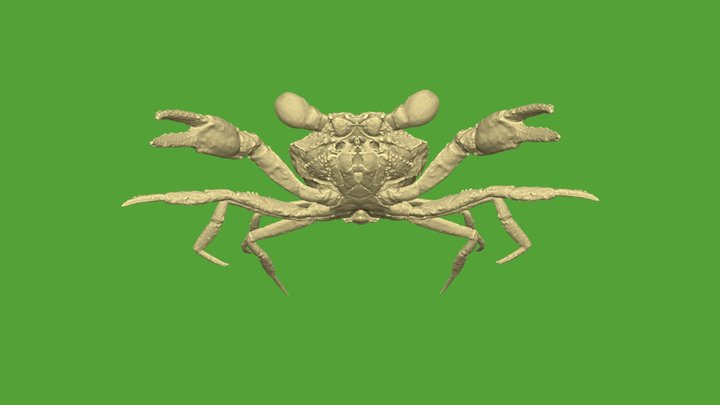
3D model
- Source
- Sketchfab
- Credit
- javipaleobio
- Licence
- CC Attribution
- Commercial use
- cannot be read from the licence given — check the record
Smithsonian Open Access and MorphoSource were not reached for this taxon, so this list is what the others held rather than everything there is.
The description on this site
- Source
- Wikipedia, “Brachyura”
- Licence
- CC BY-SA 4.0
This is what the site found, which is not the same as what exists.
Keep going
What may have been alongside itMeiura through timeFormations of the EoceneThe world it lived on
Occurrence data from the Paleobiology Database, CC BY 4.0. Latreille 1802