Aulacomya atra
Aulacomya atra, called also the Magellan mussel or the ribbed mussel, is a southern species of edible saltwater mussel, a marine bivalve mollusk in the family Mytilidae, the true mussels. Note that the common name ribbed mussel is also used of the Northern Hemisphere mussel Geukensia demissa.

Rodrigo Fernández · CC BY-SA 4.0 · via Wikipedia/Commons. May be a photograph of a specimen, or an artist’s reconstruction — an interpretation of a skeleton, since colour and soft tissue are almost never preserved.
On record
Recorded, not inferred- Sits inside
- AulacomyaPBDB
- Diet
- suspension feederPBDB, for Mytilidae
- Life habit
- epifaunalPBDB, for Mytilidae
- Motility
- stationary, attachedPBDB, for Mytilidae
- Vision
- blindPBDB, for Bivalvia
- Environment
- lagoonal,coastal,inner shelf,outer shelf,oceanic,brackish,freshwaterPBDB, for Mytilidae
Time the record covers
At least 27 million years on record.
The record covers at least 27.3 Mya to 11.7 ka. No occurrence read is dated outside 33.9 Mya to 0 Mya.
18 occurrences of Aulacomya atra on record, most of them in the Pleistocene. The Paleobiology Database records this as a living group. Bar height is expected occurrences, not a count: each fossil is spread across the span it is dated to, so a tall narrow bar means tight dating and a low wide one means loose.
When
18 occurrences- Oligocene13%
- Miocene15%
- Pliocene11%
- Pleistocene33%
- Holocene28%
These are dates about fossils, not the animal: the record can only begin after it arose and end before it died out, so either end may reach further. Shares are expected occurrences: a fossil dated to a span is counted partly in each period it straddles. More on what this infers.
Found in
4 formations
Loading coastlines…
The named rock units Aulacomya atra has been recovered from, largest first. Drawn where the rock is now, not where it formed. 12 occurrences have no formation on record, which is common for older literature.
Aulacomya atra and its relatives
PleistoceneWhere Aulacomya atra and its relatives were recorded in the Pleistocene.
Found in the same rock
267 taxa- Fissurella5 sites
- Patella5 sites
- Arca4 sites
- Buccinum digitale4 sites
- Burnupena4 sites
- Chiton4 sites
- Conus4 sites
- Corbula4 sites
- Scutellastra barbara4 sites
- Tellina4 sites
- Turritella (Torquesia) carinifera4 sites
- Vermetus4 sites
- Afrocominella capensis3 sites
- Amblychilepas scutellum3 sites
- Bullia laevissima3 sites
- Calyptraea3 sites
- Calyptraea kilburni3 sites
- Carditella3 sites
- Clanculus3 sites
- Crepidula3 sites
- Fusus3 sites
- Marginella3 sites
- Nassarius3 sites
- Oxystele3 sites
The Paleobiology Database records 8 sites for Aulacomya atra, and this reads all of them. The number is how many of those sites it was catalogued from too. The 24 sharing the most are listed.
This is not a list of everything alive at the time. It is only what has come out of the same ground as this animal and been written down.
Entered from
7 references- Tertiary Marine Molluscan Assemblages of Eastern Patagonia (Argentina): A Biostratigraphic Analysis5
- Paleoenvrionments and paleoclimates of the Quaternary molluscan faunas from the coastal area of Bahía Vera-Camarones (Chubut, Patagonia)3
- Paleoecologia de moluscos marinos del Holoceno medio de Isla Gable, Canal Beagle, Tierra del Fuego, Argentina3
- Late Tertiary and Early Quaternary Fossil Mollusca for the Hondeklip Area, Cape Province, South Africa3
- Pleistocene shorelines in the Western Cape and South-West Africa2
- A Late Pleistocene macrobenthic assemblage in Caleta Patillos, northern Chile: paleoecological and paleobiogeographical interpretations1
- The Faunal Deposits of a Late Pleistocene Raised Beach at Milnerton, Cape Province, South Africa1
Each of the 18 occurrences read was entered from one of these publications, ordered by how many each accounts for. This is not a search for papers mentioning the name. Entries link to doi.org where the Paleobiology Database holds an identifier, and to its own record where it does not. Relayed as the Paleobiology Database holds them, not checked against what they resolve to.
Media and terms
Media content1
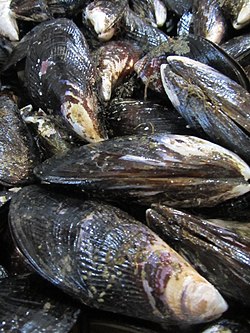
Picture of Aulacomya atra
- Source
- Wikipedia/Commons
- Credit
- Rodrigo Fernández
- Licence
- CC BY-SA 4.0
- Commercial use
- the licence allows it
No 3D scan of Aulacomya atra was found in Sketchfab.
Smithsonian Open Access and MorphoSource were not reached for this taxon, so this list is what the others held rather than everything there is.
The description on this site
- Licence
- CC BY-SA 4.0
This is what the site found, which is not the same as what exists.
Keep going
What may have been alongside itAulacomya through timeFormations of the PleistoceneThe world it lived on
Occurrence data from the Paleobiology Database, CC BY 4.0. (Molina 1782)