Zelkova
Zelkova is a genus of six species of deciduous trees in the elm family Ulmaceae, native to southern Europe, and southwest and eastern Asia. They vary in size from shrubs to large trees up to 35 m (115 ft) tall. The bark is smooth, dark brown. Unlike elms, the branchlets are never corky or winged. The leaves are alternate, with serrated margins, and a symmetrical base to the leaf blade. The leaves are in two distinct rows; they have pinnate venation and each vein extends to the leaf margin, where it terminates in a tooth. There are two stipules at each node, though these are caducous, leaving a pair of scars at the leaf base. Zelkova is polygamous. Staminate flowers are clustered in the lower leaf axils of young branchlets; the perianth is campanulate, with four to six lobes, and the stamens are short. Pistillate and hermaphrodite flowers are solitary, or rarely in clusters of two to four, in the upper leaf axils of young branchlets. The fruit is a dry, nut-like drupe with a dorsal keel, produced singly in the leaf axils. The perianth and stigma are persistent.

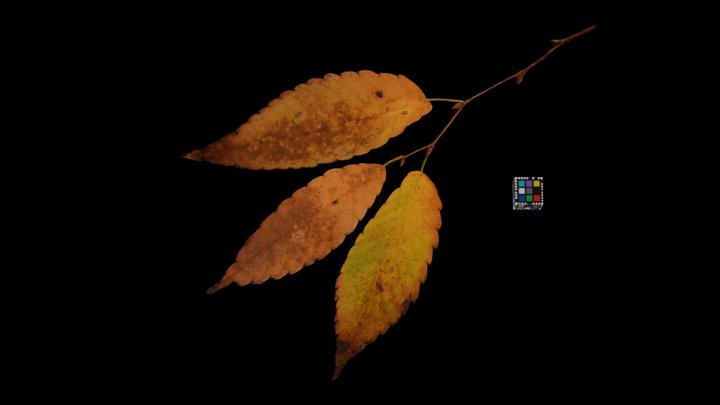
KENPEI · CC BY-SA 3.0 · via Wikipedia/Commons. May be a photograph of a specimen, or an artist’s reconstruction — an interpretation of a skeleton, since colour and soft tissue are almost never preserved.
On record
Recorded, not inferred- Also called
- zelkovaPBDB
- Sits inside
- UlmaceaePBDB
- Diet
- "photoautotroph"PBDB, for Angiospermae
Time the record covers
At least 72 million years on record.
The record covers at least 72.2 Mya to 11.7 ka. No occurrence read is dated outside 89.8 Mya to 0 Mya.
107 occurrences of Zelkova on record, most of them in the Miocene. The Paleobiology Database records this as a living group. Bar height is expected occurrences, not a count: each fossil is spread across the span it is dated to, so a tall narrow bar means tight dating and a low wide one means loose.
When
107 occurrences- Late Cretaceousunder 1%
- Paleocene13%
- Eocene16%
- Oligocene12%
- Miocene46%
- Pliocene6%
- Pleistocene5%
- Holoceneunder 1%
These are dates about fossils, not the animal: the record can only begin after it arose and end before it died out, so either end may reach further. Shares are expected occurrences: a fossil dated to a span is counted partly in each period it straddles. More on what this infers.
Found in
44 formations
- Fort Union Formation11
- Itahana Formation · Tomioka Group8
- Renova Formation · Ruby River Basin Group4
- Green River Formation4
- Yagii Formation2
- Ogawa Formation2
Loading coastlines…
The named rock units Zelkova has been recovered from, largest first. Drawn where the rock is now, not where it formed. 20 further formations hold fewer occurrences each and are not listed. 35 occurrences have no formation on record, which is common for older literature.
Zelkova and its relatives
MioceneWhere Zelkova and its relatives were recorded in the Miocene.
Found in the same rock
953 taxa- Acer28 sites
- Quercus28 sites
- Alnus27 sites
- Salix27 sites
- Ulmus25 sites
- Carpinus22 sites
- Populus20 sites
- Pterocarya19 sites
- Liquidambar18 sites
- Fagus17 sites
- Carya16 sites
- Cinnamomum16 sites
- Rhus16 sites
- Tilia16 sites
- Metasequoia occidentalis15 sites
- Celtis14 sites
- Fraxinus14 sites
- Juglans14 sites
- Bambusites13 sites
- Castanea13 sites
- Lindera13 sites
- Cladrastis12 sites
- Picea12 sites
- Vitis12 sites
The Paleobiology Database records 85 sites for Zelkova, and this reads all of them. The number is how many of those sites it was catalogued from too. The 24 sharing the most are listed.
This is not a list of everything alive at the time. It is only what has come out of the same ground as this animal and been written down.
Entered from
38 references- Late Miocene and Pliocene Floras in Central Honshu, Japan17
- A catalogue of Cenozoic megafossil plants in China15
- Paleocene flora of the Rocky Mountains and Great Plains13
- Fossil Plants of the Tertiary Beaverhead Basins in Southwestern Montana8
- Kleinsäugerstratigraphie in der miozänen Hörnlischüttung (Ostschweiz); (Biostratigraphy of small mammals in the Hörnlischüttung of Miocene age (East Switzerland))5
- Paleoecological and Floristic Heterogeneity in the Plant-Fossil Record - An Analysis Based on the Eocene of Washington4
- The Eocene Green River Flora of northwestern Colorado and northeastern Utah4
- Die mittelmiozaenen und obermiozaenen Floren aus der Meuroer und Raunoer Folge in der Lausitz. III. Fundstellen und Palaeobiologie3
- Pleistocene fossil leaflets of Albizia kalkora (Roxb.) Prain (Leguminosae subfamily Mimosoideae) from central Honshu, Japan, and its implications for historical biogeography2
- The section of Torre Picchio (Terni, Umbria, Central Italy): A Villafranchian site rich in vertebrates, molluscs, ostracods and plants.2
- The Oligocene Haynes Creek Flora of Eastern Idaho2
- Le bison (Bovidae, Artiodactyla) de Pleistocene moyen ancien de Durfort (Gard, France)2
Each of the 107 occurrences read was entered from one of these publications, ordered by how many each accounts for. This is not a search for papers mentioning the name. 26 further references are not listed. Entries link to doi.org where the Paleobiology Database holds an identifier, and to its own record where it does not. Relayed as the Paleobiology Database holds them, not checked against what they resolve to.
Media and terms
Media content2

Picture of Zelkova
- Source
- Wikipedia/Commons
- Credit
- KENPEI
- Licence
- CC BY-SA 3.0
- Commercial use
- the licence allows it
3D model
- Source
- Sketchfab
- Licence
- CC0 Public Domain
- Commercial use
- the licence allows it
Smithsonian Open Access and MorphoSource were not reached for this taxon, so this list is what the others held rather than everything there is.
The description on this site
- Source
- Wikipedia, “Zelkova”
- Licence
- CC BY-SA 4.0
This is what the site found, which is not the same as what exists.
Keep going
What may have been alongside itUlmaceae through timeFormations of the MioceneThe world it lived on
Occurrence data from the Paleobiology Database, CC BY 4.0. Spach 1841