Vinella
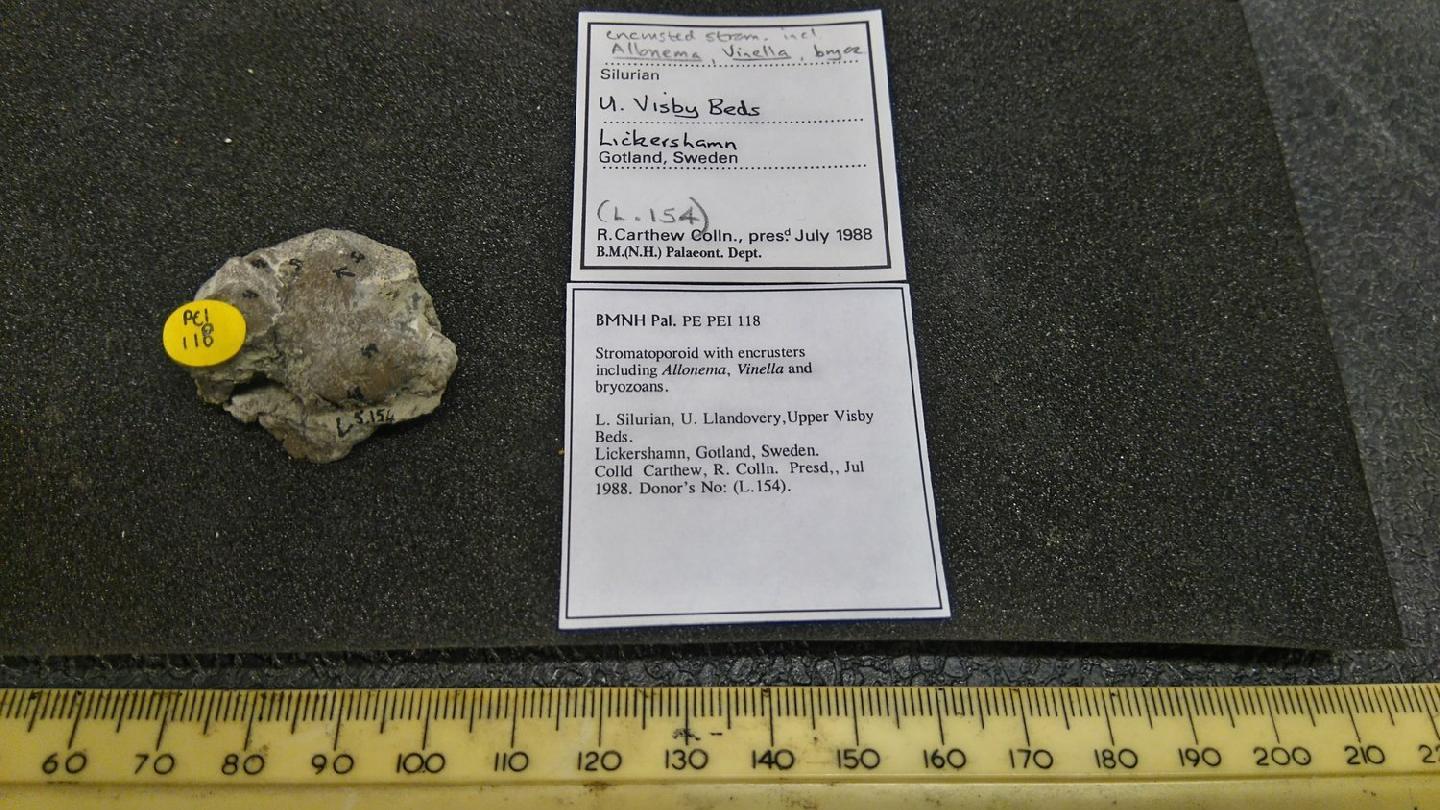
via iDigBio · CC BY · via iDigBio. May be a photograph of a specimen, or an artist’s reconstruction — an interpretation of a skeleton, since colour and soft tissue are almost never preserved.
On record
Recorded, not inferred- Sits inside
- VinellidaePBDB
- Diet
- suspension feederPBDB, for Bryozoa
- Life habit
- epifaunalPBDB, for Bryozoa
- Motility
- stationary, attachedPBDB, for Bryozoa
- Vision
- blindPBDB, for Gymnolaemata
- Environment
- marinePBDB, for Lophophorata
Time the record covers
At least 364 million years on record.
The record covers at least 450.5 Mya to 85.7 Mya. No occurrence read is dated outside 452.8 Mya to 83.6 Mya.
11 occurrences of Vinella on record, most of them in the Ordovician. Bar height is expected occurrences, not a count: each fossil is spread across the span it is dated to, so a tall narrow bar means tight dating and a low wide one means loose.
When
11 occurrencesThese are dates about fossils, not the animal: the record can only begin after it arose and end before it died out, so either end may reach further. Shares are expected occurrences: a fossil dated to a span is counted partly in each period it straddles. More on what this infers.
Found in
10 formations
- Corryville Formation1
- Redoak Hollow Formation1
- Martinsburg Formation1
- Denton Formation · Washita Group1
- Tucumcari Formation1
- Skaly Formation1
Loading coastlines…
The named rock units Vinella has been recovered from, largest first. Drawn where the rock is now, not where it formed. 1 occurrence has no formation on record, which is common for older literature.
Vinella and its relatives
OrdovicianWhere Vinella and its relatives were recorded in the Ordovician.
Found in the same rock
488 taxa- Cornulites4 sites
- Corynotrypa3 sites
- Polypora3 sites
- Ascodictyon2 sites
- Berenicea2 sites
- Clionolithes2 sites
- Conularia2 sites
- Crinoidea2 sites
- Cuneamya2 sites
- Eridopora2 sites
- Eridotrypa aedilis2 sites
- Fenestella2 sites
- Fistulipora2 sites
- Glyptocrinus2 sites
- Graptodictya bonnemai2 sites
- Hallopora dybowskii2 sites
- Hederella2 sites
- Leioclema2 sites
- Lichenocrinus2 sites
- Lophospira2 sites
- Mesopalaeaster2 sites
- Modiolopsis2 sites
- Penniretepora2 sites
- Petaloporella2 sites
The Paleobiology Database records 11 sites for Vinella, and this reads all of them. The number is how many of those sites it was catalogued from too. The 24 sharing the most are listed.
This is not a list of everything alive at the time. It is only what has come out of the same ground as this animal and been written down.
Entered from
10 references- The early Paleozoic Bryozoa of the Baltic Provinces2
- Middle Devonian brachiopod-hosted sclerobiont assemblage from the northern shelf of Gondwana (Mader Basin, Morocco): Diversity, colonization patterns and relation to coeval palaeocommunities1
- Nearshore fauna of the Tucumcari Formation (Lower Cretaceous, Albian), Quay County, New Mexico1
- Upper Ordovician tempestites from Swatara Gap, Pennsylvania: depositional processes affecting the sediments and paleoecology of the fossil faunas1
- Devonian bryozoans of the Holy Cross Mountains, Poland. Part I. Ctenostomata1
- A Paleoecologic Study of the Upper Denton Formation, Tarrant, Denton, and Cooke Counties, Texas1
- Late Mississippian fauna from the Redoak Hollow Formation of southern Oklahoma, Part I1
- The fossil fauna of the Ordovician in the Cincinnati Region1
- Geology of Anticosti Island1
- Über eine ctenostome Bryozoe aus dem Granulatensenon von Gr. Bülten bei Peine1
Each of the 11 occurrences read was entered from one of these publications, ordered by how many each accounts for. This is not a search for papers mentioning the name. Entries link to doi.org where the Paleobiology Database holds an identifier, and to its own record where it does not. Relayed as the Paleobiology Database holds them, not checked against what they resolve to.
Media and terms
Media content1
Picture of Vinella
- Source
- iDigBio
- Credit
- via iDigBio
- Licence
- CC BY
- Commercial use
- the licence allows it
No 3D scan of Vinella was found in MorphoSource and Sketchfab.
Smithsonian Open Access was not reached for this taxon, so this list is what the others held rather than everything there is.
This is what the site found, which is not the same as what exists.
Keep going
What may have been alongside itVinellidae through timeFormations of the OrdovicianThe world it lived on
Occurrence data from the Paleobiology Database, CC BY 4.0. Ulrich 1890