Vespidae
The Vespidae are a large, diverse, cosmopolitan family of wasps, including nearly all the eusocial wasps and many solitary wasps. Each social wasp colony includes a queen and a number of female workers with varying degrees of sterility relative to the queen. In temperate social species, colonies usually last only one year, dying at the onset of winter. New queens and males (drones) are produced towards the end of the summer, and after mating, the queens hibernate over winter in cracks or other sheltered locations. The nests of most species are constructed out of mud, but polistines and vespines use plant fibers, chewed to form a sort of paper. Many species are pollen vectors contributing to the pollination of several plants, being potential or even effective pollinators, while others are notable predators of pest insect species, and a few species are invasive pests.

Richard Bartz , Munich aka Makro Freak · CC BY-SA 2.5 · via Wikipedia/Commons. May be a photograph of a specimen, or an artist’s reconstruction — an interpretation of a skeleton, since colour and soft tissue are almost never preserved.
On record
Recorded, not inferred- Sits inside
- VespoideaPBDB
- Motility
- actively mobilePBDB, for Arthropoda
- Environment
- terrestrialPBDB, for Insecta
Time the record covers
At least 119 million years on record.
The record covers at least 119.57 Mya to 129 ka. No occurrence read is dated outside 121.4 Mya to 11.7 ka.
100 occurrences of Vespidae on record, most of them in the Eocene. The Paleobiology Database records this as a living group. Bar height is expected occurrences, not a count: each fossil is spread across the span it is dated to, so a tall narrow bar means tight dating and a low wide one means loose.
When
100 occurrences- Early Cretaceous11%
- Late Cretaceous17%
- Paleocene7%
- Eocene29%
- Oligocene14%
- Miocene20%
- Plioceneunder 1%
- Pleistocene2%
These are dates about fossils, not the animal: the record can only begin after it arose and end before it died out, so either end may reach further. Shares are expected occurrences: a fossil dated to a span is counted partly in each period it straddles. More on what this infers.
Found in
24 formations
- Florissant Formation12
- Shanwang Formation9
- Menat Formation7
- Dzun-Bain Formation · Bon Tsaagan Group6
- Rott Formation5
- Bouldnor Formation · Solent Group4
Loading coastlines…
The named rock units Vespidae has been recovered from, largest first. Drawn where the rock is now, not where it formed. 33 occurrences have no formation on record, which is common for older literature.
Vespidae and its relatives
EoceneWhere Vespidae and its relatives were recorded in the Eocene.
Found in the same rock
4,353 taxa- Coleoptera10 sites
- Ichneumonidae9 sites
- Formicidae8 sites
- Curculionidae6 sites
- Braconidae5 sites
- Cerambycidae5 sites
- Drepanorzeckia extrunculipennis5 sites
- Drepanorzeckia plana5 sites
- Tenthredinidae5 sites
- Blattodea4 sites
- Heteroptera4 sites
- Lepidoptera4 sites
- Proctotrupidae4 sites
- Tettigoniidae4 sites
- Aculeata3 sites
- Aeolothrips jarzembowskii3 sites
- Allophalerus bontsaganensis3 sites
- Anglogomphaeschna eocenica3 sites
- Anomala furva3 sites
- Anthophila3 sites
- Apidae3 sites
- Beraeodes vectensis3 sites
- Bibionidae3 sites
- Brachycera3 sites
The Paleobiology Database records 62 sites for Vespidae, and this reads all of them. Of that, one read hit the database's own return limit, so every count below is a floor rather than a total. The number is how many of those sites it was catalogued from too. The 24 sharing the most are listed.
This is not a list of everything alive at the time. It is only what has come out of the same ground as this animal and been written down.
Entered from
51 references- Mesozoic Vespidae10
- Piton, 19406
- Ueber alte und neue fossile Hymenopterenfunde aus den Tertiaren Ablagerungen von Rott am Siebengebirge5
- Fossil Hymenoptera from Florissant, Colorado5
- Modernisation of the Hymenoptera: ants, bees, wasps, and sawflies of the early Eocene Okanagan Highlands of western North America4
- Zhang et al., 19944
- Zhang, 19894
- Miocene fossil insects4
- Paper wasps (Hymenoptera: Vespidae, Polistinae) from Xiede (Eocene, central Tibetan Plateau): systematics and paleoecological implications3
- Vespids from the mid-Cretaceous with club-shaped antennae provide new evidence about the intrafamiliar relationships of Vespidae3
- Early lineages of Vespidae (Hymenoptera) in Cretaceous amber3
- Les insectes fossiles des terrains oligocènes de France3
Each of the 100 occurrences read was entered from one of these publications, ordered by how many each accounts for. This is not a search for papers mentioning the name. 39 further references are not listed. Entries link to doi.org where the Paleobiology Database holds an identifier, and to its own record where it does not. Relayed as the Paleobiology Database holds them, not checked against what they resolve to.
Media and terms
Media content1
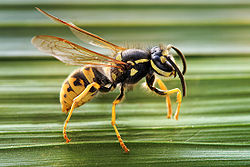
Picture of Vespidae
- Source
- Wikipedia/Commons
- Credit
- Richard Bartz , Munich aka Makro Freak
- Licence
- CC BY-SA 2.5
- Commercial use
- the licence allows it
No 3D scan of Vespidae was found in Sketchfab.
Smithsonian Open Access and MorphoSource were not reached for this taxon, so this list is what the others held rather than everything there is.
The description on this site
- Source
- Wikipedia, “Vespidae”
- Licence
- CC BY-SA 4.0
This is what the site found, which is not the same as what exists.
Keep going
What may have been alongside itVespoidea through timeFormations of the EoceneThe world it lived on
Occurrence data from the Paleobiology Database, CC BY 4.0. Latreille 1802