Anthophila
Bees are winged insects that form a monophyletic clade Anthophila within the superfamily Apoidea of the order Hymenoptera, with over 20,000 known species in seven recognized families. Some species – including honey bees, bumblebees, and stingless bees – are social insects living in colonies, whereas over 90% of bee species – including mason bees, carpenter bees, leafcutter bees, and sweat bees – are solitary.

Graham Wise from Brisbane, Australia · CC BY 2.0 · via Wikipedia/Commons. May be a photograph of a specimen, or an artist’s reconstruction — an interpretation of a skeleton, since colour and soft tissue are almost never preserved.
On record
Recorded, not inferred- Also called
- beePBDB
- Sits inside
- ApoideaPBDB
- Motility
- actively mobilePBDB, for Arthropoda
- Environment
- terrestrialPBDB, for Insecta
Time the record covers
At least 65 million years on record.
The record covers at least 66 Mya to 11.7 ka. No occurrence read is dated outside 72.2 Mya to 0 Mya.
404 occurrences of Anthophila on record, most of them in the Eocene. The Paleobiology Database records this as a living group. Bar height is expected occurrences, not a count: each fossil is spread across the span it is dated to, so a tall narrow bar means tight dating and a low wide one means loose.
When
404 occurrences- Late Cretaceousunder 1%
- Paleoceneunder 1%
- Eocene51%
- Oligocene8%
- Miocene34%
- Plioceneunder 1%
- Pleistoceneunder 1%
- Holocene4%
These are dates about fossils, not the animal: the record can only begin after it arose and end before it died out, so either end may reach further. Shares are expected occurrences: a fossil dated to a span is counted partly in each period it straddles. More on what this infers.
Found in
26 formations
- Florissant Formation36
- Randeck Maar Formation22
- Upper Freshwater-Molasse Formation21
- Shanwang Formation14
- Eifel Formation13
- Rott Formation12
Loading coastlines…
The named rock units Anthophila has been recovered from, largest first. Drawn where the rock is now, not where it formed. 2 further formations hold fewer occurrences each and are not listed. 247 occurrences have no formation on record, which is common for older literature.
Anthophila and its relatives
EoceneWhere Anthophila and its relatives were recorded in the Eocene.
Found in the same rock
4,711 taxa- Formicidae13 sites
- Apidae10 sites
- Coleoptera10 sites
- Ichneumonidae10 sites
- Archaea paradoxa8 sites
- Carabidae8 sites
- Cerambycidae8 sites
- Curculionidae8 sites
- Gesomyrmex hoernesi8 sites
- Apis7 sites
- Balticoroma serafinorum7 sites
- Bibio7 sites
- Glyptapis fuscula7 sites
- Plagiolepis klinsmanni7 sites
- Prenolepis henschei7 sites
- Prosphyracephala succini7 sites
- Staphylinidae7 sites
- Succinapis micheneri7 sites
- Tetraponera simplex7 sites
- Tettigoniidae7 sites
- Acrididae6 sites
- Anisoptera6 sites
- Bradoponera meieri6 sites
- Ctenoplectrella viridiceps6 sites
The Paleobiology Database records 164 sites for Anthophila, and this reads all of them. Of that, one read hit the database's own return limit, so every count below is a floor rather than a total. The number is how many of those sites it was catalogued from too. The 24 sharing the most are listed.
This is not a list of everything alive at the time. It is only what has come out of the same ground as this animal and been written down.
Entered from
145 references- A monograph of the Baltic amber bees and evolution of the Apoidea (Hymenoptera)84
- A monograph on fossil bees (Hymenoptera: Apoidea)22
- Versteinerte Honigbienen aus dem obermiocänen Randecker Maar17
- A review of the European fossil species of the bee Apis16
- Fossil Hymenoptera from Florissant, Colorado14
- New genera of melikertine bees with facial modifications in Baltic amber (Hymenoptera: Apidae)12
- The Middle Eocene Bee Faunas of Eckfeld and Messel, Germany (Hymenoptera: Apoidea)10
- Descriptions of Hymenoptera from Baltic amber8
- Heer, 18497
- Modernisation of the Hymenoptera: ants, bees, wasps, and sawflies of the early Eocene Okanagan Highlands of western North America6
- Stingless bees (Hymenoptera: Apidae) in Holocene copal and defaunation resin from eastern Africa indicate recent biodiversity change5
- Zhang, 19895
Each of the 404 occurrences read was entered from one of these publications, ordered by how many each accounts for. This is not a search for papers mentioning the name. 133 further references are not listed. Entries link to doi.org where the Paleobiology Database holds an identifier, and to its own record where it does not. Relayed as the Paleobiology Database holds them, not checked against what they resolve to.
Media and terms
Media content1
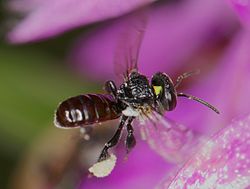
Picture of Anthophila
- Source
- Wikipedia/Commons
- Credit
- Graham Wise from Brisbane, Australia
- Licence
- CC BY 2.0
- Commercial use
- the licence allows it
No 3D scan of Anthophila was found in Sketchfab.
Smithsonian Open Access and MorphoSource were not reached for this taxon, so this list is what the others held rather than everything there is.
The description on this site
- Source
- Wikipedia, “Bee”
- Licence
- CC BY-SA 4.0
This is what the site found, which is not the same as what exists.
Keep going
What may have been alongside itApoidea through timeFormations of the EoceneThe world it lived on
Occurrence data from the Paleobiology Database, CC BY 4.0. Latreille 1804