Ursus
Searched as Ursus thibetanus kokeni. The Paleobiology Database treats Ursus as the accepted name.
Ursus is a genus in the family Ursidae (bears) that includes the widely distributed brown bear, the polar bear, the American black bear, and the Asian black bear. The name is derived from the Latin ursus, meaning bear.

derivative work: user:The Explaner · CC BY-SA 4.0 · via Wikipedia/Commons. May be a photograph of a specimen, or an artist’s reconstruction — an interpretation of a skeleton, since colour and soft tissue are almost never preserved.
On record
Recorded, not inferred- Sits inside
- UrsiniPBDB
- Diet
- herbivore, carnivorePBDB, for Ursidae
- Life habit
- ground dwellingPBDB, for Ursidae
- Motility
- actively mobilePBDB, for Osteichthyes
- Environment
- terrestrialPBDB, for Eutheria
Time the record covers
At most 763 thousand years on record.
Every occurrence read is dated to somewhere between 774 ka and 11.7 ka, and nothing in the dating separates them, so that window is what the record shows rather than a span.
2 occurrences of Ursus on record, most of them in the Pleistocene. The Paleobiology Database records this as a living group. Bar height is expected occurrences, not a count: each fossil is spread across the span it is dated to, so a tall narrow bar means tight dating and a low wide one means loose.
When
2 occurrences- Pleistocene100%
These are dates about fossils, not the animal: the record can only begin after it arose and end before it died out, so either end may reach further. Shares are expected occurrences: a fossil dated to a span is counted partly in each period it straddles. More on what this infers.
Ursus and its relatives
PleistoceneWhere Ursus and its relatives were recorded in the Pleistocene.
Found in the same rock
1,967 taxa- Equus101 sites
- Cervus68 sites
- Microtus57 sites
- Stephanorhinus etruscus57 sites
- Mimomys48 sites
- Lepus47 sites
- Sus scrofa46 sites
- Canis lupus45 sites
- Bison41 sites
- Myodes38 sites
- Canis35 sites
- Pliomys35 sites
- Allohippus stenonis33 sites
- Vulpes vulpes33 sites
- Hystrix32 sites
- Allocricetus29 sites
- Apodemus sylvaticus29 sites
- Felis29 sites
- Megaloceros29 sites
- Cervus elaphus28 sites
- Eucladoceros28 sites
- Mammuthus meridionalis28 sites
- Capreolus capreolus27 sites
- Castor fiber27 sites
The Paleobiology Database records 494 sites for Ursus, and this reads 240 of them. The number is how many of those sites it was catalogued from too. The 24 sharing the most are listed.
This is not a list of everything alive at the time. It is only what has come out of the same ground as this animal and been written down.
Entered from
2 references- A diverse hominoid fauna from the late middle Pleistocene breccia cave of Tham Khuyen, Socialist Republic of Vietnam1
- A new locality of Quaternary mammalian fossils at Tongshan in the south of Anhui Province1
Each of the 2 occurrences read was entered from one of these publications, ordered by how many each accounts for. This is not a search for papers mentioning the name. Each entry links to the Paleobiology Database's own record for the work.
Media and terms
Media content2
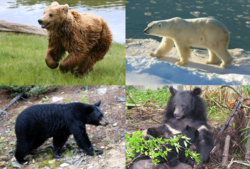
Picture of Ursus
- Source
- Wikipedia/Commons
- Credit
- derivative work: user:The Explaner
- Licence
- CC BY-SA 4.0
- Commercial use
- the licence allows it
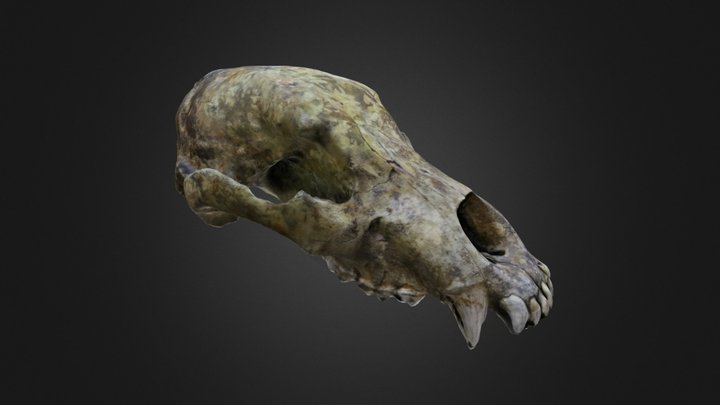
3D model
- Source
- Sketchfab
- Licence
- CC0 Public Domain
- Commercial use
- the licence allows it
Smithsonian Open Access and MorphoSource were not reached for this taxon, so this list is what the others held rather than everything there is.
The description on this site
- Licence
- CC BY-SA 4.0
This is what the site found, which is not the same as what exists.
Keep going
What may have been alongside itUrsini through timeFormations of the PleistoceneThe world it lived on
Occurrence data from the Paleobiology Database, CC BY 4.0. Linnaeus 1758