Triarthrus
Triarthrus is a genus of Upper Ordovician ptychopariid trilobite found in New York, Ohio, Kentucky, and Indiana, eastern and northern Canada, China and Scandinavia. It is the last of the Olenid trilobites, a group which flourished in the Cambrian period. The specimens of T. eatoni that are found in the Beecher's Trilobite Bed, Rome, New York area are exquisitely preserved showing soft body parts in iron pyrite. Pyrite preservation has given scientists a rare opportunity to examine the gills, walking legs, antennae, digestive systems, and eggs of trilobites, which are rarely preserved. Triarthrus is therefore commonly used in science texts to illustrate trilobite anatomy and physiology.

DardS8Br · CC BY-SA 4.0 · via Wikipedia/Commons. May be a photograph of a specimen, or an artist’s reconstruction — an interpretation of a skeleton, since colour and soft tissue are almost never preserved.
On record
Recorded, not inferred- Sits inside
- OleninaePBDB
- Diet
- carnivorePBDB, for Trilobita
- Life habit
- low-level epifaunalPBDB, for Trilobita
- Motility
- fast-movingPBDB, for Trilobita
- Vision
- well-developedPBDB, for Olenidae
- Environment
- marinePBDB, for Trilobita
Time the record covers
At least 28 million years on record.
The record covers at least 477.1 Mya to 449 Mya. No occurrence read is dated outside 486.85 Mya to 443.1 Mya.
150 occurrences of Triarthrus on record, most of them in the Ordovician. Bar height is expected occurrences, not a count: each fossil is spread across the span it is dated to, so a tall narrow bar means tight dating and a low wide one means loose.
When
150 occurrences- Ordovician100%
These are dates about fossils, not the animal: the record can only begin after it arose and end before it died out, so either end may reach further. Shares are expected occurrences: a fossil dated to a span is counted partly in each period it straddles. More on what this infers.
Found in
44 formations
- Kope Formation34
- Whitby Formation · Nottawasaga Group11
- Las Aguaditas Formation9
- Anderson Shale Formation5
- Nicolet River Formation · Lorraine Group4
- Pointe-Bleue Shale Formation4
Loading coastlines…
The named rock units Triarthrus has been recovered from, largest first. Drawn where the rock is now, not where it formed. 20 further formations hold fewer occurrences each and are not listed. 26 occurrences have no formation on record, which is common for older literature.
Triarthrus and its relatives
OrdovicianWhere Triarthrus and its relatives were recorded in the Ordovician.
Found in the same rock
598 taxa- Climacograptus17 sites
- Geisonoceras15 sites
- Leptobolus insignis13 sites
- Cryptolithus tessellatus10 sites
- Dicellograptus10 sites
- Diplograptus10 sites
- Primitiella10 sites
- Cryptolithus9 sites
- Dalmanella9 sites
- Climacograptus typicalis8 sites
- Remopleurides8 sites
- Ampyx7 sites
- Didymograptus7 sites
- Isotelus7 sites
- Lonchodomas7 sites
- Orthograptus7 sites
- Orthograptus quadrimucronatus7 sites
- Shumardia7 sites
- Symphysurus7 sites
- Ctenodonta6 sites
- Flexicalymene6 sites
- Lingula6 sites
- Nuculites6 sites
- Platycalymene trapezoidalis6 sites
The Paleobiology Database records 105 sites for Triarthrus, and this reads all of them. The number is how many of those sites it was catalogued from too. The 24 sharing the most are listed.
This is not a list of everything alive at the time. It is only what has come out of the same ground as this animal and been written down.
Entered from
53 references- Analysis of sample-level properties along a paleoenvironmental gradient: the behavior of evenness as a function of sample size29
- Palaeozoic geology of the Lake Simcoe Area, Ontario10
- Triarthrinid trilobites (Olenidae) from the Middle and Upper Ordovician, Precordillera of Argentina9
- Middle Ordovician olenid trilobites (Triarthrus Green and Porterfieldia Cooper) from Jämtland, central Sweden7
- Ordovician trilobites of Argentina7
- Upper Ordovician faunas of Ontario and Quebec7
- The Middle Ordovician of the Oslo region, Norway. 18. Rare trilobites of the families Olenidae, Harpidae, Ityophoridae and Cheiruridae5
- Stratigraphy and Paleontology of the Richfield Springs and Cooperstown Quadrangles, New York5
- On the Chasmops series of Jemtland and Sodermanland (Tvaren)5
- Stratigraphy of the Ordovician of the Lac Saint-Jean and Chicoutimi outliers, Quebec4
- Ordovician trilobites of Bolivia4
- Trilobites of trinucleid, raphiophorid and cyclopygid associations from the Ordovician (Darriwilian – early Katian) of the west Balkhash region and Betpak-Dala, Central Kazakhstan3
Each of the 150 occurrences read was entered from one of these publications, ordered by how many each accounts for. This is not a search for papers mentioning the name. 41 further references are not listed. Entries link to doi.org where the Paleobiology Database holds an identifier, and to its own record where it does not. Relayed as the Paleobiology Database holds them, not checked against what they resolve to.
Media and terms
Media content2

Picture of Triarthrus
- Source
- Wikipedia/Commons
- Credit
- DardS8Br
- Licence
- CC BY-SA 4.0
- Commercial use
- the licence allows it
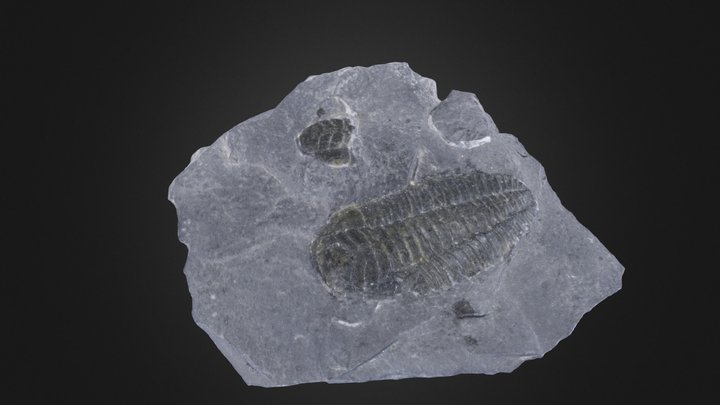
3D model
- Source
- Sketchfab
- Licence
- CC0 Public Domain
- Commercial use
- the licence allows it
Smithsonian Open Access and MorphoSource were not reached for this taxon, so this list is what the others held rather than everything there is.
The description on this site
- Source
- Wikipedia, “Triarthrus”
- Licence
- CC BY-SA 4.0
This is what the site found, which is not the same as what exists.
Keep going
What may have been alongside itOleninae through timeFormations of the OrdovicianThe world it lived on
Occurrence data from the Paleobiology Database, CC BY 4.0. Green 1832