Lonchodomas
Lonchodomas is a genus of trilobites, that lived during the Ordovician. It was eyeless, like all raphiophorids, and had a long straight sword-like frontal spine, that gradually transforms into the relatively long glabella. Both the glabellar spine and the backward directed genal spines are subquadrate in section. Lonchodomas has five thorax segments and the pleural area of the pygidium has two narrow furrows. Lonchodomas occurred in what are today Argentina, Canada (Newfoundland), Estonia, Latvia, Norway, Sweden, the Russian Federation and the United States.

Dwergenpaartje · CC BY-SA 3.0 · via Wikipedia/Commons. May be a photograph of a specimen, or an artist’s reconstruction — an interpretation of a skeleton, since colour and soft tissue are almost never preserved.
On record
Recorded, not inferred- Sits inside
- RaphiophoridaePBDB
- Diet
- suspension feederPBDB, for Raphiophoridae
- Life habit
- low-level epifaunalPBDB, for Trilobita
- Motility
- fast-movingPBDB, for Trilobita
- Vision
- blindPBDB, for Raphiophoridae
- Environment
- marinePBDB, for Trilobita
Time the record covers
At least 26 million years on record.
The record covers at least 471.3 Mya to 445.2 Mya. No occurrence read is dated outside 486.85 Mya to 432.9 Mya.
365 occurrences of Lonchodomas on record, most of them in the Ordovician. Bar height is expected occurrences, not a count: each fossil is spread across the span it is dated to, so a tall narrow bar means tight dating and a low wide one means loose.
When
365 occurrences- Ordovician100%
- Silurianunder 1%
These are dates about fossils, not the animal: the record can only begin after it arose and end before it died out, so either end may reach further. Shares are expected occurrences: a fossil dated to a span is counted partly in each period it straddles. More on what this infers.
Found in
116 formations
- Volkhov Formation29
- Solvang Formation18
- Table Cove Formation · Table Head Group18
- Crown Point Formation · Chazy Group13
- Dalby Formation10
- Dufton Shales Formation9
Loading coastlines…
The named rock units Lonchodomas has been recovered from, largest first. Drawn where the rock is now, not where it formed. 92 further formations hold fewer occurrences each and are not listed. 33 occurrences have no formation on record, which is common for older literature.
Lonchodomas and its relatives
OrdovicianWhere Lonchodomas and its relatives were recorded in the Ordovician.
Found in the same rock
1,218 taxa- Remopleurides60 sites
- Illaenus39 sites
- Linguloidea31 sites
- Paurorthis31 sites
- Apomatella ingrica29 sites
- Nileus27 sites
- Antigonambonites planus25 sites
- Pseudocrania24 sites
- Ampyx23 sites
- Onniella23 sites
- Paralenorthis orbicularis23 sites
- Asaphus (Asaphus) lepidurus22 sites
- Cyclopyge22 sites
- Ranorthis22 sites
- Sowerbyella22 sites
- Christiania21 sites
- Porambonites planus21 sites
- Tretaspis21 sites
- Climacograptus20 sites
- Sphaerocoryphe20 sites
- Telephina20 sites
- Dionide19 sites
- Trinodus19 sites
- Metopolichas18 sites
The Paleobiology Database records 347 sites for Lonchodomas, and this reads 240 of them. The number is how many of those sites it was catalogued from too. The 24 sharing the most are listed.
This is not a list of everything alive at the time. It is only what has come out of the same ground as this animal and been written down.
Entered from
106 references- Upper Arenig trilobite biostratigraphy and sea-level changes at Lynna River near Volkhov, Russia33
- Early Middle Ordovician (Chazy) trilobites of New York29
- Ordovician Sedimentary Basin and Paleobiotas of the Gorny Altai25
- Late Caradoc-early Ashgill trilobites of the central Oslo Region, Norway18
- Trilobites of the Ordovician Table Head Formation, western Newfoundland18
- The Ashgill Trilobites of the Oslo Region, Norway14
- Om de Chasmopskalken och Trinicleusskiffern motsvarande bildningarne I Skane10
- Trilobites from the Ordovician Balclatchie and lower Ardwell groups of the Girvan district, Scotland9
- A new late Katian (Late Ordovician) trilobite association from Zhenxiong, northeastern Yunnan, Southwest China and its palaeoecological implications7
- Regional stratigraphic tables of the north western China region: Volume of NinXia Province7
- Revision der Ostbaltischen Silurichen Trilobiten. Abtheilung IV: Calymmeniden, Proetiden, Bronteiden, Harpediden, Trunicleiden, Remopleuriden und Agnostiden.7
- Middle-Upper Ordovician trilobites and stratigraphy along the Kyrkbacken rivulet in the Rostånga area, southern Sweden5
Each of the 365 occurrences read was entered from one of these publications, ordered by how many each accounts for. This is not a search for papers mentioning the name. 94 further references are not listed. Entries link to doi.org where the Paleobiology Database holds an identifier, and to its own record where it does not. Relayed as the Paleobiology Database holds them, not checked against what they resolve to.
Media and terms
Media content2

Picture of Lonchodomas
- Source
- Wikipedia/Commons
- Credit
- Dwergenpaartje
- Licence
- CC BY-SA 3.0
- Commercial use
- the licence allows it
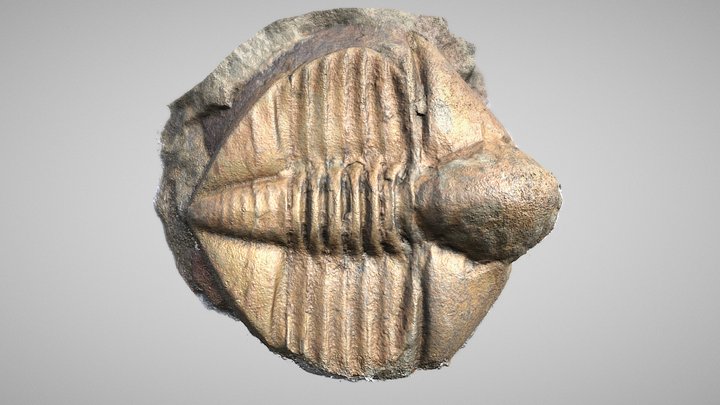
3D model
- Source
- Sketchfab
- Licence
- Free Standard
- Commercial use
- cannot be read from the licence given — check the record
Smithsonian Open Access and MorphoSource were not reached for this taxon, so this list is what the others held rather than everything there is.
The description on this site
- Source
- Wikipedia, “Lonchodomas”
- Licence
- CC BY-SA 4.0
This is what the site found, which is not the same as what exists.
Keep going
What may have been alongside itRaphiophoridae through timeFormations of the OrdovicianThe world it lived on
Occurrence data from the Paleobiology Database, CC BY 4.0. Angelin 1854