Ampyx
Ampyx is an Ordovician-Silurian genus of Asaphid trilobites of the family Raphiophoridae. Species of Ampyx are characterized by three extended spines on the head-shield, one spine derived from each free cheek, and one spine emanating from the glabellum. Species include Ampyx linleyensis.

Rama · CC BY-SA 3.0 · via Wikipedia/Commons. May be a photograph of a specimen, or an artist’s reconstruction — an interpretation of a skeleton, since colour and soft tissue are almost never preserved.
On record
Recorded, not inferred- Sits inside
- RaphiophorinaePBDB
- Diet
- suspension feederPBDB, for Raphiophoridae
- Life habit
- low-level epifaunalPBDB, for Trilobita
- Motility
- fast-movingPBDB, for Trilobita
- Vision
- blindPBDB, for Raphiophoridae
- Environment
- marinePBDB, for Trilobita
Time the record covers
At least 54 million years on record.
The record covers at least 477.1 Mya to 422.7 Mya. No occurrence read is dated outside 486.85 Mya to 419.62 Mya.
242 occurrences of Ampyx on record, most of them in the Ordovician. Bar height is expected occurrences, not a count: each fossil is spread across the span it is dated to, so a tall narrow bar means tight dating and a low wide one means loose.
When
242 occurrences- Ordovician99%
- Silurianunder 1%
These are dates about fossils, not the animal: the record can only begin after it arose and end before it died out, so either end may reach further. Shares are expected occurrences: a fossil dated to a span is counted partly in each period it straddles. More on what this infers.
Found in
98 formations
- Edinburg Formation15
- Holen Formation15
- Upper Fezouata Formation9
- Campile Formation · Duncannon Group7
- Valhallfonna Formation7
- Balclatchie Formation · Ardmillan Group6
Loading coastlines…
The named rock units Ampyx has been recovered from, largest first. Drawn where the rock is now, not where it formed. 74 further formations hold fewer occurrences each and are not listed. 43 occurrences have no formation on record, which is common for older literature.
Ampyx and its relatives
OrdovicianWhere Ampyx and its relatives were recorded in the Ordovician.
Found in the same rock
1,601 taxa- Illaenus58 sites
- Remopleurides49 sites
- Lonchodomas40 sites
- Nileus37 sites
- Geragnostus24 sites
- Isotelus22 sites
- Megistaspis20 sites
- Asaphellus18 sites
- Calyptaulax18 sites
- Cyclopyge18 sites
- Sphaerexochus18 sites
- Amphilichas17 sites
- Raymondaspis17 sites
- Trinodus17 sites
- Arthrorhachis16 sites
- Dionide15 sites
- Climacograptus14 sites
- Sphaerocoryphe14 sites
- Tretaspis14 sites
- Birmanites13 sites
- Carolinites13 sites
- Harpidella13 sites
- Ptychopyge13 sites
- Asaphus (Asaphus) raniceps12 sites
The Paleobiology Database records 235 sites for Ampyx, and this reads all of them. The number is how many of those sites it was catalogued from too. The 24 sharing the most are listed.
This is not a list of everything alive at the time. It is only what has come out of the same ground as this animal and been written down.
Entered from
100 references- The Asaphus Limestone in northernmost Öland16
- Description of the upper portion of the drill-core from Finngrundet in the South Bothnian Bay15
- On the Early Ordovician of Sweden stratigraphy and fauna9
- Trilobite faunas of the Duncannon Group: Caradoc stratigraphy, environments and palaeobiogeography of the Leinster Terrane, Ireland8
- Trilobites from the Ordovician Balclatchie and lower Ardwell groups of the Girvan district, Scotland7
- Om de Chasmopskalken och Trinicleusskiffern motsvarande bildningarne I Skane7
- Trilobite Biofacies along an Ordovician (Sandbian) Carbonate Buildup to Basin Gradient, Southwestern Virginia6
- Some Middle Ordovician Brachiopods and Trilobites from the Basin Ranges, Western United States6
- Silicified Middle Ordovician trilobites: Remopleuridae, Trinucleidae, Raphiophoridae, Endymioniidae6
- Early Ordovician trilobite taxonomy and biostratigraphy of the Emanuel Formation, Canning Basin, western Australia. Part 15
- The trilobite fauna of the Raheen Formation (upper Caradoc), Co. Waterford, Ireland5
- Early Ordovician (Arenig) stratigraphy and faunas of the Carmarthen District, southwest Wales5
Each of the 242 occurrences read was entered from one of these publications, ordered by how many each accounts for. This is not a search for papers mentioning the name. 88 further references are not listed. Entries link to doi.org where the Paleobiology Database holds an identifier, and to its own record where it does not. Relayed as the Paleobiology Database holds them, not checked against what they resolve to.
Media and terms
Media content2

Picture of Ampyx
- Source
- Wikipedia/Commons
- Credit
- Rama
- Licence
- CC BY-SA 3.0
- Commercial use
- the licence allows it
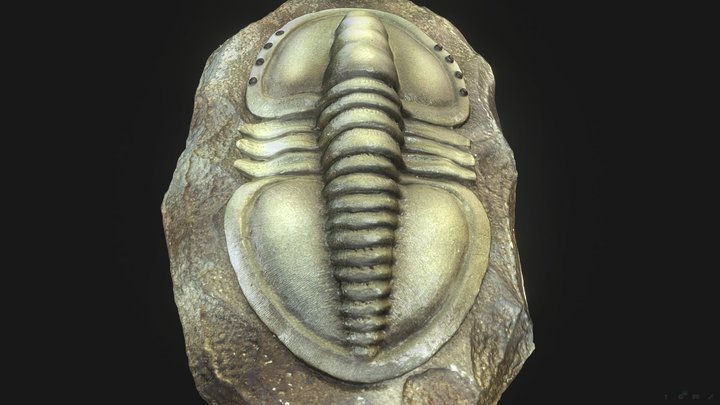
3D model
- Source
- Sketchfab
- Credit
- darwinmuseum.ru
- Licence
- CC Attribution-NonCommercial-NoDerivs
- Commercial use
- the licence does not allow it
This entry was cached before the site began recording what Smithsonian Open Access and MorphoSource did, so a search that failed cannot be told from one that found nothing.
The description on this site
- Licence
- CC BY-SA 4.0
This is what the site found, which is not the same as what exists.
Keep going
What may have been alongside itRaphiophorinae through timeFormations of the OrdovicianThe world it lived on
Occurrence data from the Paleobiology Database, CC BY 4.0. (Dalman 1827)