Testudinoidea
Testudinoidea is a superfamily within the suborder Cryptodira of the order Testudines. It includes the pond turtles, Asian turtles, the monotypic big-headed turtle, and the tortoises.

D. Gordon E. Robertson · CC BY-SA 3.0 · via Wikipedia/Commons. May be a photograph of a specimen, or an artist’s reconstruction — an interpretation of a skeleton, since colour and soft tissue are almost never preserved.
On record
Recorded, not inferred- Sits inside
- PantestudinoideaPBDB
- Diet
- omnivorePBDB, for Cryptodira
- Life habit
- aquaticPBDB, for Cryptodira
- Motility
- actively mobilePBDB, for Osteichthyes
- Environment
- freshwaterPBDB, for Cryptodira
Time the record covers
At least 201 million years on record.
The record covers at least 201.4 Mya to 11.7 ka. No occurrence read is dated outside 205.7 Mya to 0 Mya.
2,957 occurrences of Testudinoidea on record, most of them in the Miocene. The Paleobiology Database records this as a living group. Bar height is expected occurrences, not a count: each fossil is spread across the span it is dated to, so a tall narrow bar means tight dating and a low wide one means loose.
When
2,957 occurrences- Late Triassicunder 1%
- Early Cretaceousunder 1%
- Late Cretaceous3%
- Paleocene2%
- Eocene18%
- Oligocene6%
- Miocene33%
- Pliocene10%
- Pleistocene25%
- Holocene4%
These are dates about fossils, not the animal: the record can only begin after it arose and end before it died out, so either end may reach further. Shares are expected occurrences: a fossil dated to a span is counted partly in each period it straddles. More on what this infers.
Found in
407 formations
- Bridger Formation79
- Uinta Formation75
- Willwood Formation31
- Valentine Formation · Ogallala Group31
- San Jose Formation31
- Collon Cura Formation31
Loading coastlines…
The named rock units Testudinoidea has been recovered from, largest first. Drawn where the rock is now, not where it formed. 383 further formations hold fewer occurrences each and are not listed. 1,569 occurrences have no formation on record, which is common for older literature.
Testudinoidea and its relatives
MioceneWhere Testudinoidea and its relatives were recorded in the Miocene.
Found in the same rock
3,505 taxa- Geochelone50 sites
- Trionyx41 sites
- Testudinidae37 sites
- Equus35 sites
- Hipparion35 sites
- Rana33 sites
- Bovidae30 sites
- Trionychidae30 sites
- Gazella29 sites
- Testudo29 sites
- Aves27 sites
- Crocodylus27 sites
- Ceratotherium26 sites
- Euthecodon brumpti25 sites
- Clarias24 sites
- Crocodylus niloticus24 sites
- Emydidae24 sites
- Polypterus23 sites
- Hystrix21 sites
- Lates20 sites
- Lepisosteus20 sites
- Canis19 sites
- Cercopithecidae19 sites
- Crocuta crocuta19 sites
The Paleobiology Database records at least 1,425 sites for Testudinoidea, and this reads 240 of them. The number is how many of those sites it was catalogued from too. The 24 sharing the most are listed.
This is not a list of everything alive at the time. It is only what has come out of the same ground as this animal and been written down.
Entered from
972 references- Contribution a l'etude des Cheloniens. Cheloniens continentaux due Cretace et du Tertiare de France131
- Systématique du groupe "Palaeochelys sensu lato – Mauremys" (Chelonii, Testudinoidea) du Tertiaire d'Europe occidentale: principaux résultats [Systematic of the "Palaeochelys sensu lato – Mauremys" group (Chelonii, Testudinoidea) from the Tertiary of Western Europe: principal results107
- Geometric morphometrics and anatomical network analyses reveal ecospace partitioning among geoemydid turtles from the Uinta Formation, Utah51
- Bridgeremys (Geoemydidae,Testudines), a new genus from the middle Eocene of North America45
- The recent fossil turtle record of the central plain of Thailand reveals local extinctions35
- Pleistocene Amphibians and Reptiles in Britain and Europe34
- Testudinid turtle remains from the Late Miocene palaeo-island of Gargano, Italy, and an overview of Mediterranean insular tortoises30
- Turtles of the lower Eocene San Jose Formation, San Juan Basin, New Mexico30
- Tortoises and turtles from Huayquerías del Este (late Miocene–early Pliocene), Mendoza, Argentina29
- Morphology of the mid-sized tortoises (Testudines: Testudinidae) from the Middle Miocene of Northwestern Chubut27
- Neogene Testudines of Germany. Their stratigraphical and ecological evaluation24
- The Fossil Chelonians of Greece. Systematics - Evolution - Stratigraphy - Palaeoecology23
Each of the 2,957 occurrences read was entered from one of these publications, ordered by how many each accounts for. This is not a search for papers mentioning the name. 960 further references are not listed. Entries link to doi.org where the Paleobiology Database holds an identifier, and to its own record where it does not. Relayed as the Paleobiology Database holds them, not checked against what they resolve to.
Media and terms
Media content1
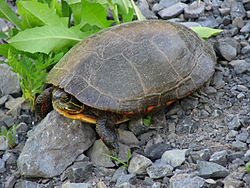
Picture of Testudinoidea
- Source
- Wikipedia/Commons
- Credit
- D. Gordon E. Robertson
- Licence
- CC BY-SA 3.0
- Commercial use
- the licence allows it
No 3D scan was found. Smithsonian Open Access, MorphoSource and Sketchfab were all searched.
The description on this site
- Licence
- CC BY-SA 4.0
This is what the site found, which is not the same as what exists.
Keep going
What may have been alongside itPantestudinoidea through timeFormations of the MioceneThe world it lived on
Occurrence data from the Paleobiology Database, CC BY 4.0. Gray 1825