Terebratella
Terebratella is a genus of brachiopods belonging to the family Terebratellidae.

Luis Ruiz Berti · CC BY-SA 4.0 · via Wikipedia/Commons. May be a photograph of a specimen, or an artist’s reconstruction — an interpretation of a skeleton, since colour and soft tissue are almost never preserved.
On record
Recorded, not inferred- Sits inside
- TerebratellinaePBDB
- Diet
- suspension feederPBDB, for Terebratellidae
- Life habit
- low-level epifaunalPBDB, for Terebratellidae
- Motility
- stationaryPBDB, for Terebratellidae
- Vision
- blindPBDB, for Rhynchonellata
- Environment
- marinePBDB, for Lophophorata
Time the record covers
At least 172 million years on record.
The record covers at least 174.7 Mya to 2.58 Mya. No occurrence read is dated outside 180.4 Mya to 0 Mya.
71 occurrences of Terebratella on record, most of them in the Eocene. The Paleobiology Database records this as a living group. Bar height is expected occurrences, not a count: each fossil is spread across the span it is dated to, so a tall narrow bar means tight dating and a low wide one means loose.
When
71 occurrences- Early Jurassic1%
- Late Jurassic6%
- Early Cretaceous18%
- Late Cretaceous10%
- Paleocene1%
- Eocene27%
- Oligocene7%
- Miocene26%
- Pliocene2%
- Pleistocene1%
These are dates about fossils, not the animal: the record can only begin after it arose and end before it died out, so either end may reach further. Shares are expected occurrences: a fossil dated to a span is counted partly in each period it straddles. More on what this infers.
Found in
26 formations
- El Chacay Formation10
- Red Bluff Tuff Formation · Kekerione Group8
- Guadal Formation5
- La Meseta Formation · Seymour Island Group4
- Budden Canyon Formation4
- Woburn Sand Formation · Lower Greensand Group2
Loading coastlines…
The named rock units Terebratella has been recovered from, largest first. Drawn where the rock is now, not where it formed. 2 further formations hold fewer occurrences each and are not listed. 15 occurrences have no formation on record, which is common for older literature.
Terebratella and its relatives
EoceneWhere Terebratella and its relatives were recorded in the Eocene.
Found in the same rock
742 taxa- Ostrea7 sites
- Terebratula7 sites
- Liothyrella6 sites
- Nerinea6 sites
- Notostrea6 sites
- Probolarina6 sites
- Serpula6 sites
- Spondylus6 sites
- Arca5 sites
- Chlamys5 sites
- Cidaris5 sites
- Lithophaga5 sites
- Pleurotomaria5 sites
- Scalaria5 sites
- Terebratulina suessi5 sites
- Turbo5 sites
- Turritella5 sites
- Astarte4 sites
- Cardium4 sites
- Cerithium4 sites
- Eucidaris4 sites
- Natica4 sites
- Pholadomya4 sites
- Psammechinus4 sites
The Paleobiology Database records 46 sites for Terebratella, and this reads all of them. The number is how many of those sites it was catalogued from too. The 24 sharing the most are listed.
This is not a list of everything alive at the time. It is only what has come out of the same ground as this animal and been written down.
Entered from
32 references- Cretaceous-Cenozoic geology and biostratigraphy of the Chatham Islands, New Zealand11
- Observaciones estratigraficas en el Paleogeno del noroeste de la Provincia de Santa Cruz (Republica Argentina). Parte II: Invertebrados marinos de la Formacion El Chacy (Eoceno), Provincia de Santa Cruz, Argentina. Systematica y bioestratigrafia10
- Note sur la géologie et la paléontologie de la Patagonie6
- Invertibrados fósiles marinos de la Formación Guadal (Oligoceno superio-Mioceno inferior) en Pampa, Castillo region, región de Aisén, Chile5
- Lower Cretaceous stratigraphic units of Northern California4
- Die Typus-Profile des Valanginien und Hauterivien3
- Jura Vaudois et Neuchatelois3
- Geología de la Carta Freirina-El Morado, Región de Atacama. Servicio Nacional de Geología y Minería, Carta Geológica de Chile, Serie Geología Básica, No. 100, 50 p, 1 mapa escala 1:100.0002
- Brachiopods from the Eocene La Meseta Formation of Seymour Island, Antarctic Peninsula2
- Middle to Late Eocene invertebrate fauna from the San Julian Formation at Punta Casamayor, Santa Cruz Province, Southern Argentina2
- Tertiary and Cretaceous brachiopods from Seymour, Cockburn and James Ross Islands, Antarctica2
- The stratigraphical palaeontology of the Lower Greensand2
Each of the 71 occurrences read was entered from one of these publications, ordered by how many each accounts for. This is not a search for papers mentioning the name. 19 further references are not listed. Entries link to doi.org where the Paleobiology Database holds an identifier, and to its own record where it does not. Relayed as the Paleobiology Database holds them, not checked against what they resolve to.
Media and terms
Media content2
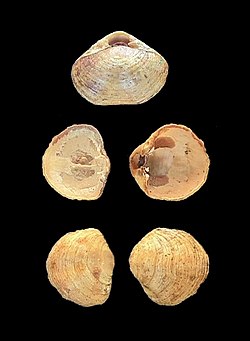
Picture of Terebratella
- Source
- Wikipedia/Commons
- Credit
- Luis Ruiz Berti
- Licence
- CC BY-SA 4.0
- Commercial use
- the licence allows it
Photogrammetry
- Source
- MorphoSource
- Licence
- not stated by the source
- Commercial use
- cannot be read from the licence given — check the record
- Specimen
- terebratella sp. · MST:PALEO:MST-SP-7000
Smithsonian Open Access was not reached for this taxon, so this list is what the others held rather than everything there is.
The description on this site
- Licence
- CC BY-SA 4.0
This is what the site found, which is not the same as what exists.
Keep going
What may have been alongside itTerebratellinae through timeFormations of the EoceneThe world it lived on
Occurrence data from the Paleobiology Database, CC BY 4.0. d'Orbigny 1847