Sphaeronites
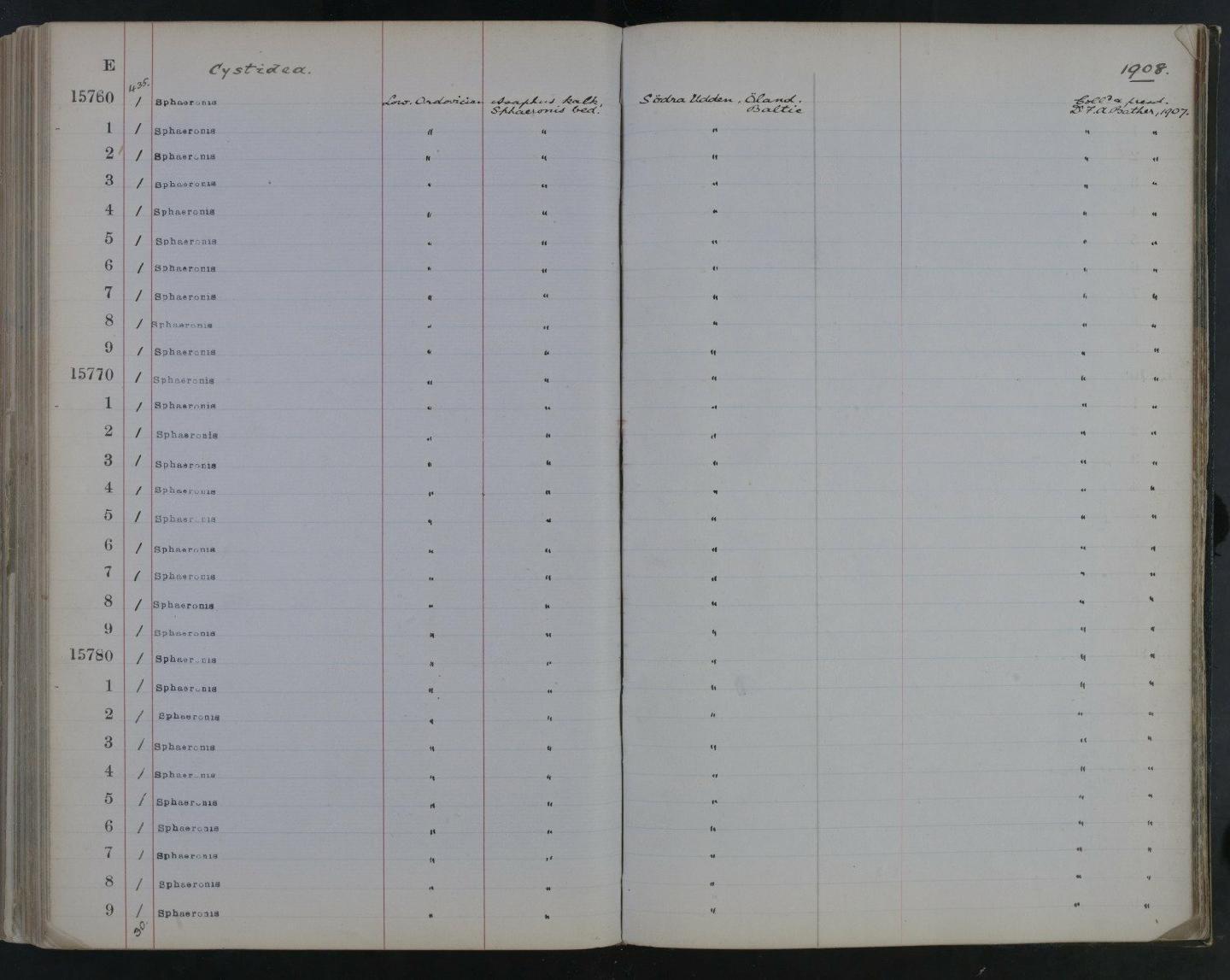
via iDigBio · CC BY · via iDigBio. May be a photograph of a specimen, or an artist’s reconstruction — an interpretation of a skeleton, since colour and soft tissue are almost never preserved.
On record
Recorded, not inferred- Sits inside
- SphaeronitidaePBDB
- Diet
- suspension feederPBDB, for Blastozoa
- Life habit
- epifaunalPBDB, for Blastozoa
- Motility
- stationaryPBDB, for Blastozoa
- Environment
- marinePBDB, for Echinodermata
Time the record covers
At least 19 million years on record.
The record covers at least 468 Mya to 448.8 Mya. No occurrence read is dated outside 477.1 Mya to 443.1 Mya.
58 occurrences of Sphaeronites on record, most of them in the Ordovician. Bar height is expected occurrences, not a count: each fossil is spread across the span it is dated to, so a tall narrow bar means tight dating and a low wide one means loose.
When
58 occurrences- Ordovician100%
These are dates about fossils, not the animal: the record can only begin after it arose and end before it died out, so either end may reach further. Shares are expected occurrences: a fossil dated to a span is counted partly in each period it straddles. More on what this infers.
Found in
25 formations
- Asaphus Limestone Formation13
- Holen Formation8
- Dalby Formation3
- Sholeshook Formation3
- Boda Limestone Formation3
- Rhiwlas Formation3
Loading coastlines…
The named rock units Sphaeronites has been recovered from, largest first. Drawn where the rock is now, not where it formed. One further formation holds fewer occurrences and is not listed. 2 occurrences have no formation on record, which is common for older literature.
Sphaeronites and its relatives
OrdovicianWhere Sphaeronites and its relatives were recorded in the Ordovician.
Found in the same rock
323 taxa- Illaenus8 sites
- Remopleurides5 sites
- Dianulites4 sites
- Sinuites rugulosus4 sites
- Telephina4 sites
- Calymenesun3 sites
- Chasmops3 sites
- Curtoceras3 sites
- Echinosphaerites3 sites
- Echinosphaerites aurantium3 sites
- Endoceras3 sites
- Esthoniopora curvata3 sites
- Leptestia3 sites
- Lonchodomas3 sites
- Mesotrypa3 sites
- Orthoceras3 sites
- Paraceraurus3 sites
- Porambonites3 sites
- Pseudoasaphus tecticaudatus tecticaudatus3 sites
- Tallinnella3 sites
- Amplexograptus2 sites
- Ampyx2 sites
- Aristocystites2 sites
- Aserioceras purtsensis2 sites
The Paleobiology Database records 55 sites for Sphaeronites, and this reads all of them. The number is how many of those sites it was catalogued from too. The 24 sharing the most are listed.
This is not a list of everything alive at the time. It is only what has come out of the same ground as this animal and been written down.
Entered from
10 references- Evolution and Functional Morphology of the Cystoid Sphaeronites in Britain and Scandinavia19
- Non-Crinoid Pelmatozoa from the Paleozoic of Sweden18
- The Diploporita of the Oslo region, Norway5
- The Lower Palaeozoic fossils of the Northern Shan States, Burma. With a section of Ordovician cystidea by F. A. Bather [q.v.]4
- Stratigraphic Summary of the Southwestern Region of China3
- Stratigrafia viruskoy i kharjuskoy seriy (ordovik) Sevemoy Estonii. [Stratigraphy of the Viruan and Harjuan Series (Ordovician) in North Estonia]3
- Lower Palaeozoic geology of southern Sweden2
- Swedish Late Ordovician marine benthic assemblages and their bearing on brachiopod biogeography2
- The Stratigraphy and Structure of Ordovician Rocks of the South - East Part of the Baltic Basin (Druksiu Area)1
- Stratigraphic table of northwestern region of China: XinJiang Province part1
Each of the 58 occurrences read was entered from one of these publications, ordered by how many each accounts for. This is not a search for papers mentioning the name. Each entry links to the Paleobiology Database's own record for the work.
Media and terms
Media content1
Picture of Sphaeronites
- Source
- iDigBio
- Credit
- via iDigBio
- Licence
- CC BY
- Commercial use
- the licence allows it
No 3D scan of Sphaeronites was found in Sketchfab.
Smithsonian Open Access and MorphoSource were not reached for this taxon, so this list is what the others held rather than everything there is.
This is what the site found, which is not the same as what exists.
Keep going
What may have been alongside itSphaeronitidae through timeFormations of the OrdovicianThe world it lived on
Occurrence data from the Paleobiology Database, CC BY 4.0. Hisinger 1828