Schisandra
Schisandra, the magnolia vines, is a genus of twining shrubs that generally climb on other vegetation. Various authors have included the plants in the Illiciaceae.

Doronenko · CC BY 2.5 · via Wikipedia/Commons. May be a photograph of a specimen, or an artist’s reconstruction — an interpretation of a skeleton, since colour and soft tissue are almost never preserved.
On record
Recorded, not inferred- Sits inside
- SchisandraceaePBDB
- Diet
- "photoautotroph"PBDB, for Angiospermae
Time the record covers
At least 55 million years on record.
The record covers at least 56 Mya to 11.7 ka. No occurrence read is dated outside 59.24 Mya to 0 Mya.
9 occurrences of Schisandra on record, most of them in the Miocene. The Paleobiology Database records this as a living group. Bar height is expected occurrences, not a count: each fossil is spread across the span it is dated to, so a tall narrow bar means tight dating and a low wide one means loose.
When
9 occurrencesThese are dates about fossils, not the animal: the record can only begin after it arose and end before it died out, so either end may reach further. Shares are expected occurrences: a fossil dated to a span is counted partly in each period it straddles. More on what this infers.
Found in
3 formations
Loading coastlines…
The named rock units Schisandra has been recovered from, largest first. Drawn where the rock is now, not where it formed. 5 occurrences have no formation on record, which is common for older literature.
Schisandra and its relatives
MioceneWhere Schisandra and its relatives were recorded in the Miocene.
Found in the same rock
270 taxa- Quercus4 sites
- Alnus3 sites
- Betula3 sites
- Celtis3 sites
- Rhus3 sites
- Albizia2 sites
- Carpinus2 sites
- Cinnamomum2 sites
- Corylus2 sites
- Fabaceae2 sites
- Fraxinus2 sites
- Glyptostrobus europaeus2 sites
- Hydrangea2 sites
- Ilex2 sites
- Koelreuteria2 sites
- Lindera2 sites
- Meliosma2 sites
- Myrica2 sites
- Nelumbo2 sites
- Pinus2 sites
- Piperaceae2 sites
- Populus2 sites
- Populus glandulifera2 sites
- Ulmus2 sites
The Paleobiology Database records 5 sites for Schisandra, and this reads all of them. The number is how many of those sites it was catalogued from too. The 24 sharing the most are listed.
This is not a list of everything alive at the time. It is only what has come out of the same ground as this animal and been written down.
Entered from
6 references- A catalogue of Cenozoic megafossil plants in China3
- Die "Saugbaggerflora", eine Frucht- und Samenflora aus dem Grenzbereich Miozaen- Pliozaen von Sessenheim im Elsass (Frankreich)2
- First Clarkforkian Equivalent Land Mammal Age in the Latest Paleocene Basal Sparnacian Facies of Europe: Fauna, Flora, Paleoenvironment and (Bio)stratigraphy1
- Quantitative reconstruction of the Late Miocene monsoon climates of southwest China: A case study of the Lincang flora from Yunnan Province1
- Fruits and seeds of the Middle Eocene Nut Beds Flora, Clarno Formation, Oregon1
- A Catalogue of Fossil Plants from India Part 6: Cenozoic (Quaternary) Palynology and Palaeobotany1
Each of the 9 occurrences read was entered from one of these publications, ordered by how many each accounts for. This is not a search for papers mentioning the name. Entries link to doi.org where the Paleobiology Database holds an identifier, and to its own record where it does not. Relayed as the Paleobiology Database holds them, not checked against what they resolve to.
Media and terms
Media content1
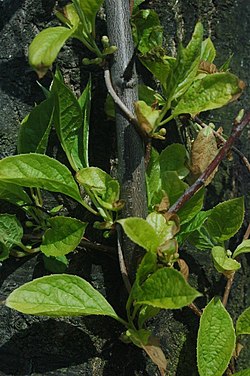
Picture of Schisandra
- Source
- Wikipedia/Commons
- Credit
- Doronenko
- Licence
- CC BY 2.5
- Commercial use
- the licence allows it
No 3D scan of Schisandra was found in MorphoSource and Sketchfab.
Smithsonian Open Access was not reached for this taxon, so this list is what the others held rather than everything there is.
The description on this site
- Source
- Wikipedia, “Schisandra”
- Licence
- CC BY-SA 4.0
This is what the site found, which is not the same as what exists.
Keep going
What may have been alongside itSchisandraceae through timeFormations of the MioceneThe world it lived on
Occurrence data from the Paleobiology Database, CC BY 4.0. Michaux 1803