Rheidae
Searched as Rhea. The Paleobiology Database treats Rheidae as the accepted name.
The rhea, also known as the ñandú is a South American ratite of the order Rheiformes. Rheas are distantly related to the two African ostriches and Australia's emu, with rheas placing just behind the emu in height and overall size.

Adrian Pingstone ( Arpingstone ) · Public Domain · via Wikipedia/Commons. May be a photograph of a specimen, or an artist’s reconstruction — an interpretation of a skeleton, since colour and soft tissue are almost never preserved.
On record
Recorded, not inferred- Also called
- rheaPBDB
- Sits inside
- RheiformesPBDB
- Diet
- carnivorePBDB, for Coelurosauria
- Life habit
- ground dwelling, solitaryPBDB, for Theropoda
- Motility
- actively mobilePBDB, for Theropoda
- Environment
- terrestrialPBDB, for Theropoda
Time the record covers
At least 48 million years on record.
The record covers at least 48.07 Mya to 11.7 ka. No occurrence read is dated outside 56 Mya to 0 Mya.
34 occurrences of Rheidae on record, most of them in the Miocene. The Paleobiology Database records this as a living group. Bar height is expected occurrences, not a count: each fossil is spread across the span it is dated to, so a tall narrow bar means tight dating and a low wide one means loose.
When
34 occurrences- Eocene3%
- Miocene38%
- Pliocene15%
- Pleistocene24%
- Holocene21%
These are dates about fossils, not the animal: the record can only begin after it arose and end before it died out, so either end may reach further. Shares are expected occurrences: a fossil dated to a span is counted partly in each period it straddles. More on what this infers.
Found in
11 formations
- Santa Cruz Formation6
- Monte Hermoso Formation3
- Ituzaingo Formation2
- Nuapua Formation1
- Luján Formation1
- Andalhuala Formation1
Loading coastlines…
The named rock units Rheidae has been recovered from, largest first. Drawn where the rock is now, not where it formed. 15 occurrences have no formation on record, which is common for older literature.
Rheidae and its relatives
MioceneWhere Rheidae and its relatives were recorded in the Miocene.
Found in the same rock
636 taxa- Rhea7 sites
- Chaetophractus villosus6 sites
- Zaedyus pichiy6 sites
- Lama guanicoe5 sites
- Opisthodactylus patagonicus5 sites
- Rhea americana5 sites
- Adinotherium4 sites
- Cladosictis patagonica4 sites
- Ctenomys4 sites
- Lagostomus maximus4 sites
- Myocastor4 sites
- Nesodon4 sites
- Palaeocavia4 sites
- Reithrodon auritus4 sites
- Stenotatus4 sites
- Tupinambis4 sites
- Cardiomys3 sites
- Cavia aperea3 sites
- Cervidae3 sites
- Equus3 sites
- Hippidion3 sites
- Lama3 sites
- Macroeuphractus retusus3 sites
- Mazama3 sites
The Paleobiology Database records 29 sites for Rheidae, and this reads all of them. The number is how many of those sites it was catalogued from too. The 24 sharing the most are listed.
This is not a list of everything alive at the time. It is only what has come out of the same ground as this animal and been written down.
Entered from
25 references- Late Cenozoic mammal bio-chronostratigraphy in southwestern Buenos Aires Province, Argentina4
- Catálogo de los pájaros fósiles de la República Argentina conservados en el Museo de La Plata [Catalogue of the fossil birds from the Argentine Republic housed in the Museo de La Plata]4
- New records of birds from the Santa Cruz Formation (Early-Middle Miocene) at the Río Santa Cruz Valley, Patagonia, Argentina2
- Late Cenozoic vertebrates from the Southern Pampean region: systematic and bio-chronostratigraphic update2
- Le site paléo-indien de Piedra Museo (Patagonie). Sa contribution au débat sur le premier peuplement du continent amérlcaln2
- Sedimentology and fossil vertebrates of the Santa Cruz formation (early Miocene) in Lago Posadas, southwestern Patagonia, Argentina1
- New records of birds from the Santa Cruz Formation (Early-Middle Miocene) at the Río Santa Cruz Valley, Patagonia1
- A New Species of Opisthodactylus Ameghino, 1891 (Aves, Rheidae), from the Late Miocene of Northwestern Argentina, with Implications for the Paleobiogeography and Phylogeny of Rheas1
- Late Quaternary caviomorph rodents (Rodentia: Hystricognathi) from the Serra da Capivara, northeastern Brazil, with description of a new taxon1
- New fossil bird remains from the Chichinales Formation (Early Miocene) of northern Patagonia, Argentina1
- No se les escapó la tortuga. Uso antrópico de Chelonoidis chilensis en un sitio de la región chaco-santiagueña (provincia de Santiago del Estero)1
- Tertiary ground birds from Patagonia (Argentina) in the Tournouër collection of the Muséum National d’Histoire Naturelle, Paris1
Each of the 34 occurrences read was entered from one of these publications, ordered by how many each accounts for. This is not a search for papers mentioning the name. 13 further references are not listed. Entries link to doi.org where the Paleobiology Database holds an identifier, and to its own record where it does not. Relayed as the Paleobiology Database holds them, not checked against what they resolve to.
Media and terms
Media content3
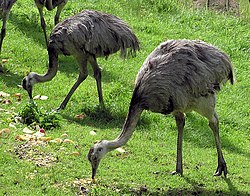
Picture of Rheidae
- Source
- Wikipedia/Commons
- Credit
- Adrian Pingstone ( Arpingstone )
- Licence
- Public Domain
- Commercial use
- the licence allows it
CT scan
- Source
- MorphoSource
- Credit
- CM Birds Collection
- Licence
- not stated by the source
- Commercial use
- cannot be read from the licence given — check the record
- Specimen
- Rhea americana · CM:Birds:S9197
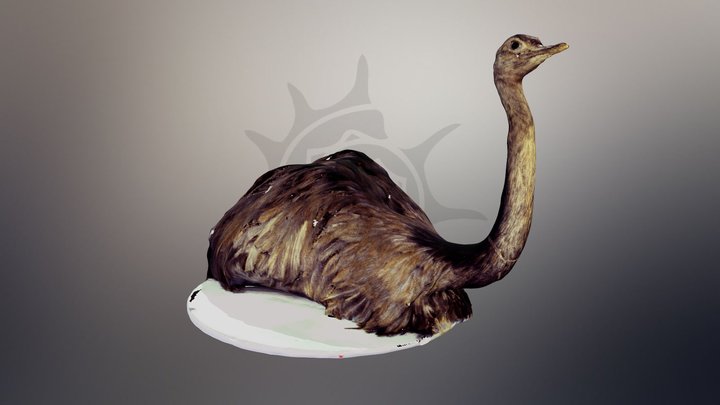
3D model
- Source
- Sketchfab
- Credit
- darwinmuseum.ru
- Licence
- CC Attribution-NonCommercial
- Commercial use
- the licence does not allow it
Smithsonian Open Access was not reached for this taxon, so this list is what the others held rather than everything there is.
The description on this site
- Source
- Wikipedia, “Rhea (bird)”
- Licence
- CC BY-SA 4.0
This is what the site found, which is not the same as what exists.
Keep going
What may have been alongside itRheiformes through timeFormations of the MioceneThe world it lived on
Occurrence data from the Paleobiology Database, CC BY 4.0. Bonaparte 1849