Ranunculaceae
Ranunculaceae, commonly called the buttercup family, is a large family of flowering plants, whose range is distributed worldwide.

Uncredited · CC BY-SA 3.0 · via Wikipedia/Commons. May be a photograph of a specimen, or an artist’s reconstruction — an interpretation of a skeleton, since colour and soft tissue are almost never preserved.
On record
Recorded, not inferred- Also called
- buttercupPBDB
- Sits inside
- RanunculalesPBDB
- Diet
- "photoautotroph"PBDB, for Angiospermae
Time the record covers
At least 65 million years on record.
The record covers at least 66 Mya to 11.7 ka. No occurrence read is dated outside 72.2 Mya to 0 Mya.
181 occurrences of Ranunculaceae on record, most of them in the Pleistocene. The Paleobiology Database records this as a living group. Bar height is expected occurrences, not a count: each fossil is spread across the span it is dated to, so a tall narrow bar means tight dating and a low wide one means loose.
When
181 occurrences- Late Cretaceous2%
- Paleoceneunder 1%
- Eoceneunder 1%
- Oligocene3%
- Miocene22%
- Pliocene21%
- Pleistocene46%
- Holocene5%
These are dates about fossils, not the animal: the record can only begin after it arose and end before it died out, so either end may reach further. Shares are expected occurrences: a fossil dated to a span is counted partly in each period it straddles. More on what this infers.
Found in
10 formations
- Hell Creek Formation4
- Santa Maria di Ciciliano Formation4
- Varswater Formation1
- Olduvai Formation1
- Norwich Crag Formation1
- Cullen Formation1
Loading coastlines…
The named rock units Ranunculaceae has been recovered from, largest first. Drawn where the rock is now, not where it formed. 165 occurrences have no formation on record, which is common for older literature.
Ranunculaceae and its relatives
PleistoceneWhere Ranunculaceae and its relatives were recorded in the Pleistocene.
Found in the same rock
1,316 taxa- Poaceae50 sites
- Cyperaceae41 sites
- Asteraceae38 sites
- Quercus31 sites
- Apiaceae30 sites
- Caryophyllaceae27 sites
- Chenopodiaceae27 sites
- Alnus26 sites
- Artemisia26 sites
- Betula26 sites
- Plantago25 sites
- Potamogeton25 sites
- Myriophyllum24 sites
- Rosaceae22 sites
- Salix22 sites
- Picea21 sites
- Abies20 sites
- Botryococcus20 sites
- Ericaceae20 sites
- Myrtaceae19 sites
- Polygonum19 sites
- Urticaceae19 sites
- Fabaceae18 sites
- Acacia17 sites
The Paleobiology Database records 83 sites for Ranunculaceae, and this reads all of them. The number is how many of those sites it was catalogued from too. The 24 sharing the most are listed.
This is not a list of everything alive at the time. It is only what has come out of the same ground as this animal and been written down.
Entered from
35 references- Tretichnye Flory Zapadnoi Sibiri26
- Late Devensian river deposits beneath the floodplain terrace of the River Thames at Abingdon, Berkshire, England23
- A Catalogue of Fossil Plants from India Part 6: Cenozoic (Quaternary) Palynology and Palaeobotany22
- Die pliozaenen Floren von Thueringen, Deutsche Demokratische Republik22
- Die mittelmiozaenen und obermiozaenen Floren aus der Meuroer und Raunoer Folge in der Lausitz. III. Fundstellen und Palaeobiologie13
- A Late Pleistocene fauna and flora from Upton Warren, Worcestershire10
- Early Pleistocene vegetation change in upland south-eastern Australia8
- A complete pollen record of the last 230 ka from Lynch's Crater, north-eastern Australia7
- Miocenska Flora ze Starych Gliwic na Slasku (Miocene Flora of Stare Gliwice in Upper Silesia)5
- The section of Torre Picchio (Terni, Umbria, Central Italy): A Villafranchian site rich in vertebrates, molluscs, ostracods and plants.4
- Megaflora of the Hell Creek and lower Fort Union Formations in the western Dakotas: Vegetational response to climate change, the Cretaceous-Tertiary boundary event, and rapid marine transgression4
- A catalogue of Cenozoic megafossil plants in China4
Each of the 181 occurrences read was entered from one of these publications, ordered by how many each accounts for. This is not a search for papers mentioning the name. 23 further references are not listed. Entries link to doi.org where the Paleobiology Database holds an identifier, and to its own record where it does not. Relayed as the Paleobiology Database holds them, not checked against what they resolve to.
Media and terms
Media content1
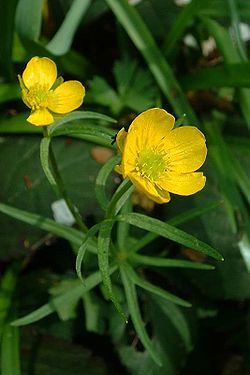
Picture of Ranunculaceae
- Source
- Wikipedia/Commons
- Credit
- nobody named on the record
- Licence
- CC BY-SA 3.0
- Commercial use
- the licence allows it
No 3D scan of Ranunculaceae was found in MorphoSource and Sketchfab.
Smithsonian Open Access was not reached for this taxon, so this list is what the others held rather than everything there is.
The description on this site
- Licence
- CC BY-SA 4.0
This is what the site found, which is not the same as what exists.
Keep going
What may have been alongside itRanunculales through timeFormations of the PleistoceneThe world it lived on
Occurrence data from the Paleobiology Database, CC BY 4.0. Jussieu 1789