Porzana porzana
The spotted crake is a small waterbird of the family Rallidae. The scientific name is derived from Venetian terms for small rails.

Noel Reynolds · CC BY 2.0 · via Wikipedia/Commons. May be a photograph of a specimen, or an artist’s reconstruction — an interpretation of a skeleton, since colour and soft tissue are almost never preserved.
On record
Recorded, not inferred- Also called
- spotted crakePBDB
- Sits inside
- PorzanaPBDB
- Diet
- carnivorePBDB, for Coelurosauria
- Life habit
- ground dwelling, solitaryPBDB, for Theropoda
- Motility
- actively mobilePBDB, for Theropoda
- Environment
- terrestrialPBDB, for Theropoda
- Mass
- 10.9 gWikidata
Time the record covers
At least 117 thousand years on record.
The record covers at least 129 ka to 11.7 ka. No occurrence read is dated outside 2.58 Mya to 0 Mya.
8 occurrences of Porzana porzana on record, most of them in the Pleistocene. The Paleobiology Database records this as a living group. Bar height is expected occurrences, not a count: each fossil is spread across the span it is dated to, so a tall narrow bar means tight dating and a low wide one means loose.
When
8 occurrences- Pleistocene88%
- Holocene13%
These are dates about fossils, not the animal: the record can only begin after it arose and end before it died out, so either end may reach further. Shares are expected occurrences: a fossil dated to a span is counted partly in each period it straddles. More on what this infers.
Porzana porzana and its relatives
PleistoceneWhere Porzana porzana and its relatives were recorded in the Pleistocene.
Found in the same rock
148 taxa- Pyrrhocorax graculus6 sites
- Columba livia5 sites
- Erithacus rubecula5 sites
- Tyto alba5 sites
- Corvus monedula4 sites
- Pyrrhocorax4 sites
- Turdus4 sites
- Athene noctua3 sites
- Chloris chloris3 sites
- Coccothraustes coccothraustes3 sites
- Columba3 sites
- Columba oenas3 sites
- Emberiza3 sites
- Accipiter gentilis2 sites
- Aegolius funereus2 sites
- Alauda arvensis2 sites
- Aquila chrysaetos2 sites
- Asio flammeus2 sites
- Athene cretensis2 sites
- Bufo viridis2 sites
- Buteo buteo2 sites
- Cervus2 sites
- Coracias garrulus2 sites
- Discoglossus2 sites
The Paleobiology Database records 8 sites for Porzana porzana, and this reads all of them. The number is how many of those sites it was catalogued from too. The 24 sharing the most are listed.
This is not a list of everything alive at the time. It is only what has come out of the same ground as this animal and been written down.
Entered from
6 references- Upper Pleistocene and Holocene fossil avifauna from Moleta cave (Mallorca, Balearic Islands)2
- The Quaternary avifauna of Crete, Greece2
- The bird assemblage from the Middle Palaeolithic level I of Arbreda Cave: A taphonomic story1
- Castiglione 3, un nouveau remplissage fosilifere d'age Pleistocene moyen dans le karst de la region d'Oletta (Haute-Corse)1
- Biostratigraphy of amphibians, reptiles, birds and mammals in Corsica and the role of man in the Holocene faunal turnover1
- The Pleistocene birds of south-eastern England1
Each of the 8 occurrences read was entered from one of these publications, ordered by how many each accounts for. This is not a search for papers mentioning the name. Entries link to doi.org where the Paleobiology Database holds an identifier, and to its own record where it does not. Relayed as the Paleobiology Database holds them, not checked against what they resolve to.
Media and terms
Media content3
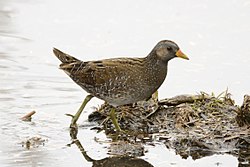
Picture of Porzana porzana
- Source
- Wikipedia/Commons
- Credit
- Noel Reynolds
- Licence
- CC BY 2.0
- Commercial use
- the licence allows it
CT scan
- Source
- MorphoSource
- Licence
- In Copyright
- Commercial use
- cannot be read from the licence given — check the record
- Specimen
- Porzana porzana · FMNH:Birds:313724
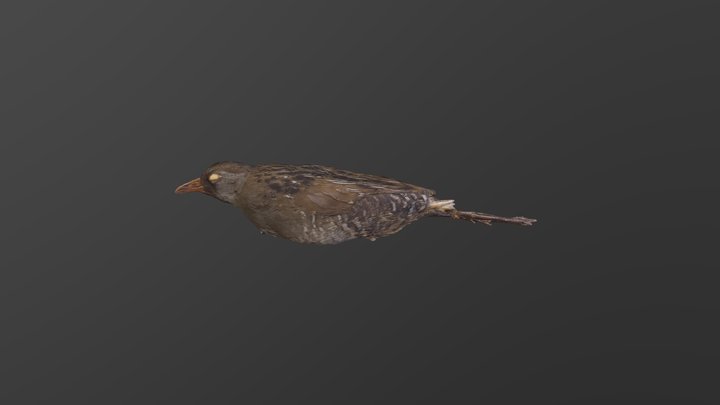
Smithsonian Open Access was not reached for this taxon, so this list is what the others held rather than everything there is.
The description on this site
- Licence
- CC BY-SA 4.0
This is what the site found, which is not the same as what exists.
Keep going
What may have been alongside itPorzana through timeFormations of the PleistoceneThe world it lived on
Occurrence data from the Paleobiology Database, CC BY 4.0. (Linnaeus 1766)