Phyllacanthus

François Michonneau · CC BY 3.0 · via Wikidata/Commons. May be a photograph of a specimen, or an artist’s reconstruction — an interpretation of a skeleton, since colour and soft tissue are almost never preserved.
On record
Recorded, not inferred- Sits inside
- CidarinaePBDB
- Diet
- grazer, omnivorePBDB, for Cidaroida
- Life habit
- low-level epifaunalPBDB, for Cidaroida
- Motility
- slow-movingPBDB, for Cidaroida
- Vision
- limitedPBDB, for Echinoidea
- Environment
- marinePBDB, for Cidaroida
Time the record covers
At least 130 million years on record.
The record covers at least 132.6 Mya to 2.58 Mya. No occurrence read is dated outside 137.05 Mya to 11.7 ka.
49 occurrences of Phyllacanthus on record, most of them in the Miocene. The Paleobiology Database records this as a living group. Bar height is expected occurrences, not a count: each fossil is spread across the span it is dated to, so a tall narrow bar means tight dating and a low wide one means loose.
When
49 occurrencesThese are dates about fossils, not the animal: the record can only begin after it arose and end before it died out, so either end may reach further. Shares are expected occurrences: a fossil dated to a span is counted partly in each period it straddles. More on what this infers.
Found in
12 formations
- Futuna Limestone Formation10
- Pirabas Formation4
- Castle Hayne Formation2
- Crystal River Limestone Formation · Ocala Group2
- Ndalithoni Limestone Formation2
- Titanosarcolites Limestone Formation2
Loading coastlines…
The named rock units Phyllacanthus has been recovered from, largest first. Drawn where the rock is now, not where it formed. 21 occurrences have no formation on record, which is common for older literature.
Phyllacanthus and its relatives
MioceneWhere Phyllacanthus and its relatives were recorded in the Miocene.
Found in the same rock
467 taxa- Agariciidae8 sites
- Magasella neozelandica8 sites
- Notosaria antipoda8 sites
- Chlamys5 sites
- Clypeaster5 sites
- Lopha cristagalli5 sites
- Pycnodonte (Crenostrea)5 sites
- Goniopygus4 sites
- Hemipristis serra4 sites
- Lopha4 sites
- Lovenia4 sites
- Naticarius canrena4 sites
- Reteporella4 sites
- Serripecten hutchinsoni4 sites
- Acanthocarpus obscurus3 sites
- Amauropsis3 sites
- Anthozoa3 sites
- Bathylasma aucklandicum3 sites
- Carcharhinus ackermannii3 sites
- Cardium3 sites
- Chondrocidaris3 sites
- Cubitostrea3 sites
- Dioplotherium allisoni3 sites
- Echinolampas3 sites
The Paleobiology Database records 42 sites for Phyllacanthus, and this reads all of them. The number is how many of those sites it was catalogued from too. The 24 sharing the most are listed.
This is not a list of everything alive at the time. It is only what has come out of the same ground as this animal and been written down.
Entered from
16 references- Geology of Lau, Fiji12
- Fossil communities in an Early Miocene transgressive sequence, Mathesons Bay, Leigh, Auckland9
- Recherches géologiques sur le Crétacé inférieur de l'Estremadura (Portugal)6
- Localidades fossiliferas da Formacao Pirabas (Mioceno Inferior)4
- Jamaican Cretaceous Echinoidea3
- The Echinoids of the Middle Eocene Warley Hill Formation, Santee Limestone, and Castle Hayne Limestone of North and South Carolina2
- The echinoid fauna from Japan and adjacent regions, Part I2
- Cenozoic Regular Echinoids of Eastern United States2
- Die Tertiärschichten auf Java. Nach den Entdecjungen von Fr. Junghuhn2
- Echinoid assemblages as a tool for palaeoenvironmental reconstruction - an example from the Early Miocene of Egypt1
- Diversity patterns and biostratigraphy of Cenozoic echinodems from Florida1
- Cenozoic Molluscs and Echinoids of Barrow Island, Western Australia1
Each of the 49 occurrences read was entered from one of these publications, ordered by how many each accounts for. This is not a search for papers mentioning the name. 4 further references are not listed. Entries link to doi.org where the Paleobiology Database holds an identifier, and to its own record where it does not. Relayed as the Paleobiology Database holds them, not checked against what they resolve to.
Media and terms
Media content2
Picture of Phyllacanthus
- Source
- Wikidata/Commons
- Credit
- François Michonneau
- Licence
- CC BY 3.0
- Commercial use
- the licence allows it
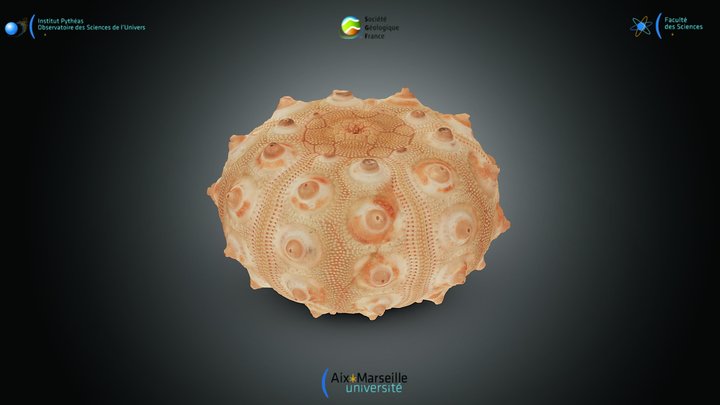
3D model
- Source
- Sketchfab
- Licence
- CC Attribution-NonCommercial-ShareAlike
- Commercial use
- the licence does not allow it
Smithsonian Open Access and MorphoSource were not reached for this taxon, so this list is what the others held rather than everything there is.
This is what the site found, which is not the same as what exists.
Keep going
What may have been alongside itCidarinae through timeFormations of the MioceneThe world it lived on
Occurrence data from the Paleobiology Database, CC BY 4.0. Brandt