Agariciidae
The Agariciidae are a family of reef-building stony corals. This family includes cactus corals, plate corals, and lettuce corals. Members of the family include symbiotic algae called zooxanthellae in their tissues which help provide their energy requirements.

Dr. Dwayne Meadows, NOAA/NMFS/OPR · Public Domain · via Wikipedia/Commons. May be a photograph of a specimen, or an artist’s reconstruction — an interpretation of a skeleton, since colour and soft tissue are almost never preserved.
On record
Recorded, not inferred- Sits inside
- AgariciicaePBDB
- Diet
- microcarnivore, photosymbioticPBDB, for Scleractinia
- Life habit
- intermediate-level epifaunal, colonial, clonalPBDB, for Scleractinia
- Motility
- stationary, attachedPBDB, for Scleractinia
- Vision
- blindPBDB, for Anthozoa
- Environment
- marinePBDB, for Scleractinia
Time the record covers
At least 154 million years on record.
The record covers at least 154.8 Mya to 11.7 ka. No occurrence read is dated outside 161.5 Mya to 0 Mya.
1,254 occurrences of Agariciidae on record, most of them in the Pleistocene. The Paleobiology Database records this as a living group. Bar height is expected occurrences, not a count: each fossil is spread across the span it is dated to, so a tall narrow bar means tight dating and a low wide one means loose.
When
1,254 occurrences- Late Jurassicunder 1%
- Early Cretaceous2%
- Late Cretaceous4%
- Paleoceneunder 1%
- Eocene6%
- Oligocene11%
- Miocene18%
- Pliocene10%
- Pleistocene43%
- Holocene6%
These are dates about fossils, not the animal: the record can only begin after it arose and end before it died out, so either end may reach further. Shares are expected occurrences: a fossil dated to a span is counted partly in each period it straddles. More on what this infers.
Found in
143 formations
- Moin Formation · Limon Group194
- Ironshore Formation31
- Quebrada Chocolate Formation · Limon Group28
- Urraca Formation26
- Salcedo Formation25
- Castelgomberto Formation23
Loading coastlines…
The named rock units Agariciidae has been recovered from, largest first. Drawn where the rock is now, not where it formed. 119 further formations hold fewer occurrences each and are not listed. 492 occurrences have no formation on record, which is common for older literature.
Agariciidae and its relatives
PleistoceneWhere Agariciidae and its relatives were recorded in the Pleistocene.
Found in the same rock
1,434 taxa- Agaricia agaricites108 sites
- Porites51 sites
- Stephanocoenia duncani51 sites
- Orbicella limbata49 sites
- Madracis decactis45 sites
- Stephanocoenia intersepta43 sites
- Montastraea cylindrica42 sites
- Agaricia lamarcki41 sites
- Pavona40 sites
- Agaricia grahamae38 sites
- Montastraea38 sites
- Siderastrea siderea38 sites
- Manicina areolata37 sites
- Agaricia undata36 sites
- Caulastrea portoricensis35 sites
- Porites astreoides34 sites
- Acropora cervicornis31 sites
- Madracis myriaster31 sites
- Placocyathus variabilis30 sites
- Porites baracoaensis30 sites
- Montastraea cavernosa29 sites
- Colpophyllia28 sites
- Colpophyllia natans28 sites
- Montastraea faveolata27 sites
The Paleobiology Database records 374 sites for Agariciidae, and this reads 240 of them. The number is how many of those sites it was catalogued from too. The 24 sharing the most are listed.
This is not a list of everything alive at the time. It is only what has come out of the same ground as this animal and been written down.
Entered from
233 references- Pliocene to Pleistocene reef coral assemblages in the Limon Group of Costa Rica228
- Neogene reef coral assemblages of the Bocas del Toro region, Panama: the rise of Acropora palmata49
- Variations in Pleistocene coral assemblages in space and time in southern and northern central Ryukyu Islands, Japan38
- Coral associations of the Pleistocene Ironshore Formation, Grand Cayman31
- Systematische und paläoökologische Untersuchungen an oligozänen Korallen der Umgebung von San Luca (Provinz Vicenza, Norditalien) [Systematic and paleoecologic studies of Oligocene corals from San Luca area (Vicenza, northern Italy)]31
- Die Anthozoenfauna des Jungtertiärs von Borneo [Anthozoa from the Upper Tertiary of Borneo]25
- Coral assemblages and reef environments in the Bahamas Drilling Project cores22
- Paläontologische Studien über die älteren Tertiärschichten der Alpen, 1: Die fossilen Anthozoen der Schichten von Castelgomberto [Paleontological studies about the older Tertiary beds in the Alps, 1: The fossil Anthozoa from the Castelcomberto Formation]21
- Middle Miocene recovery of Caribbean reef corals: new data from the Tamana Formation, Trinidad18
- Carbonate deposition in accretionary prism settings: Early Miocene coral limestones and corals of the Makran Mountain Range in southern Iran18
- Evolutionary dynamics of Indo-Pacific reef corals throughout the Neogene16
- Past corals and recent reefs in Indonesia16
Each of the 1,254 occurrences read was entered from one of these publications, ordered by how many each accounts for. This is not a search for papers mentioning the name. 221 further references are not listed. Entries link to doi.org where the Paleobiology Database holds an identifier, and to its own record where it does not. Relayed as the Paleobiology Database holds them, not checked against what they resolve to.
Media and terms
Media content1
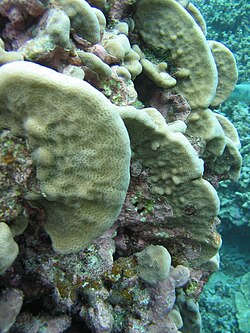
Picture of Agariciidae
- Source
- Wikipedia/Commons
- Credit
- Dr. Dwayne Meadows, NOAA/NMFS/OPR
- Licence
- Public Domain
- Commercial use
- the licence allows it
No 3D scan of Agariciidae was found in Sketchfab.
Smithsonian Open Access and MorphoSource were not reached for this taxon, so this list is what the others held rather than everything there is.
The description on this site
- Source
- Wikipedia, “Agariciidae”
- Licence
- CC BY-SA 4.0
This is what the site found, which is not the same as what exists.
Keep going
What may have been alongside itAgariciicae through timeFormations of the PleistoceneThe world it lived on
Occurrence data from the Paleobiology Database, CC BY 4.0. Gray 1847