Oxymycterus
Oxymycterus is a genus of rat-like rodents commonly known as hocicudos. They are endemic to South America. As of April 2019, the genus contains the following 16 species:O. akodontius Thomas, 1921 Argentine hocicudo O. amazonicus Herzhkovitz, 1994 Amazon hocicudo O. angularis Thomas, 1909 angular hocicudo O. caparaoe Hershkovitz, 1998 Caparao hocicudo O. dasytrichus (Schinz, 1821) Atlantic Forest hocicudo O. delator Thomas, 1903 spy hocicudo O. hiska Hinojosa, Anderson & Patton, 1987 small hocicudo O. hispidus Pictet, 1843 hispid hocicudo O. hucucha Hinojosa, Anderson & Patton, 1987 Quechuan hocicudo O. inca Thomas, 1900 Incan hocicudo O. itapeby Peçanha et al. 2019 Itapevi hocicudo O. josei Hoffmann, Lessa & Smith, 2002 Cook's hocicudo O. nasutus (Waterhouse, 1837) long-nosed hocicudo O. paramensis Paramo hocicudo O. quaestor Thomas, 1903 Quaestor hocicudo O. roberti Thomas, 1901 Robert's hocicudo O. rufus (Fischer, 1814) red hocicudo O. wayku Jayat et al., 2008 ravine hocicudo

Bell, Thomas; Darwin, Charles; Gould, Elizabeth; Gould, John; Owen, Richard; Waterhouse, G. R. · Public Domain · via Wikipedia/Commons. May be a photograph of a specimen, or an artist’s reconstruction — an interpretation of a skeleton, since colour and soft tissue are almost never preserved.
On record
Recorded, not inferred- Also called
- hocicudoPBDB
- Sits inside
- AkodontiniPBDB
- Diet
- herbivorePBDB, for Rodentia
- Life habit
- semifossorialPBDB
- Motility
- actively mobilePBDB, for Osteichthyes
- Environment
- terrestrialPBDB, for Eutheria
Time the record covers
At least 762 thousand years on record.
The record covers at least 774 ka to 11.7 ka. No occurrence read is dated outside 2.58 Mya to 0 Mya.
6 occurrences of Oxymycterus on record, most of them in the Pleistocene. The Paleobiology Database records this as a living group. Bar height is expected occurrences, not a count: each fossil is spread across the span it is dated to, so a tall narrow bar means tight dating and a low wide one means loose.
When
6 occurrences- Pleistocene82%
- Holocene18%
These are dates about fossils, not the animal: the record can only begin after it arose and end before it died out, so either end may reach further. Shares are expected occurrences: a fossil dated to a span is counted partly in each period it straddles. More on what this infers.
Found in
3 formations
Loading coastlines…
The named rock units Oxymycterus has been recovered from, largest first. Drawn where the rock is now, not where it formed. 3 occurrences have no formation on record, which is common for older literature.
Oxymycterus and its relatives
PleistoceneWhere Oxymycterus and its relatives were recorded in the Pleistocene.
Found in the same rock
143 taxa- Akodon3 sites
- Oligoryzomys3 sites
- Reithrodon auritus3 sites
- Abrothrix2 sites
- Akodon (Akodon) azarae2 sites
- Andinomys edax2 sites
- Calomys2 sites
- Calomys musculinus2 sites
- Cavia tschudii2 sites
- Chaetophractus villosus2 sites
- Ctenomys2 sites
- Galea leucoblephara2 sites
- Gomphotheriidae2 sites
- Hippidion principale2 sites
- Lama2 sites
- Lestodon armatus2 sites
- Lutreolina crassicaudata2 sites
- Neochoerus2 sites
- Phyllotis2 sites
- Tafimys powelli2 sites
- Aenocyon dirus1 site
- Akodon iniscatus1 site
- Andinomys1 site
- Arctotherium tarijense1 site
The Paleobiology Database records 5 sites for Oxymycterus, and this reads all of them. The number is how many of those sites it was catalogued from too. The 24 sharing the most are listed.
This is not a list of everything alive at the time. It is only what has come out of the same ground as this animal and been written down.
Entered from
6 references- Síntesis actualizada del registro paleontológico pleistoceno en el Noroeste argentino1
- Evolution of small mammal communities during the late Quaternary in a middle-altitude valley of Northwestern Argentina1
- Diversidade de pequenos mamíferos (Didelphimorphia e Rodentia) do Holoceno do nordeste do estado do Rio Grande do Sul, Brasil: implicações taxonômicas e paleo ambientais1
- Primer registro fósil para dos especies de sigmodontinos (Rodentia, Cricetidae) endémicas del extremo sur de las Yungas de Argentina1
- Late Cenozoic mammal bio-chronostratigraphy in southwestern Buenos Aires Province, Argentina1
- The Eocene to Pleistocene vertebrates of Bolivia and their stratigraphic context: a review1
Each of the 6 occurrences read was entered from one of these publications, ordered by how many each accounts for. This is not a search for papers mentioning the name. Entries link to doi.org where the Paleobiology Database holds an identifier, and to its own record where it does not. Relayed as the Paleobiology Database holds them, not checked against what they resolve to.
Media and terms
Media content1
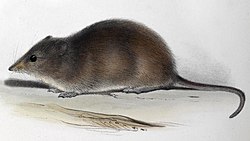
Picture of Oxymycterus
- Source
- Wikipedia/Commons
- Credit
- Bell, Thomas; Darwin, Charles; Gould, Elizabeth; Gould, John; Owen, Richard; Waterhouse, G. R.
- Licence
- Public Domain
- Commercial use
- the licence allows it
No 3D scan of Oxymycterus was found in Sketchfab.
Smithsonian Open Access and MorphoSource were not reached for this taxon, so this list is what the others held rather than everything there is.
The description on this site
- Source
- Wikipedia, “Oxymycterus”
- Licence
- CC BY-SA 4.0
This is what the site found, which is not the same as what exists.
Keep going
What may have been alongside itAkodontini through timeFormations of the PleistoceneThe world it lived on
Occurrence data from the Paleobiology Database, CC BY 4.0. Waterhouse 1837