Abrothrix
Abrothrix is a genus of rodent in the tribe Abrotrichini of family Cricetidae. It contains the following living species:Abrothrix andina Abrothrix hershkovitzi Abrothrix hirta Abrothrix illutea Abrothrix jelskii Abrothrix lanosa Abrothrix longipilis Abrothrix manni Abrothrix olivacea Abrothrix sanborni Abrothrix xanthorhina

Jorge Cárdenas · CC BY 2.0 · via Wikipedia/Commons. May be a photograph of a specimen, or an artist’s reconstruction — an interpretation of a skeleton, since colour and soft tissue are almost never preserved.
On record
Recorded, not inferred- Sits inside
- SigmodontinaePBDB
- Diet
- herbivorePBDB, for Rodentia
- Life habit
- ground dwellingPBDB, for Rodentia
- Motility
- actively mobilePBDB, for Osteichthyes
- Environment
- terrestrialPBDB, for Eutheria
Time the record covers
At least 2.8 million years on record.
The record covers at least 3 Mya to 129 ka. No occurrence read is dated outside 3.8 Mya to 0 Mya.
13 occurrences of Abrothrix on record, most of them in the Pliocene. The Paleobiology Database records this as a living group. Bar height is expected occurrences, not a count: each fossil is spread across the span it is dated to, so a tall narrow bar means tight dating and a low wide one means loose.
When
13 occurrences- Pliocene64%
- Pleistocene35%
- Holoceneunder 1%
These are dates about fossils, not the animal: the record can only begin after it arose and end before it died out, so either end may reach further. Shares are expected occurrences: a fossil dated to a span is counted partly in each period it straddles. More on what this infers.
Found in
8 formations
- Brochero Formation2
- Barranca de los Lobos Formation2
- Cura Brochero Formation2
- Tafí del Valle Formation1
- Uquía Formation1
- Vorohué Formation1
Loading coastlines…
The named rock units Abrothrix has been recovered from, largest first. Drawn where the rock is now, not where it formed. 2 occurrences have no formation on record, which is common for older literature.
Abrothrix and its relatives
PlioceneWhere Abrothrix and its relatives were recorded in the Pliocene.
Found in the same rock
117 taxa- Akodon (Abrothrix) magnus4 sites
- Akodon3 sites
- Ctenomys3 sites
- Reithrodon auritus3 sites
- Rhinella3 sites
- Sigmodontinae3 sites
- Abrocoma2 sites
- Akodon lorenzinii2 sites
- Andinomys edax2 sites
- Calomys musculinus2 sites
- Cavia tschudii2 sites
- Cholomys pearsoni2 sites
- Chukimys favaloroi2 sites
- Dankomys2 sites
- Galea leucoblephara2 sites
- Megatherium2 sites
- Microcavia2 sites
- Oligoryzomys2 sites
- Oxymycterus2 sites
- Tafimys powelli2 sites
- Abalosia castellanosi1 site
- Aconaemys fuscus1 site
- Anas flavirostris1 site
- Anas georgica1 site
The Paleobiology Database records 10 sites for Abrothrix, and this reads all of them. The number is how many of those sites it was catalogued from too. The 24 sharing the most are listed.
This is not a list of everything alive at the time. It is only what has come out of the same ground as this animal and been written down.
Entered from
10 references- Reassesment of the Pliocene-Pleistocene continental time scale of Southern South America. Correlation of the type Chapadmalalan with Bolivian sections3
- Posición sistemática de Akodon (Abrothrix) kermacki Y A. (AB.) magnus (Rodentia, Cricetidae) del plio-Pleistoceno del sudeste de Buenos Aires, Argentina2
- Advances in the understanding of Neogene mammalian fauna in the Pampean region (central Argentina) through revising “biozone” hypotheses based on new dates and biochronological analyses1
- Taguatagua 1: New insights into the late Pleistocene fauna, paleoenvironment, and human subsistence in a unique lacustrine context in central Chile1
- Síntesis actualizada del registro paleontológico pleistoceno en el Noroeste argentino1
- Evolution of small mammal communities during the late Quaternary in a middle-altitude valley of Northwestern Argentina1
- New Vertebrates of the Brochero Formation (Córdoba, Argentina): A Review of the Pliocene of Central Argentina1
- A new genus of Sigmodontinae (Mammalia, Rodentia, Cricetidae) from the Pliocene of Central Argentina1
- Exceptional Late Pliocene microvertebrate diversity in northwestern Argentina reveals a marked small mammal turnover1
- A New Fossil Phyllotine (Rodentia: Muridae) from Northwestern Argentina and Relationships of Reithrodon Group1
Each of the 13 occurrences read was entered from one of these publications, ordered by how many each accounts for. This is not a search for papers mentioning the name. Entries link to doi.org where the Paleobiology Database holds an identifier, and to its own record where it does not. Relayed as the Paleobiology Database holds them, not checked against what they resolve to.
Media and terms
Media content1
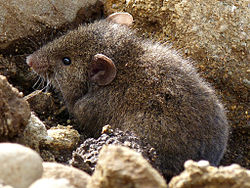
Picture of Abrothrix
- Source
- Wikipedia/Commons
- Credit
- Jorge Cárdenas
- Licence
- CC BY 2.0
- Commercial use
- the licence allows it
No 3D scan of Abrothrix was found in Sketchfab.
Smithsonian Open Access and MorphoSource were not reached for this taxon, so this list is what the others held rather than everything there is.
The description on this site
- Source
- Wikipedia, “Abrothrix”
- Licence
- CC BY-SA 4.0
This is what the site found, which is not the same as what exists.
Keep going
What may have been alongside itSigmodontinae through timeFormations of the PlioceneThe world it lived on
Occurrence data from the Paleobiology Database, CC BY 4.0. Thomas 1916