Ophiomorpha
Ophiomorpha is an ichnotaxon, usually interpreted as a burrow of an organism living in the near-shore environment. The burrow lining is more or less smooth on the inside, and densely to strongly mammalated or nodose on the outside, due to the packing of nodules for support of the burrow. Branching is irregular but Y-shaped where present. It is often considered part of the Skolithos ichnofacies, where it has occurred since the early Permian, though it has also occurred in deep water settings since the Late Jurassic, such as well-oxygenated turbidites.

Jstuby at en.wikipedia · Public Domain · via Wikipedia/Commons. May be a photograph of a specimen, or an artist’s reconstruction — an interpretation of a skeleton, since colour and soft tissue are almost never preserved.
On record
Recorded, not inferred- Sits inside
- IchnofossilsPBDB
Time the record covers
At least 251 million years on record.
The record covers at least 251.902 Mya to 11.7 ka. No occurrence read is dated outside 538.8 Mya to 0 Mya.
65 occurrences of Ophiomorpha on record, most of them in the Late Cretaceous. Bar height is expected occurrences, not a count: each fossil is spread across the span it is dated to, so a tall narrow bar means tight dating and a low wide one means loose.
When
65 occurrences- Cambrianunder 1%
- Ordovicianunder 1%
- Silurianunder 1%
- Devonianunder 1%
- Carboniferousunder 1%
- Permianunder 1%
- Early Jurassic12%
- Middle Jurassic2%
- Early Cretaceous8%
- Late Cretaceous22%
- Paleocene6%
- Eocene17%
- Oligocene3%
- Miocene15%
- Pliocene3%
- Pleistocene10%
- Holocene2%
These are dates about fossils, not the animal: the record can only begin after it arose and end before it died out, so either end may reach further. Shares are expected occurrences: a fossil dated to a span is counted partly in each period it straddles. More on what this infers.
Found in
38 formations
- Fox Hills Formation · Montana Group3
- Chaya Formation2
- Ardanatz Sandstone Formation2
- Aguja Formation2
- Agrio Formation2
- Cape Stewart Beds Formation2
Loading coastlines…
The named rock units Ophiomorpha has been recovered from, largest first. Drawn where the rock is now, not where it formed. 14 further formations hold fewer occurrences each and are not listed. 18 occurrences have no formation on record, which is common for older literature.
Ophiomorpha and its relatives
Late CretaceousWhere Ophiomorpha and its relatives were recorded in the Late Cretaceous.
Found in the same rock
717 taxa- Thalassinoides5 sites
- Arcomya4 sites
- Astarte4 sites
- Cardinia hybrida4 sites
- Cardium4 sites
- Crocodylia4 sites
- Gryphaea cymbium4 sites
- Liostrea4 sites
- Oxytoma inequivalvis4 sites
- Pecten priscus4 sites
- Plicatula4 sites
- Tancredia4 sites
- Camptonectes3 sites
- Carcharias3 sites
- Chlamys substriata3 sites
- Chondrites3 sites
- Echinoidea3 sites
- Entolium3 sites
- Entolium callosum3 sites
- Gastropoda3 sites
- Gryphaea arcuata3 sites
- Limea3 sites
- Liotrigonia lingonensis3 sites
- Modiolus3 sites
The Paleobiology Database records 46 sites for Ophiomorpha, and this reads all of them. The number is how many of those sites it was catalogued from too. The 24 sharing the most are listed.
This is not a list of everything alive at the time. It is only what has come out of the same ground as this animal and been written down.
Entered from
49 references- The Lower Jurassic Rocks of East Greenland Part 17
- Fossil associations from the middle and upper Eocene strata of the Pamplona Basin and surrounding areas (Navarre, western Pyrenees)5
- Characterization of the Ophiomorpha rudis 3D boxwork in a turbiditic succession (Oligocene of the Alicante Province, southeastern Spain)2
- The genus Struthiochenopus (Gastropoda, Aporrhaidae): neu Miocene records from southern Chile2
- Devínska Kobyla- a window into the Middle Miocene shallow-water marine environments of the Central Paratethys (Vienna Basin, Slovakia)2
- Paleoenvironmental framework of dinosaur tracksites and other ichnofossils in Early Cretaceous mixed siliciclastic-carbonate deposits in the Neuquén Basin, northern Patagonia (Argentina)2
- Stratigraphic distribution and depositional environment of the Chaya Formation along the northwestern coast of Saurashtra Peninsula, western India2
- Early Cretaceous Trigonids of the Crimea2
- Sedimentology and taphonomy of sirenian remains from the Middle Eocene of the Pamplona Basin (Navarre, western Pyrenees1
- Xiphiorhynchus cf. X. eocaenicus (Woodward, 1901), (Scombroidei: Xiphiidae: Xiphiorhynchinae) from the middle Eocene of Mississippi, the first transatlantic distribution of a species of Xiphiorhynchus1
- New dinosaur sites correlated with Upper Maastrichtian pelagic deposits in the Spanish Pyrenees: implications for the dinosaur extinction pattern in Europe1
- Stratigraphy, paleontology, and tectonics of Lower Miocene rocks in the Waipatiki/Mangatuna area, southern Hawke's Bay, New Zealand1
Each of the 65 occurrences read was entered from one of these publications, ordered by how many each accounts for. This is not a search for papers mentioning the name. 37 further references are not listed. Entries link to doi.org where the Paleobiology Database holds an identifier, and to its own record where it does not. Relayed as the Paleobiology Database holds them, not checked against what they resolve to.
Media and terms
Media content2

Picture of Ophiomorpha
- Source
- Wikipedia/Commons
- Credit
- Jstuby at en.wikipedia
- Licence
- Public Domain
- Commercial use
- the licence allows it
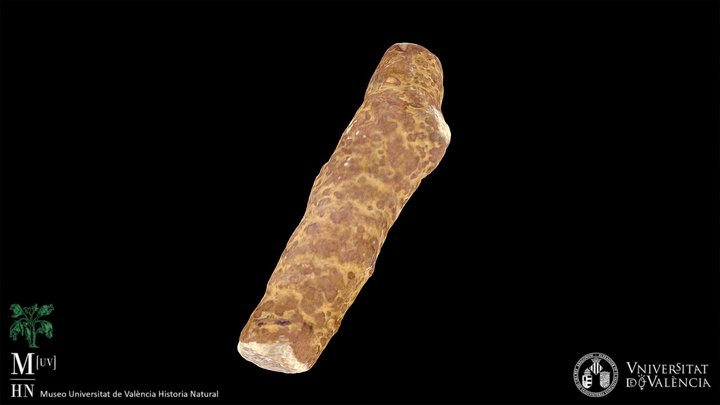
3D model
- Source
- Sketchfab
- Licence
- CC Attribution
- Commercial use
- cannot be read from the licence given — check the record
Smithsonian Open Access was not reached for this taxon, so this list is what the others held rather than everything there is.
The description on this site
- Source
- Wikipedia, “Ophiomorpha”
- Licence
- CC BY-SA 4.0
This is what the site found, which is not the same as what exists.
Keep going
What may have been alongside itIchnofossils through timeFormations of the Late CretaceousThe world it lived on
Occurrence data from the Paleobiology Database, CC BY 4.0. Lundgren 1891