Ommatotriton
Ommatotriton or banded newts is a genus of salamanders in the family Salamandridae. The genus occurs in Western Asia and Caucasus. The species in this genus were formerly placed in the genus Triturus.

GoEThe · CC BY 3.0 · via Wikipedia/Commons. May be a photograph of a specimen, or an artist’s reconstruction — an interpretation of a skeleton, since colour and soft tissue are almost never preserved.
On record
Recorded, not inferred- Sits inside
- SalamandridaePBDB
- Diet
- carnivorePBDB, for Temnospondyli
- Life habit
- amphibiousPBDB, for Temnospondyli
- Motility
- actively mobilePBDB, for Temnospondyli
- Environment
- brackish,freshwater,terrestrialPBDB, for Tetrapoda
Time the record covers
At most 5.2 million years on record.
Every occurrence read is dated to somewhere between 8.725 Mya and 3.55 Mya, and nothing in the dating separates them, so that window is what the record shows rather than a span.
2 occurrences of Ommatotriton on record, most of them in the Pliocene. The Paleobiology Database records this as a living group, and the chart stops with its fossils rather than at the present. Bar height is expected occurrences, not a count: each fossil is spread across the span it is dated to, so a tall narrow bar means tight dating and a low wide one means loose.
When
2 occurrencesThese are dates about fossils, not the animal: the record can only begin after it arose and end before it died out, so either end may reach further. Shares are expected occurrences: a fossil dated to a span is counted partly in each period it straddles. More on what this infers.
Found in
2 formations
Loading coastlines…
The named rock units Ommatotriton has been recovered from, largest first. Drawn where the rock is now, not where it formed.
Ommatotriton and its relatives
PlioceneWhere Ommatotriton and its relatives were recorded in the Pliocene.
Found in the same rock
127 taxa- Anguinae2 sites
- Apodemus2 sites
- Lacertidae2 sites
- Paraxenophis spanios2 sites
- Pelophylax2 sites
- Periergophis micros2 sites
- Pseudopus2 sites
- Ranidae2 sites
- Serpentes2 sites
- Squamata2 sites
- Agaminae1 site
- Alilepus1 site
- Amblycoptus jessiae1 site
- Amphisbaenia1 site
- Amphisbaenia indet.1 site
- Anguimorpha1 site
- Anguis1 site
- Anura1 site
- Apodemus gudrunae1 site
- Archaeodesmana1 site
- Asoriculus gibberodon1 site
- Bithynia1 site
- Boselaphini1 site
- Bufonidae1 site
The Paleobiology Database records 2 sites for Ommatotriton, and this reads all of them. The number is how many of those sites it was catalogued from too. The 24 sharing the most are listed.
This is not a list of everything alive at the time. It is only what has come out of the same ground as this animal and been written down.
Entered from
2 references- New diverse amphibian and reptile assemblages from the late Neogene of northern Greece provide novel insights into the emergence of extant herpetofaunas of the southern Balkans1
- Fossil amphibians and reptiles from the Neogene locality of Maramena (Greece), the most diverse European herpetofauna at the Miocene/Pliocene transition boundary1
Each of the 2 occurrences read was entered from one of these publications, ordered by how many each accounts for. This is not a search for papers mentioning the name. Each entry links to doi.org. Relayed as the Paleobiology Database holds them, not checked against what they resolve to.
Media and terms
Media content2
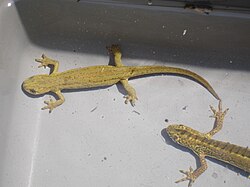
Picture of Ommatotriton
- Source
- Wikipedia/Commons
- Credit
- GoEThe
- Licence
- CC BY 3.0
- Commercial use
- the licence allows it

CT scan
- Source
- MorphoSource
- Credit
- MCZ Herpetology
- Licence
- In Copyright
- Commercial use
- cannot be read from the licence given — check the record
- Specimen
- Ommatotriton vittatus · MCZ:Herp:A-30391
Smithsonian Open Access was not reached for this taxon, so this list is what the others held rather than everything there is.
The description on this site
- Licence
- CC BY-SA 4.0
This is what the site found, which is not the same as what exists.
Keep going
What may have been alongside itSalamandridae through timeFormations of the PlioceneThe world it lived on
Occurrence data from the Paleobiology Database, CC BY 4.0. Owen 1850