Oleaceae
Oleaceae, also known as the olive family or sometimes the lilac family, is a taxonomic family of flowering shrubs, trees, and a few lianas in the order Lamiales. It presently comprises 28 genera, one of which is recently extinct. The extant genera include Cartrema, which was resurrected in 2012. The number of species in the Oleaceae is variously estimated in a wide range around 700. The flowers are often numerous and highly odoriferous. The family has a subcosmopolitan distribution, ranging from the subarctic to the southernmost parts of Africa, Australia, and South America. Notable members include olive, ash, jasmine, and several popular ornamental plants including privet, forsythia, fringetrees, and lilac.

Rodrigo Nuno Bragança da Cunha · CC BY-SA 3.0 · via Wikipedia/Commons. May be a photograph of a specimen, or an artist’s reconstruction — an interpretation of a skeleton, since colour and soft tissue are almost never preserved.
On record
Recorded, not inferred- Sits inside
- LamialesPBDB
- Diet
- "photoautotroph"PBDB, for Angiospermae
Time the record covers
At least 65 million years on record.
The record covers at least 66 Mya to 11.7 ka. No occurrence read is dated outside 100.5 Mya to 0 Mya.
268 occurrences of Oleaceae on record, most of them in the Pleistocene. The Paleobiology Database records this as a living group. Bar height is expected occurrences, not a count: each fossil is spread across the span it is dated to, so a tall narrow bar means tight dating and a low wide one means loose.
When
268 occurrencesThese are dates about fossils, not the animal: the record can only begin after it arose and end before it died out, so either end may reach further. Shares are expected occurrences: a fossil dated to a span is counted partly in each period it straddles. More on what this infers.
Found in
53 formations
- Fort Union Formation8
- Itahana Formation · Tomioka Group7
- Olduvai Formation · Vogel River Series Group7
- Okinoyama Formation · Ube Group5
- Deccan Intertrappean Formation5
- Lance Formation4
Loading coastlines…
The named rock units Oleaceae has been recovered from, largest first. Drawn where the rock is now, not where it formed. 29 further formations hold fewer occurrences each and are not listed. 169 occurrences have no formation on record, which is common for older literature.
Oleaceae and its relatives
PleistoceneWhere Oleaceae and its relatives were recorded in the Pleistocene.
Found in the same rock
2,015 taxa- Poaceae109 sites
- Quercus96 sites
- Cyperaceae75 sites
- Pinus67 sites
- Chenopodiaceae66 sites
- Alnus64 sites
- Olea61 sites
- Asteraceae59 sites
- Artemisia57 sites
- Apiaceae50 sites
- Ericaceae49 sites
- Salix49 sites
- Plantago48 sites
- Betula47 sites
- Ulmus43 sites
- Celtis42 sites
- Urticaceae42 sites
- Taraxacum40 sites
- Fraxinus39 sites
- Typha38 sites
- Acer37 sites
- Brassicaceae37 sites
- Fabaceae36 sites
- Isoetes36 sites
The Paleobiology Database records 202 sites for Oleaceae, and this reads all of them. Of that, one read hit the database's own return limit, so every count below is a floor rather than a total. The number is how many of those sites it was catalogued from too. The 24 sharing the most are listed.
This is not a list of everything alive at the time. It is only what has come out of the same ground as this animal and been written down.
Entered from
67 references- A Catalogue of Fossil Plants from India Part 6: Cenozoic (Quaternary) Palynology and Palaeobotany31
- Late Miocene and Pliocene Floras in Central Honshu, Japan17
- A complete pollen record of the last 230 ka from Lynch's Crater, north-eastern Australia16
- Niche evolution versus niche conservatism and habitat loss determine persistence and extirpation in late Neogene European Fagaceae10
- Paleocene flora of the Rocky Mountains and Great Plains10
- Site U13869
- Site U13899
- Early Pleistocene vegetation change in upland south-eastern Australia9
- A catalogue of Cenozoic megafossil plants in China8
- A Late Pleistocene and Holocene pollen diagram from Lynch’s Crater, northeastern Queensland, Australia8
- Site U13857
- Site U13877
Each of the 268 occurrences read was entered from one of these publications, ordered by how many each accounts for. This is not a search for papers mentioning the name. 55 further references are not listed. Entries link to doi.org where the Paleobiology Database holds an identifier, and to its own record where it does not. Relayed as the Paleobiology Database holds them, not checked against what they resolve to.
Media and terms
Media content1
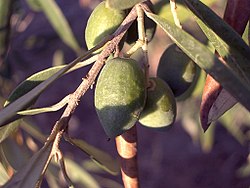
Picture of Oleaceae
- Source
- Wikipedia/Commons
- Credit
- Rodrigo Nuno Bragança da Cunha
- Licence
- CC BY-SA 3.0
- Commercial use
- the licence allows it
No 3D scan of Oleaceae was found in MorphoSource and Sketchfab.
Smithsonian Open Access was not reached for this taxon, so this list is what the others held rather than everything there is.
The description on this site
- Source
- Wikipedia, “Oleaceae”
- Licence
- CC BY-SA 4.0
This is what the site found, which is not the same as what exists.
Keep going
What may have been alongside itLamiales through timeFormations of the PleistoceneThe world it lived on
Occurrence data from the Paleobiology Database, CC BY 4.0. Hoffmannsegg and Link 1809