Lepus arcticus
The Arctic hare is a species of hare highly adapted to living in the Arctic tundra and other icy biomes. The Arctic hare survives with shortened ears and limbs, a small nose, fat that makes up close to 20% of its body, and a thick coat of fur. It usually digs holes in the ground or under the snow to keep warm and to sleep. Arctic hares look like rabbits but have shorter ears, are taller when standing, and, unlike rabbits, can thrive in extreme cold. They can travel together with many other hares, sometimes huddling with dozens or more, but are usually found alone, sometimes taking more than one partner. The Arctic hare can run up to 60 kilometres per hour (40 mph).

Steve Sayles from Rankin Inlet, Nunavut, Canada · CC BY-SA 2.0 · via Wikipedia/Commons. May be a photograph of a specimen, or an artist’s reconstruction — an interpretation of a skeleton, since colour and soft tissue are almost never preserved.
On record
Recorded, not inferred- Sits inside
- LepusPBDB
- Diet
- grazer, browserPBDB, for Leporidae
- Life habit
- ground dwellingPBDB, for Leporidae
- Motility
- actively mobilePBDB, for Osteichthyes
- Environment
- terrestrialPBDB, for Eutheria
Time the record covers
At least 198 thousand years on record.
The record covers at least 210 ka to 11.7 ka. No occurrence read is dated outside 1.4 Mya to 0 Mya.
33 occurrences of Lepus arcticus on record. The Paleobiology Database records this as a living group. Bar height is expected occurrences, not a count: each fossil is spread across the span it is dated to, so a tall narrow bar means tight dating and a low wide one means loose.
When
33 occurrences- Pleistocene9%
- Holocene91%
These are dates about fossils, not the animal: the record can only begin after it arose and end before it died out, so either end may reach further. Shares are expected occurrences: a fossil dated to a span is counted partly in each period it straddles. More on what this infers.
Found in the same rock
113 taxa- Ovibos moschatus22 sites
- Vulpes lagopus21 sites
- Rangifer tarandus20 sites
- Ursus maritimus19 sites
- Branta14 sites
- Odobenus rosmarus13 sites
- Phoca hispida13 sites
- Erignathus barbatus12 sites
- Salvelinus12 sites
- Canis10 sites
- Larus hyperboreus10 sites
- Lagopus muta9 sites
- Larus8 sites
- Anatidae7 sites
- Phocadae7 sites
- Cepphus grylle6 sites
- Dicrostonyx groenlandicus6 sites
- Lagopus6 sites
- Somateria6 sites
- Somateria spectabilis6 sites
- Balaena mysticetus5 sites
- Branta bernicla5 sites
- Clangula5 sites
- Dicrostonyx5 sites
The Paleobiology Database records 33 sites for Lepus arcticus, and this reads all of them. The number is how many of those sites it was catalogued from too. The 24 sharing the most are listed.
This is not a list of everything alive at the time. It is only what has come out of the same ground as this animal and been written down.
Entered from
11 references- The Northernmost Ruins of the Globe16
- Polar bear fossil and archaeological records from the Pleistocene and Holocene in relation to sea ice extent and open water polynyas7
- Stratigraphic, Sedimentological and Faunal Evidence for the Occurrence of Pre-Sangamonian Artefacts in Northern Yukon2
- Variability in Thule Inuit Subsistence Economy: A Faunal Analysis of OkRn-1, Banks Island, NWT1
- Oakes Bay 1: A Preliminary Reconstruction of a Labrador Inuit Seal Hunting Economy in the Context of Climate Change1
- Animals and the precontact Inuit of Labrador: an examination using faunal remains, space and myth1
- Central Inuit Household Economies: Zooarchaeology, Environmental, and Historical Evidence from Outer Frobisher Bay, Baffin Island, Canada1
- Thule Subsistence and Optimal Diet: A Zooarchaeological Test of a Linear Programming Model1
- Porden Point: An Intrasite Approach to Settlement System Analysis1
- Recent archaeological investigations in Frobisher Bay, Baffin Island, NWT1
- Quaternary vertebrate faunas of Canada and Alaska and their suggested chronological sequence1
Each of the 33 occurrences read was entered from one of these publications, ordered by how many each accounts for. This is not a search for papers mentioning the name. Entries link to doi.org where the Paleobiology Database holds an identifier, and to its own record where it does not. Relayed as the Paleobiology Database holds them, not checked against what they resolve to.
Media and terms
Media content1
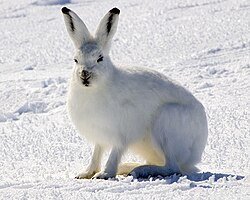
Picture of Lepus arcticus
- Source
- Wikipedia/Commons
- Credit
- Steve Sayles from Rankin Inlet, Nunavut, Canada
- Licence
- CC BY-SA 2.0
- Commercial use
- the licence allows it
No 3D scan of Lepus arcticus was found in Sketchfab.
Smithsonian Open Access and MorphoSource were not reached for this taxon, so this list is what the others held rather than everything there is.
The description on this site
- Source
- Wikipedia, “Arctic hare”
- Licence
- CC BY-SA 4.0
This is what the site found, which is not the same as what exists.
Keep going
What may have been alongside itLepus through timeThe world it lived on
Occurrence data from the Paleobiology Database, CC BY 4.0. Ross 1819