Vulpes lagopus
The Arctic fox, also known as the white fox, polar fox, or snow fox, is a small species of fox native to the Arctic regions of the Northern Hemisphere and common throughout the Arctic tundra. It is well adapted to living in cold environments, and is known for its thick, warm fur that can be used as camouflage against snow in the winter. It has a large and fluffy tail. In the wild, most individuals do not live past their first year but some exceptional ones survive up to 11 years. Its body length ranges from 46 to 68 cm, with a generally rounded body shape to minimize the escape of body heat.

Uncredited · via Wikipedia/Commons. May be a photograph of a specimen, or an artist’s reconstruction — an interpretation of a skeleton, since colour and soft tissue are almost never preserved.
On record
Recorded, not inferred- Also called
- Arctic foxPBDB
- Sits inside
- VulpesPBDB
- Diet
- carnivore, omnivorePBDB, for Vulpes
- Life habit
- ground dwellingPBDB, for Vulpes
- Motility
- actively mobilePBDB, for Osteichthyes
- Environment
- terrestrialPBDB, for Eutheria
Time the record covers
At least 198 thousand years on record.
The record covers at least 210 ka to 11.7 ka. No occurrence read is dated outside 1.4 Mya to 0 Mya.
45 occurrences of Vulpes lagopus on record. The Paleobiology Database records this as a living group. Bar height is expected occurrences, not a count: each fossil is spread across the span it is dated to, so a tall narrow bar means tight dating and a low wide one means loose.
When
45 occurrences- Pleistocene22%
- Holocene78%
These are dates about fossils, not the animal: the record can only begin after it arose and end before it died out, so either end may reach further. Shares are expected occurrences: a fossil dated to a span is counted partly in each period it straddles. More on what this infers.
Found in
1 formation
Loading coastlines…
The named rock units Vulpes lagopus has been recovered from, largest first. Drawn where the rock is now, not where it formed. 44 occurrences have no formation on record, which is common for older literature.
Found in the same rock
180 taxa- Rangifer tarandus31 sites
- Ursus maritimus30 sites
- Ovibos moschatus23 sites
- Erignathus barbatus21 sites
- Lepus arcticus21 sites
- Phoca hispida20 sites
- Odobenus rosmarus19 sites
- Branta16 sites
- Salvelinus13 sites
- Canis12 sites
- Larus hyperboreus11 sites
- Lagopus muta10 sites
- Larus10 sites
- Anatidae9 sites
- Balaena mysticetus9 sites
- Canis familiaris9 sites
- Pagophilus groenlandica9 sites
- Somateria9 sites
- Dicrostonyx8 sites
- Aves7 sites
- Canis lupus7 sites
- Cepphus grylle7 sites
- Lagopus7 sites
- Laridae7 sites
The Paleobiology Database records 45 sites for Vulpes lagopus, and this reads all of them. The number is how many of those sites it was catalogued from too. The 24 sharing the most are listed.
This is not a list of everything alive at the time. It is only what has come out of the same ground as this animal and been written down.
Entered from
25 references- The Northernmost Ruins of the Globe10
- Polar bear fossil and archaeological records from the Pleistocene and Holocene in relation to sea ice extent and open water polynyas9
- The Weichselian (c. 115,000 - 10,000 B.P.) vertebrate fauna of Norway2
- Sea mammal hunters of Chukotka, Bering Strait: recent archaeological results and problems2
- Stratigraphic, Sedimentological and Faunal Evidence for the Occurrence of Pre-Sangamonian Artefacts in Northern Yukon2
- Neo-Inuit strategies for ensuring food security during the Little Ice Age climate change episode, Foxe Basin, Arctic Canada1
- Variability in Thule Inuit Subsistence Economy: A Faunal Analysis of OkRn-1, Banks Island, NWT1
- 2013. Evidence for intensive walrus hunting by Thule Inuit, northwest Foxe Basin, Nunavut, Canada1
- The evolution of Arctic marine mammals1
- Patterns of faunal extinction and paleoclimatic change from mid-Holocene mammoth and polar bear remains, Pribilof Islands, Alaska1
- The Archaeology of St. Matthew Island, Bering Sea1
- Ancient Arctic Hunters: Material Culture and Survival Strategy1
Each of the 45 occurrences read was entered from one of these publications, ordered by how many each accounts for. This is not a search for papers mentioning the name. 13 further references are not listed. Entries link to doi.org where the Paleobiology Database holds an identifier, and to its own record where it does not. Relayed as the Paleobiology Database holds them, not checked against what they resolve to.
Media and terms
Media content3

Picture of Vulpes lagopus
- Source
- Wikipedia/Commons
- Credit
- nobody named on the record
- Licence
- not stated by the source
- Commercial use
- cannot be read from the licence given — check the record
CT scan
- Source
- MorphoSource
- Licence
- In Copyright
- Commercial use
- cannot be read from the licence given — check the record
- Specimen
- Vulpes lagopus lagopus · UCLA:Mammals:15163
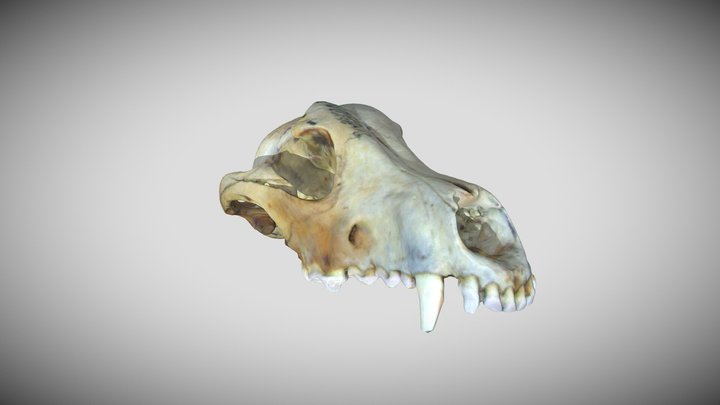
Smithsonian Open Access was not reached for this taxon, so this list is what the others held rather than everything there is.
The description on this site
- Source
- Wikipedia, “Arctic fox”
- Licence
- CC BY-SA 4.0
This is what the site found, which is not the same as what exists.
Keep going
What may have been alongside itVulpes through timeThe world it lived on
Occurrence data from the Paleobiology Database, CC BY 4.0. (Linnaeus 1758)