Leptoceratops
Leptoceratops is a genus of ceratopsian dinosaur from the Late Cretaceous of North America. First found in Alberta in 1910, the type species Leptoceratops gracilis was named in 1914 by Barnum Brown for a partial skull and skeleton of two individuals found in the Scollard Formation of Alberta. Additional specimens found in the Scollard include one complete and two mostly complete skeletons together, uncovered in 1947 by Charles M. Sternberg. Specimens from Montana that were among the earliest referred to Leptoceratops have since been moved to their own genera Montanoceratops and Cerasinops, while new specimens of L. gracilis include bonebed remains from the Hell Creek Formation of Montana and a partial skeleton from the Lance Formation of Wyoming. Together with related taxa, Leptoceratops is the eponymous genus of the family Leptoceratopsidae. Leptoceratops is known from more than ten individuals, all from Maastrichtian deposits of Alberta, Montana and Wyoming, representing the entire skeleton.

Hectonichus · CC BY-SA 3.0 · via Wikipedia/Commons. May be a photograph of a specimen, or an artist’s reconstruction — an interpretation of a skeleton, since colour and soft tissue are almost never preserved.
On record
Recorded, not inferred- Sits inside
- LeptoceratopsidaePBDB
- Diet
- herbivorePBDB, for Ceratopsia
- Life habit
- ground dwellingPBDB, for Ceratopsia
- Motility
- actively mobilePBDB, for Ornithischia
- Environment
- terrestrialPBDB, for Ceratopsia
- Length
- 3 mWikidata
Time the record covers
At most 6.2 million years on record.
Every occurrence read is dated to somewhere between 72.2 Mya and 66 Mya, and nothing in the dating separates them, so that window is what the record shows rather than a span.
8 occurrences of Leptoceratops on record, most of them in the Late Cretaceous. Bar height is expected occurrences, not a count: each fossil is spread across the span it is dated to, so a tall narrow bar means tight dating and a low wide one means loose.
When
8 occurrences- Late Cretaceous100%
These are dates about fossils, not the animal: the record can only begin after it arose and end before it died out, so either end may reach further. Shares are expected occurrences: a fossil dated to a span is counted partly in each period it straddles. More on what this infers.
Found in
4 formations
- Scollard Formation · Edmonton Group3
- Hell Creek Formation · Montana Group3
- "Lance" Formation1
- Pinyon Conglomerate Formation1
Loading coastlines…
The named rock units Leptoceratops has been recovered from, largest first. Drawn where the rock is now, not where it formed.
Leptoceratops and its relatives
Late CretaceousWhere Leptoceratops and its relatives were recorded in the Late Cretaceous.
Found in the same rock
78 taxa- Champsosaurus2 sites
- Hadrosauridae2 sites
- Lepisosteus2 sites
- Acheroraptor temertyorum1 site
- Acipenser albertensis1 site
- Adocus1 site
- Albertonykus1 site
- Ankylosaurus magniventris1 site
- Anzu wyliei1 site
- Apalone1 site
- Aspideretoides1 site
- Aves1 site
- Axestemys infernalis1 site
- Basilemys1 site
- Bivalvia1 site
- Borealosuchus1 site
- Brachychampsa1 site
- Cemeterius1 site
- Ceratopsidae1 site
- Crocodylia1 site
- Cyclurus1 site
- Cyclurus fragosus1 site
- Dakotaraptor steini1 site
- Didelphodon1 site
The Paleobiology Database records 8 sites for Leptoceratops, and this reads all of them. The number is how many of those sites it was catalogued from too. The 24 sharing the most are listed.
This is not a list of everything alive at the time. It is only what has come out of the same ground as this animal and been written down.
Entered from
7 references- Cranial anatomy and biogeography of the first Leptoceratops gracilis (Dinosauria: Ornithischia) specimens from the Hell Creek Formation, southeast Montana2
- The paleontology, geology and taphonomy of the Tooth Draw Deposit; Hell Creek Formation (Maastrictian), Butte County, South Dakota1
- Biostratigraphy and paleontology of the Scollard Formation, Late Cretaceous and Paleocene of Alberta1
- <i>Leptoceratops gracilis</i> from the "Lance" Formation of Wyoming1
- Local stratigraphic and tectonic significance of Leptoceratops, a Cretaceous dinosaur in the Pinyon Conglomerate, northwestern Wyoming1
- Leptoceratops, the most primitive horned dinosaur, from the Upper Edmonton of Alberta1
- Leptoceratops, a new genus of Ceratopsia from the Edmonton Cretaceous of Alberta1
Each of the 8 occurrences read was entered from one of these publications, ordered by how many each accounts for. This is not a search for papers mentioning the name. Entries link to doi.org where the Paleobiology Database holds an identifier, and to its own record where it does not. Relayed as the Paleobiology Database holds them, not checked against what they resolve to.
Media and terms
Media content2

Picture of Leptoceratops
- Source
- Wikipedia/Commons
- Credit
- Hectonichus
- Licence
- CC BY-SA 3.0
- Commercial use
- the licence allows it
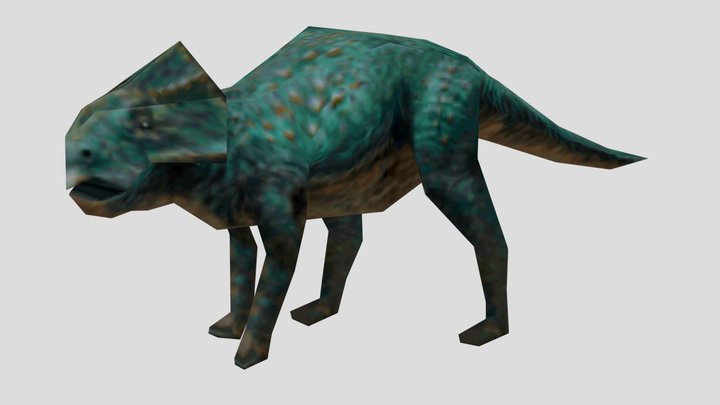
3D model
- Source
- Sketchfab
- Credit
- Ziggertron
- Licence
- CC Attribution
- Commercial use
- cannot be read from the licence given — check the record
Smithsonian Open Access and MorphoSource were not reached for this taxon, so this list is what the others held rather than everything there is.
The description on this site
- Licence
- CC BY-SA 4.0
This is what the site found, which is not the same as what exists.
Keep going
What may have been alongside itLeptoceratopsidae through timeFormations of the Late CretaceousThe world it lived on
Occurrence data from the Paleobiology Database, CC BY 4.0. Brown 1914