Goniophora
Goniophora is an extinct genus of clams. It lived during the Ordovician to Permian periods.

via iDigBio · CC0 · via iDigBio. May be a photograph of a specimen, or an artist’s reconstruction — an interpretation of a skeleton, since colour and soft tissue are almost never preserved.
On record
Recorded, not inferred- Sits inside
- ModiomorphinaePBDB
- Diet
- suspension feederPBDB
- Life habit
- semi-infaunalPBDB
- Motility
- stationaryPBDB
- Vision
- blindPBDB, for Bivalvia
- Environment
- marinePBDB, for Modiomorphidae
Time the record covers
At least 213 million years on record.
The record covers at least 473.8 Mya to 259.857 Mya. No occurrence read is dated outside 477.1 Mya to 251.902 Mya.
216 occurrences of Goniophora on record, most of them in the Devonian. Bar height is expected occurrences, not a count: each fossil is spread across the span it is dated to, so a tall narrow bar means tight dating and a low wide one means loose.
When
216 occurrences- Ordovician8%
- Silurian29%
- Devonian62%
- Carboniferousunder 1%
- Permianunder 1%
These are dates about fossils, not the animal: the record can only begin after it arose and end before it died out, so either end may reach further. Shares are expected occurrences: a fossil dated to a span is counted partly in each period it straddles. More on what this infers.
Found in
85 formations
- Glen Aubrey Formation · Sonyea Group16
- Overton Formation15
- Skaneateles Formation · Hamilton Group14
- Moscow Formation · Hamilton Group14
- Ludlowville Formation · Hamilton Group13
- Geneseo Formation · Genesee Group11
Loading coastlines…
The named rock units Goniophora has been recovered from, largest first. Drawn where the rock is now, not where it formed. 61 further formations hold fewer occurrences each and are not listed. 12 occurrences have no formation on record, which is common for older literature.
Goniophora and its relatives
DevonianWhere Goniophora and its relatives were recorded in the Devonian.
Found in the same rock
1,637 taxa- Crinoidea47 sites
- Nuculites44 sites
- Modiomorpha41 sites
- Camarotoechia40 sites
- Actinopteria38 sites
- Paracyclas38 sites
- Cypricardella37 sites
- Leptodesma (Leiopteria)34 sites
- Mucrospirifer mucronatus34 sites
- Palaeoneilo constricta33 sites
- Palaeoneilo32 sites
- Grammysia30 sites
- Bryozoa28 sites
- Tropidoleptus carinatus26 sites
- Eoschizodus25 sites
- Favosites25 sites
- Sphenotus25 sites
- Chonetes24 sites
- Tentaculites24 sites
- Lingula23 sites
- Ambocoelia22 sites
- Gastropoda22 sites
- Nuculoidea22 sites
- Productella22 sites
The Paleobiology Database records 191 sites for Goniophora, and this reads all of them. The number is how many of those sites it was catalogued from too. The 24 sharing the most are listed.
This is not a list of everything alive at the time. It is only what has come out of the same ground as this animal and been written down.
Entered from
79 references- Quantitative community analysis: Recurrent group and cluster techniques applied to the fauna of the Upper Devonian Sonyea Group, New York24
- Faunas from the Upper Silurian (Upper Ludlovian) in the Ludlow-Much Wenlock District, England15
- Silurian nuculoid and modiomorphid bivalves from Sweden13
- Redefinition, Stratigraphy and Depostional Environments of the Mottville Member (Hamilton Group) in Central and Eastern New York9
- Relative taxonomic and ecological stability in Devonian marine faunas of New York State: a test of coordinated stasis7
- Quantitative Analysis of Paleocommunities in the Lower Part of the Hamilton Group near Cazenovia, New York7
- Work with Thayer collections, Yale Peabody Accession 7112, published, in part, "New perspectives on transitions between ecological-evolutionary subunits in the "type interval" for coordinated stasis", James J Zambito IV, Carlton E Brett, Gordon C Baird, Sarah E Kolbe, Arnold I Miller; Paleobiology6
- Devonian sections in Guangxi from which pelecypods were collected6
- A new bivalve community from the lower Ludlow of the Prague Basin (Perunica, Bohemia)5
- Lower Devonian pelecypods from southeastern Australia5
- Stratigraphy and Paleontology of the Jaycox Shale Member, Hamilton Group of the Finger Lakes Region of New York State5
- Benthic community organization in the Ludlow Series of the Welsh Borderland5
Each of the 216 occurrences read was entered from one of these publications, ordered by how many each accounts for. This is not a search for papers mentioning the name. 67 further references are not listed. Entries link to doi.org where the Paleobiology Database holds an identifier, and to its own record where it does not. Relayed as the Paleobiology Database holds them, not checked against what they resolve to.
Media and terms
Media content2
Picture of Goniophora
- Source
- iDigBio
- Credit
- via iDigBio
- Licence
- CC0
- Commercial use
- the licence allows it
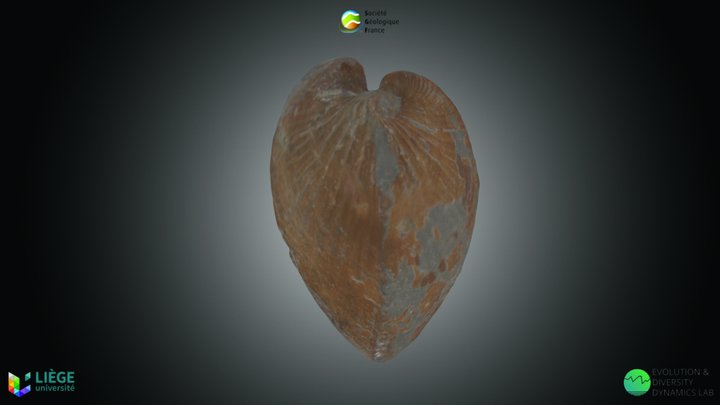
3D model
- Source
- Sketchfab
- Licence
- CC Attribution-NonCommercial-ShareAlike
- Commercial use
- the licence does not allow it
Smithsonian Open Access was not reached for this taxon, so this list is what the others held rather than everything there is.
The description on this site
- Source
- Wikipedia, “Goniophora”
- Licence
- CC BY-SA 4.0
This is what the site found, which is not the same as what exists.
Keep going
What may have been alongside itModiomorphinae through timeFormations of the DevonianThe world it lived on
Occurrence data from the Paleobiology Database, CC BY 4.0. (Phillips 1848)