Gigantopecten
Gigantopecten is a genus of fossil scallops, marine bivalve molluscs in the family Pectinidae, the scallops.

Hectonichus · CC BY-SA 3.0 · via Wikipedia/Commons. May be a photograph of a specimen, or an artist’s reconstruction — an interpretation of a skeleton, since colour and soft tissue are almost never preserved.
On record
Recorded, not inferred- Sits inside
- PectinidaePBDB
- Diet
- suspension feederPBDB, for Pectinidae
- Life habit
- low-level epifaunalPBDB, for Pectinidae
- Motility
- facultatively mobilePBDB, for Pectinidae
- Vision
- limitedPBDB, for Pectinidae
- Environment
- marinePBDB, for Pectinida
Time the record covers
At least 23 million years on record.
The record covers at least 27.3 Mya to 3.6 Mya. No occurrence read is dated outside 33.9 Mya to 2.58 Mya.
24 occurrences of Gigantopecten on record, most of them in the Miocene. Bar height is expected occurrences, not a count: each fossil is spread across the span it is dated to, so a tall narrow bar means tight dating and a low wide one means loose.
When
24 occurrencesThese are dates about fossils, not the animal: the record can only begin after it arose and end before it died out, so either end may reach further. Shares are expected occurrences: a fossil dated to a span is counted partly in each period it straddles. More on what this infers.
Found in
6 formations
- Qom Formation3
- Partimao Formation2
- Niechobrz Formation1
- Slama Formation1
- Sables des Landes Formation1
- Guadaíra Formation1
Loading coastlines…
The named rock units Gigantopecten has been recovered from, largest first. Drawn where the rock is now, not where it formed. 15 occurrences have no formation on record, which is common for older literature.
Gigantopecten and its relatives
MioceneWhere Gigantopecten and its relatives were recorded in the Miocene.
Found in the same rock
452 taxa- Cardita4 sites
- Chlamys4 sites
- Pecten4 sites
- Acar3 sites
- Barbatia (Barbatia) barbata3 sites
- Chlamys scabrellus3 sites
- Conus3 sites
- Flabellipecten3 sites
- Glycymeris3 sites
- Lima lima3 sites
- Lithophaga lithophaga3 sites
- Modiolus3 sites
- Spondylus crassicosta3 sites
- Turritella3 sites
- Aequipecten2 sites
- Aequipecten macrotis2 sites
- Ammonia2 sites
- Anadara2 sites
- Arbacina2 sites
- Arca noae2 sites
- Callista2 sites
- Carcharodon hastalis2 sites
- Cardium2 sites
- Cerithiopsis2 sites
The Paleobiology Database records 9 sites for Gigantopecten, and this reads all of them. The number is how many of those sites it was catalogued from too. The 24 sharing the most are listed.
This is not a list of everything alive at the time. It is only what has come out of the same ground as this animal and been written down.
Entered from
16 references- Ecospace variability along a carbonate platform at the northern boundary of the Miocene reef belt (Upper Langhian, Austria)5
- The Oligo/Miocene Qom Formation (Iran): evidence for an early Burdigalian restriction of the Tethyan Seaway and closure of its Iranian gateways3
- Paleoenvironment and taphonomy of lower Miocene bivalve and macroid assemblages: the Lagos Biocalcarenite (Lagos‑Portimão Formation, southern Portugal)2
- Etude paléontologique de Pecten subbenedictus Font. et ses variations dans le Burdigalien de Manosque (Alpes-de-Haute-Provence)2
- Late Miocene Cymodocea seagrass in the Guadalquivir Basin (southern Spain)1
- Les poissons cartilagineux (chondrichtyens) du Serravallien de la vallée de l'Eyre (Gironde, France) (1/2)1
- Palaeoecology, taphonomy, and preservation of a lower Pliocene shell bed (coquina) froma volcanic oceanic island (Santa Maria Island, Azores)1
- Biodiversity and taphonomy of bivalve assemblages of the Pliocene of Algeria (Bas Chelif Basin)1
- Devínska Kobyla- a window into the Middle Miocene shallow-water marine environments of the Central Paratethys (Vienna Basin, Slovakia)1
- A Middle Miocene carbonate platform under silici-volcaniclastic sedimentation stress (Leitha Limestone, Styrian Basin, Austria) — Depositional environments, sedimentary evolution and palaeoecology1
- Bivalves from the Middle Miocene reefs of Poland and Ukraine: A new approach to Badenian/Sarmatian boundary in the Paratethys1
- A new basal balaenopterid whale from the Pliocene of northern Italy1
Each of the 24 occurrences read was entered from one of these publications, ordered by how many each accounts for. This is not a search for papers mentioning the name. 4 further references are not listed. Entries link to doi.org where the Paleobiology Database holds an identifier, and to its own record where it does not. Relayed as the Paleobiology Database holds them, not checked against what they resolve to.
Media and terms
Media content2

Picture of Gigantopecten
- Source
- Wikipedia/Commons
- Credit
- Hectonichus
- Licence
- CC BY-SA 3.0
- Commercial use
- the licence allows it
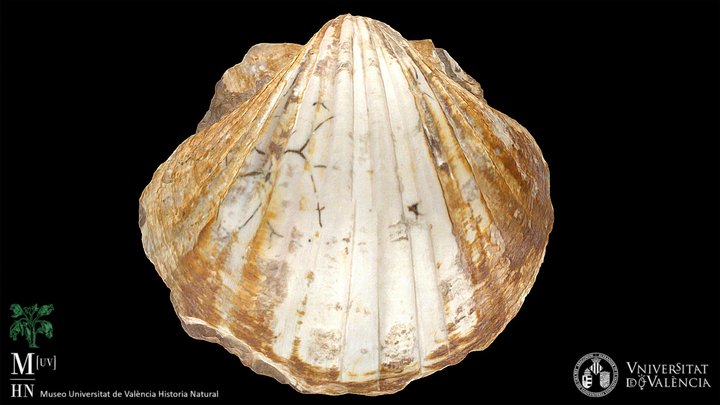
3D model
- Source
- Sketchfab
- Licence
- CC Attribution
- Commercial use
- cannot be read from the licence given — check the record
Smithsonian Open Access and MorphoSource were not reached for this taxon, so this list is what the others held rather than everything there is.
The description on this site
- Licence
- CC BY-SA 4.0
This is what the site found, which is not the same as what exists.
Keep going
What may have been alongside itPectinidae through timeFormations of the MioceneThe world it lived on
Occurrence data from the Paleobiology Database, CC BY 4.0.