Erotylidae
Erotylidae, or the pleasing fungus beetles, is a family of small beetles. At most some 2 cm long, some species of Erotylidae are as small as 2 mm. They belong to superfamily Cucujoidea and contain hundreds of genera, with much more than 3.000 described species, and new ones being discovered even today. The family name, like the common name referring to their often colorful, shiny and rounded "cute" appearance, means "darling" or "beloved" ; they were historically popular with insect collectors.

H.S. Gorham (text) · Public Domain · via Wikipedia/Commons. May be a photograph of a specimen, or an artist’s reconstruction — an interpretation of a skeleton, since colour and soft tissue are almost never preserved.
On record
Recorded, not inferred- Also called
- pleasing fungus beetlePBDB
- Sits inside
- ErotyloideaPBDB
- Motility
- actively mobilePBDB, for Arthropoda
- Environment
- terrestrialPBDB, for Insecta
Time the record covers
At least 116 million years on record.
The record covers at least 119.57 Mya to 2.58 Mya. No occurrence read is dated outside 121.4 Mya to 1.8 Mya.
32 occurrences of Erotylidae on record, most of them in the Eocene. The Paleobiology Database records this as a living group, and the chart stops with its fossils rather than at the present. Bar height is expected occurrences, not a count: each fossil is spread across the span it is dated to, so a tall narrow bar means tight dating and a low wide one means loose.
When
32 occurrences- Early Cretaceous6%
- Eocene72%
- Miocene16%
- Pliocene3%
- Pleistocene3%
These are dates about fossils, not the animal: the record can only begin after it arose and end before it died out, so either end may reach further. Shares are expected occurrences: a fossil dated to a span is counted partly in each period it straddles. More on what this infers.
Found in
5 formations
- Florissant Formation4
- Tranquille Formation · Kamloops Group1
- Green River Formation1
- Turga Formation1
- Bouldnor Formation · Solent Group1
Loading coastlines…
The named rock units Erotylidae has been recovered from, largest first. Drawn where the rock is now, not where it formed. 24 occurrences have no formation on record, which is common for older literature.
Erotylidae and its relatives
EoceneWhere Erotylidae and its relatives were recorded in the Eocene.
Found in the same rock
2,179 taxa- Staphylinidae5 sites
- Coleoptera4 sites
- Curculionidae4 sites
- Dasyhelea4 sites
- Forcipomyia4 sites
- Formicidae4 sites
- Araneae3 sites
- Brachypogon (Isohelea)3 sites
- Culicoides (Oecacta)3 sites
- Forcipomyia (Forcipomyia)3 sites
- Scarabaeoidea3 sites
- Stilobezzia3 sites
- Abdera (Abdera) hoffeinsorum2 sites
- Aeshnidae2 sites
- Aphididae2 sites
- Archaeocercoides puchkovi2 sites
- Atomaria (Atomaria) saxonica2 sites
- Balticoroma serafinorum2 sites
- Bezzia eocenica2 sites
- Boreallodape baltica2 sites
- Borinquena parva2 sites
- Brachypogon (Isohelea) prominulus2 sites
- Braconidae2 sites
- Ceratonotha mumia2 sites
The Paleobiology Database records 21 sites for Erotylidae, and this reads all of them. The number is how many of those sites it was catalogued from too. The 24 sharing the most are listed.
This is not a list of everything alive at the time. It is only what has come out of the same ground as this animal and been written down.
Entered from
27 references- First fossil representatives of Pharaxonothinae Crowson (Coleoptera: Erotylidae): indirect evidence for cycads existence in Baltic amber forest3
- The genus Dacne Latreille (Coleoptera: Erotylidae) in tropical America2
- A new species of Dacne Latreille from Dominican amber, with a key and checklist to the known species of Dacne (Erotylidae: Dacninae)2
- A report on some recent collections of fossil Coleoptera from the Miocene shales of Florissant2
- Thallisellites augustinusii sp. nov. (Coleoptera: Erotylidae: Languriinae) from Priabonian Baltic amber1
- Unexpected diversity of Xenoscelinae in Priabonian European amber: the third xenosceline species from Rovno amber1
- A new extinct species of Zavaljus Reitter (Coleoptera: Erotylidae) from Rovno amber: boreal distribution range since the Eocene1
- A new genus of the subfamily Languriinae (Coleoptera: Erotylidae) from the late Eocene Baltic amber1
- A new species of Notaepytus Skelley, 2009 (Coleoptera: Erotylidae: Tritomini) from Dominican amber1
- The beetle (Coleoptera) fauna of the Insect Limestone (late Eocene), Isle of Wight, southern England1
- Microzavaljus, a second extinct genus of pleasing fungus beetles (Coleoptera: Erotylidae) from Bitterfeld Amber1
- Serramorphus, a new genus of Erotylidae from Eocene amber (Coleoptera: Clavicornia) from late Eocene Bitterfeldian amber1
Each of the 32 occurrences read was entered from one of these publications, ordered by how many each accounts for. This is not a search for papers mentioning the name. 15 further references are not listed. Entries link to doi.org where the Paleobiology Database holds an identifier, and to its own record where it does not. Relayed as the Paleobiology Database holds them, not checked against what they resolve to.
Media and terms
Media content2

Picture of Erotylidae
- Source
- Wikipedia/Commons
- Credit
- H.S. Gorham (text)
- Licence
- Public Domain
- Commercial use
- the licence allows it
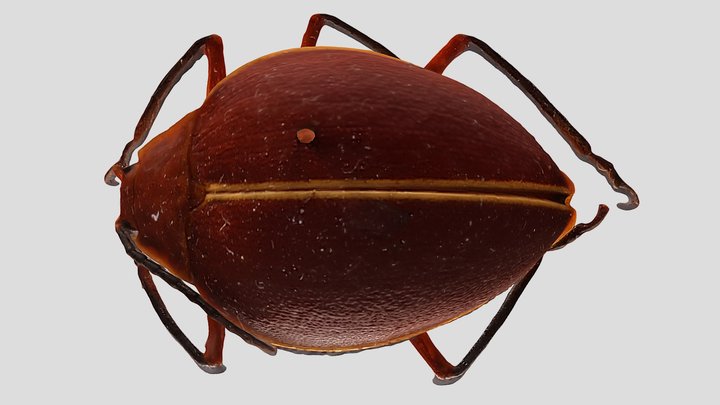
3D model
- Source
- Sketchfab
- Credit
- Yale Peabody Museum
- Licence
- CC Attribution
- Commercial use
- cannot be read from the licence given — check the record
Smithsonian Open Access was not reached for this taxon, so this list is what the others held rather than everything there is.
The description on this site
- Source
- Wikipedia, “Erotylidae”
- Licence
- CC BY-SA 4.0
This is what the site found, which is not the same as what exists.
Keep going
What may have been alongside itErotyloidea through timeFormations of the EoceneThe world it lived on
Occurrence data from the Paleobiology Database, CC BY 4.0. Latreille 1802