Erinaceinae
A hedgehog is a spiny mammal of the subfamily Erinaceinae, in the eulipotyphlan family Erinaceidae. There are 17 species of hedgehog in five genera found throughout parts of Europe, Asia, and Africa, and in New Zealand by introduction. There are no hedgehogs native to Australia and no living species native to the Americas. However, the extinct genus Amphechinus was once present in North America.

Gibe · CC BY-SA 3.0 · via Wikipedia/Commons. May be a photograph of a specimen, or an artist’s reconstruction — an interpretation of a skeleton, since colour and soft tissue are almost never preserved.
On record
Recorded, not inferred- Sits inside
- ErinaceidaePBDB
- Diet
- insectivore, carnivorePBDB, for Erinaceidae
- Life habit
- semifossorialPBDB, for Erinaceidae
- Motility
- actively mobilePBDB, for Osteichthyes
- Environment
- terrestrialPBDB, for Eutheria
Time the record covers
At least 33 million years on record.
The record covers at least 33.9 Mya to 11.7 ka. No occurrence read is dated outside 37.71 Mya to 0 Mya.
309 occurrences of Erinaceinae on record, most of them in the Miocene. The Paleobiology Database records this as a living group. Bar height is expected occurrences, not a count: each fossil is spread across the span it is dated to, so a tall narrow bar means tight dating and a low wide one means loose.
When
309 occurrencesThese are dates about fossils, not the animal: the record can only begin after it arose and end before it died out, so either end may reach further. Shares are expected occurrences: a fossil dated to a span is counted partly in each period it straddles. More on what this infers.
Found in
59 formations
- Hsanda Gol Formation18
- Valentine Formation · Ogallala Group16
- Loh Formation16
- Aral Formation9
- Xianshuihe Formation8
- Renova Formation5
Loading coastlines…
The named rock units Erinaceinae has been recovered from, largest first. Drawn where the rock is now, not where it formed. 35 further formations hold fewer occurrences each and are not listed. 154 occurrences have no formation on record, which is common for older literature.
Erinaceinae and its relatives
MioceneWhere Erinaceinae and its relatives were recorded in the Miocene.
Found in the same rock
2,941 taxa- Erinaceus57 sites
- Mimomys33 sites
- Amphechinus32 sites
- Lepus31 sites
- Parvericius montanus31 sites
- Beremendia fissidens28 sites
- Allocricetus26 sites
- Chiroptera26 sites
- Microtus26 sites
- Myodes26 sites
- Sinolagomys kansuensis26 sites
- Apodemus sylvaticus25 sites
- Aves25 sites
- Equus25 sites
- Soricidae24 sites
- Pliomys23 sites
- Rana23 sites
- Sorex23 sites
- Myotis22 sites
- Sorex minutus22 sites
- Bohlinosminthus parvulus21 sites
- Apodemus20 sites
- Crocidura20 sites
- Untermannerix copiosus20 sites
The Paleobiology Database records 252 sites for Erinaceinae, and this reads 240 of them. The number is how many of those sites it was catalogued from too. The 24 sharing the most are listed.
This is not a list of everything alive at the time. It is only what has come out of the same ground as this animal and been written down.
Entered from
141 references- Oligocene stratigraphy across the Eocene and Miocene boundaries in the Valley of Lakes (Mongolia)39
- Vertebrate biostratigraphy of the Ogallala Group in Nebraska22
- Erinaceidae and Dimylidae (Lipotyphla) from the Upper Middle Miocene of South Germany12
- Pleistocene vertebrate faunas of Hungary12
- Origin and History of the Erinaceinae and Brachyericinae (Mammalia, Insectivora) in North America12
- Micromammal fossils from red mudstone of Lower Member of Xianshuihe Formation in Lanzhou Basin, China8
- Mittelpleistozane Saugetierfaunen aus Mitteleuropa - der Versuch einer biostratigraphischen Zuordnung8
- The Pliocene and Pleistocene Insectivores (Mammalia) of Poland I. Erinaceidae and Desmaninae6
- Biostratigraphy and biochronology of early Arikareean through late Hemingfordian small mammal faunas from the Nebraska Panhandle and adjacent areas5
- Oligocene and Early Miocene Insectivores (Mammalia) from Western Kazakhstan5
- Fossil small mammals from the Harrison Formation (late Arikareean: earliest Miocene), Cherry County, Nebraska5
- Didelphidae, Erinaceidae, Metacodontidae und Dimylidae (Mammalia) aus dem Oberoligozän und Untermiozän Süddeutschlands5
Each of the 309 occurrences read was entered from one of these publications, ordered by how many each accounts for. This is not a search for papers mentioning the name. 129 further references are not listed. Entries link to doi.org where the Paleobiology Database holds an identifier, and to its own record where it does not. Relayed as the Paleobiology Database holds them, not checked against what they resolve to.
Media and terms
Media content2
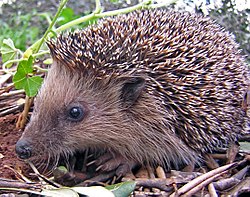
Picture of Erinaceinae
- Source
- Wikipedia/Commons
- Credit
- Gibe
- Licence
- CC BY-SA 3.0
- Commercial use
- the licence allows it
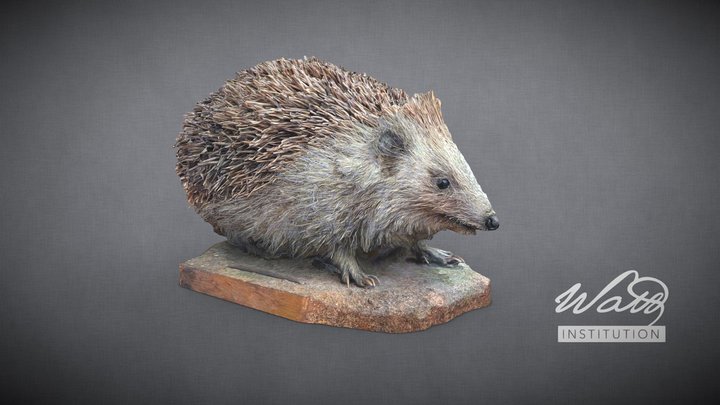
3D model
- Source
- Sketchfab
- Credit
- The Watt Institution
- Licence
- CC Attribution
- Commercial use
- cannot be read from the licence given — check the record
The description on this site
- Source
- Wikipedia, “Hedgehog”
- Licence
- CC BY-SA 4.0
This is what the site found, which is not the same as what exists.
Keep going
What may have been alongside itErinaceidae through timeFormations of the MioceneThe world it lived on
Occurrence data from the Paleobiology Database, CC BY 4.0. Fischer de Waldheim 1817