Eoradiolites
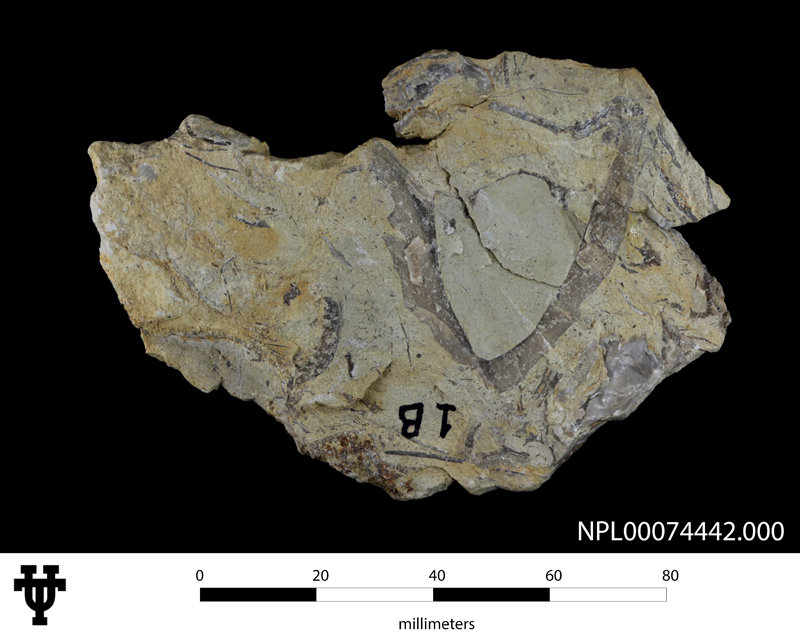
Scott, Robert · CC0 · via GBIF. May be a photograph of a specimen, or an artist’s reconstruction — an interpretation of a skeleton, since colour and soft tissue are almost never preserved.
On record
Recorded, not inferred- Sits inside
- RadiolitidaePBDB
- Diet
- suspension feederPBDB, for Hippuritida
- Life habit
- intermediate-level epifaunal, gregariousPBDB, for Hippuritida
- Motility
- stationary, attachedPBDB, for Hippuritida
- Vision
- blindPBDB, for Bivalvia
- Environment
- marinePBDB, for Hippuritida
Time the record covers
At least 41 million years on record.
The record covers at least 113.2 Mya to 72.2 Mya. No occurrence read is dated outside 121.4 Mya to 66 Mya.
108 occurrences of Eoradiolites on record, most of them in the Late Cretaceous. Bar height is expected occurrences, not a count: each fossil is spread across the span it is dated to, so a tall narrow bar means tight dating and a low wide one means loose.
When
108 occurrencesThese are dates about fossils, not the animal: the record can only begin after it arose and end before it died out, so either end may reach further. Shares are expected occurrences: a fossil dated to a span is counted partly in each period it straddles. More on what this infers.
Found in
18 formations
- Halal Formation15
- Rizan Aneiza Formation7
- Galala Formation6
- Al Hassanat Formation4
- Zirc Limestone Formation4
- El Abra Formation3
Loading coastlines…
The named rock units Eoradiolites has been recovered from, largest first. Drawn where the rock is now, not where it formed. 52 occurrences have no formation on record, which is common for older literature.
Eoradiolites and its relatives
Late CretaceousWhere Eoradiolites and its relatives were recorded in the Late Cretaceous.
Found in the same rock
315 taxa- Orbitolina10 sites
- Toucasia10 sites
- Chondrodonta9 sites
- Horiopleura7 sites
- Icthyosarcolites7 sites
- Agriopleura6 sites
- Polyconites6 sites
- Cuneolina5 sites
- Harpagodes nodosus5 sites
- Requienia5 sites
- Pchelinsevia4 sites
- Praeradiolites4 sites
- Pseudotoucasia4 sites
- Sellaea4 sites
- Ampullina3 sites
- Apricardia3 sites
- Bivalvia3 sites
- Bryozoa3 sites
- Gastropoda3 sites
- Nerinella3 sites
- Radiolites3 sites
- Texicaprina3 sites
- Aporrhais2 sites
- Bacinella2 sites
The Paleobiology Database records 47 sites for Eoradiolites, and this reads all of them. The number is how many of those sites it was catalogued from too. The 24 sharing the most are listed.
This is not a list of everything alive at the time. It is only what has come out of the same ground as this animal and been written down.
Entered from
40 references- Development of rudist lithosomes in the Coniacian-Lower Campanian carbonate shelves of central-southern Italy: high-energy vs low-energy settings22
- Chemostratigraphy of the Cenomanian-Turonian shallow-water carbonate: new correlation for the rudist levels from north Sinai, Egypt6
- Upper Aptian-Albian rudist bivalves from northern Sinai, Egypt6
- Sequence Stratigraphy and Rudist Facies Development of the Upper Barremian-Lower Cenomanian Platform, Northern Sinai, Egypt5
- Rudist facies distribution in the late Cretaceous of Cilento and western Basilicata (southern Italy)5
- Taxonomy and palaeoecology of the Cenomanian-Turonian macroinvertebrates from eastern Sinai, Egypt (part A)5
- Carbon and oxygen stable isotopes of selected Cenomanian and Turonian rudists from Egypt and Czech Republic, and a note on changes in rudist diversity4
- Lower Cretaceous Rudist faunas of Southeast Spain: an overview4
- Stratigraphy and tectonosedimentary evolution of a late Aptian-Albian carbonate margin: the northeastern Jebel Akhdar (Sultanate of Oman)4
- Die paläoökologische, biostratigraphische und paläogeographische Auswertung der Mollusken-Fauna der Zirc-Kalk-Formation [Paleoecological, biostratigraphic and paleogeographic analysis of the mollusc fauna of the Zirc Limestone Formation]4
- Cenomanian–Turonian rudist (bivalvia) lithosomes from NW of Jordan3
- Late Cretaceous macrofossils from Sinai, Egypt3
Each of the 108 occurrences read was entered from one of these publications, ordered by how many each accounts for. This is not a search for papers mentioning the name. 28 further references are not listed. Entries link to doi.org where the Paleobiology Database holds an identifier, and to its own record where it does not. Relayed as the Paleobiology Database holds them, not checked against what they resolve to.
Media and terms
Media content1
Picture of Eoradiolites
- Source
- GBIF
- Credit
- Scott, Robert
- Licence
- CC0
- Commercial use
- the licence allows it
No 3D scan was found. Smithsonian Open Access, MorphoSource and Sketchfab were all searched.
This is what the site found, which is not the same as what exists.
Keep going
What may have been alongside itRadiolitidae through timeFormations of the Late CretaceousThe world it lived on
Occurrence data from the Paleobiology Database, CC BY 4.0. Douvillé 1909