Cuneolina
Cuneolina is an extinct genus of prehistoric foraminifera in the family Cuneolinidae with species from the Jurassic and Cretaceous.Name brought to synonymyCuneolina angusta Cushman, 1919, a synonym for Textulariella angusta

Unknown author Unknown author · Public Domain · via Wikipedia/Commons. May be a photograph of a specimen, or an artist’s reconstruction — an interpretation of a skeleton, since colour and soft tissue are almost never preserved.
On record
Recorded, not inferred- Sits inside
- CuneolininaePBDB
- Diet
- detritivorePBDB, for Textulariina
- Life habit
- infaunalPBDB, for Textulariina
- Motility
- stationaryPBDB, for Foraminifera
Time the record covers
At least 70 million years on record.
The record covers at least 143.1 Mya to 72.2 Mya. No occurrence read is dated outside 161.5 Mya to 56 Mya.
177 occurrences of Cuneolina on record, most of them in the Late Cretaceous. Bar height is expected occurrences, not a count: each fossil is spread across the span it is dated to, so a tall narrow bar means tight dating and a low wide one means loose.
When
177 occurrences- Late Jurassic1%
- Early Cretaceous24%
- Late Cretaceous75%
- Paleoceneunder 1%
These are dates about fossils, not the animal: the record can only begin after it arose and end before it died out, so either end may reach further. Shares are expected occurrences: a fossil dated to a span is counted partly in each period it straddles. More on what this infers.
Found in
20 formations
- Polat Formation · Geyik Dagi Unit Group22
- Trieste Karst Limestone Formation5
- Langshan Formation4
- Calcaires à Rudistes de Praia dos Coxos Formation3
- Al Hassanat Formation2
- Abu Roash Formation2
Loading coastlines…
The named rock units Cuneolina has been recovered from, largest first. Drawn where the rock is now, not where it formed. 125 occurrences have no formation on record, which is common for older literature.
Cuneolina and its relatives
Late CretaceousWhere Cuneolina and its relatives were recorded in the Late Cretaceous.
Found in the same rock
503 taxa- Miliolidae10 sites
- Pseudocyclammina8 sites
- Radiolites8 sites
- Orbitolina7 sites
- Dicyclina schlumbergeri6 sites
- Nezzazata6 sites
- Ophthalmidiidae6 sites
- Textulariidae6 sites
- Acicularia5 sites
- Dictyopsella5 sites
- Hippurites5 sites
- Thaumatoporella parvovesiculifera5 sites
- Vaccinites5 sites
- Vidalina5 sites
- Ammobaculites4 sites
- Biconcava4 sites
- Biplanata4 sites
- Echinoidea4 sites
- Haplophragmoides4 sites
- Lenticulina4 sites
- Moncharmontia4 sites
- Naticidae4 sites
- Nautiloculina4 sites
- Polystrata alba4 sites
The Paleobiology Database records 41 sites for Cuneolina, and this reads all of them. The number is how many of those sites it was catalogued from too. The 24 sharing the most are listed.
This is not a list of everything alive at the time. It is only what has come out of the same ground as this animal and been written down.
Entered from
44 references- Late Maastrichtian Rudists and microfossils in the Karst Region (NE Italy and Slovenia)33
- Development of rudist lithosomes in the Coniacian-Lower Campanian carbonate shelves of central-southern Italy: high-energy vs low-energy settings22
- Taxonomic and Paelogeographic Approaches to the Dasyclad Algae in the Upper Jurassic (Kimmeridgian)-Upper Cretaceous (Cenomanian) Peritidal Carbonates of the Fele (YassÝbel) Area (Western Taurides, Turkey)22
- Upper Cretaceous rudist biostratigraphy of the Bey Daglari Carbonate Platform, Western Taurides, SW Turkey19
- Cenomanian Rudist-dominated shelf-margin limestones from the Panormide Carbonate Platform (Sicily, Italy): facies analysis and sequence stratigraphy8
- The Coniacian–Campanian Latium–Abruzzi carbonate platform,an example of a facies mosaic6
- Recherches géologiques sur le Crétacé inférieur de l'Estremadura (Portugal)6
- The development of the mollusc fauna in the Cenomanian of the stratigraphie sequence of Visogliano (Karst of Trieste, Italy)5
- Palaeontology of the 1985 Geotraverse, Lhasa to Golmud4
- La faune à rudistes, porifères et scléractiniaires du Crétacé superieur du mont Ptoon (Béotie septentrionale, Grèce continentale) [The fauna with rudists, porifers and corals of upper Cretaceous of mount Ptoon (Northern Beotia, central Greece)]3
- The Cenomanian (Late Cretaceous) Konservat-Lagerstätte of en Nammoûra (Kesrouâne Province), northern Lebanon3
- Calcareous Algae from Cretaceous Carbonates of Egypt, Sinai, and Southern Jordan3
Each of the 177 occurrences read was entered from one of these publications, ordered by how many each accounts for. This is not a search for papers mentioning the name. 32 further references are not listed. Entries link to doi.org where the Paleobiology Database holds an identifier, and to its own record where it does not. Relayed as the Paleobiology Database holds them, not checked against what they resolve to.
Media and terms
Media content1
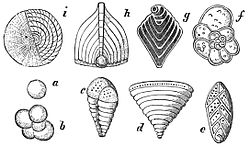
Picture of Cuneolina
- Source
- Wikipedia/Commons
- Credit
- Unknown author Unknown author
- Licence
- Public Domain
- Commercial use
- the licence allows it
No 3D scan of Cuneolina was found in Sketchfab.
Smithsonian Open Access and MorphoSource were not reached for this taxon, so this list is what the others held rather than everything there is.
The description on this site
- Source
- Wikipedia, “Cuneolina”
- Licence
- CC BY-SA 4.0
This is what the site found, which is not the same as what exists.
Keep going
What may have been alongside itCuneolininae through timeFormations of the Late CretaceousThe world it lived on
Occurrence data from the Paleobiology Database, CC BY 4.0.