Elmidae
Elmidae, commonly known as riffle beetles, is a family of beetles in the superfamily Byrrhoidea described by John Curtis in 1830. Both adults and larvae are usually aquatic, living under rocks in fast-flowing shallow areas of streams, such as riffles, feeding on algae and biofilms. There are more than 150 genera and 1,500 described species in Elmidae. The oldest record of the group is Cretohypsilara from the Cenomanian aged Burmese amber.

Hendrik Freitag · CC BY 3.0 · via Wikipedia/Commons. May be a photograph of a specimen, or an artist’s reconstruction — an interpretation of a skeleton, since colour and soft tissue are almost never preserved.
On record
Recorded, not inferred- Also called
- riffle beetlePBDB
- Sits inside
- DryopoideaPBDB
- Motility
- actively mobilePBDB, for Arthropoda
- Environment
- terrestrialPBDB, for Insecta
Time the record covers
At least 93 million years on record.
The record covers at least 93.9 Mya to 129 ka. No occurrence read is dated outside 100.5 Mya to 11.7 ka.
102 occurrences of Elmidae on record, most of them in the Pleistocene. The Paleobiology Database records this as a living group. Bar height is expected occurrences, not a count: each fossil is spread across the span it is dated to, so a tall narrow bar means tight dating and a low wide one means loose.
When
102 occurrences- Late Cretaceousunder 1%
- Eocene3%
- Oligoceneunder 1%
- Pleistocene95%
These are dates about fossils, not the animal: the record can only begin after it arose and end before it died out, so either end may reach further. Shares are expected occurrences: a fossil dated to a span is counted partly in each period it straddles. More on what this infers.
Found in
5 formations
- Highbury Silts and Sands Formation60
- Olympia beds Formation3
- Rott Formation1
- Yoshino Formation1
- Palana Formation1
Loading coastlines…
The named rock units Elmidae has been recovered from, largest first. Drawn where the rock is now, not where it formed. 36 occurrences have no formation on record, which is common for older literature.
Elmidae and its relatives
PleistoceneWhere Elmidae and its relatives were recorded in the Pleistocene.
Found in the same rock
2,011 taxa- Aphodius18 sites
- Hydraena18 sites
- Oulimnius troglodytes18 sites
- Stenus18 sites
- Oulimnius tuberculatus16 sites
- Limnius volckmari13 sites
- Rhynchaenus quercus13 sites
- Anotylus rugosus12 sites
- Adelocera murina11 sites
- Esolus parallelepipedus11 sites
- Aleocharinae10 sites
- Bryaxis10 sites
- Dyschiriodes globosus10 sites
- Gyrinus10 sites
- Helophorus10 sites
- Dascillus cervinus9 sites
- Elmis aenea9 sites
- Helodidae9 sites
- Ochthebius minimus9 sites
- Riolus nitens9 sites
- Bagous8 sites
- Bembidion (Diplocampa) assimile8 sites
- Carpelimus8 sites
- Donacia cinerea8 sites
The Paleobiology Database records 32 sites for Elmidae, and this reads all of them. The number is how many of those sites it was catalogued from too. The 24 sharing the most are listed.
This is not a list of everything alive at the time. It is only what has come out of the same ground as this animal and been written down.
Entered from
10 references- Marine Isotope Stage 9 environments of fluvial deposits at Hackney, north London, UK60
- Middle Pleistocene deposits at Frog Hall Pit, Stretton-on-Dunsmore, Warwickshire, English Midlands, and their implications for the age of the type Wolstonian31
- The paleoenvironment of the Olympia beds based on fossil beetles from Discovery Park, Seattle, Washington, U.S.A.3
- Late Devensian river deposits beneath the floodplain terrace of the River Thames at Abingdon, Berkshire, England2
- Discovery of the oldest known elmid larva (Coleoptera, Elmidae) from the Lower Eocene of Rajasthan (India, Palana Formation)1
- A new riffle beetle in Upper Cretaceous amber from northern Myanmar (Coleoptera: Elmidae)1
- The riffle beetles (Coleoptera: Elmidae) of the Eocene Baltic amber: Heterelmis groehni sp. nov. and Heterlimnius samlandicus (Bollow, 1940) comb. nov1
- Middle Pleistocene fossil insects from the Yoshino Formation of Kawachimachi, Kumamoto City, Kyushu, Japan1
- Die erste Helminide (Col. Dryop.) aus Bernstein1
- Geradflügler und Wasserkäfer der oligocänen Ablagerungen von Rott1
Each of the 102 occurrences read was entered from one of these publications, ordered by how many each accounts for. This is not a search for papers mentioning the name. Entries link to doi.org where the Paleobiology Database holds an identifier, and to its own record where it does not. Relayed as the Paleobiology Database holds them, not checked against what they resolve to.
Media and terms
Media content1
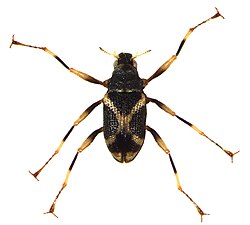
Picture of Elmidae
- Source
- Wikipedia/Commons
- Credit
- Hendrik Freitag
- Licence
- CC BY 3.0
- Commercial use
- the licence allows it
No 3D scan of Elmidae was found in Sketchfab.
Smithsonian Open Access and MorphoSource were not reached for this taxon, so this list is what the others held rather than everything there is.
The description on this site
- Source
- Wikipedia, “Elmidae”
- Licence
- CC BY-SA 4.0
This is what the site found, which is not the same as what exists.
Keep going
What may have been alongside itDryopoidea through timeFormations of the PleistoceneThe world it lived on
Occurrence data from the Paleobiology Database, CC BY 4.0. Curtis 1830