Eidolon helvum
The straw-coloured fruit bat is a large fruit bat that is the most widely distributed of all the African megabats. It is quite common throughout its area ranging from the southwestern Arabian Peninsula, across forest and savanna zones of sub-Saharan Africa. It is listed as Near Threatened on the IUCN Red List due to a decreasing population trend. Straw-coloured fruit bats travel in massive colonies of at least 100,000 bats and sometimes massing up to 1 million. From October to end of December every year, in the largest migration of mammals on the planet, up to 10 million straw-coloured fruit bats congregate in Kasanka National Park, Zambia, roosting in a 2 hectares area of Mushitu forest each day. This migration was only discovered in 1980. Their necks and backs are a yellowish-brown colour, while their undersides are tawny olive or brownish.

Fritz Geller-Grimm · CC BY-SA 2.5 · via Wikipedia/Commons. May be a photograph of a specimen, or an artist’s reconstruction — an interpretation of a skeleton, since colour and soft tissue are almost never preserved.
On record
Recorded, not inferred- Sits inside
- EidolonPBDB
- Diet
- herbivore, insectivorePBDB, for Pteropodidae
- Life habit
- volantPBDB, for Chiroptera
- Motility
- actively mobilePBDB, for Osteichthyes
- Environment
- terrestrialPBDB, for Chiroptera
Time the record covers
At most 1.1 million years on record.
The one occurrence read is dated to somewhere between 3.6 Mya and 2.58 Mya, which is a dating window rather than a span.
1 occurrence of Eidolon helvum on record, most of them in the Pliocene. The Paleobiology Database records this as a living group, and the chart stops with its fossils rather than at the present. Bar height is expected occurrences, not a count: each fossil is spread across the span it is dated to, so a tall narrow bar means tight dating and a low wide one means loose.
When
1 occurrences- Pliocene100%
These are dates about fossils, not the animal: the record can only begin after it arose and end before it died out, so either end may reach further. Shares are expected occurrences: a fossil dated to a span is counted partly in each period it straddles. More on what this infers.
Found in
1 formation
- Shungura Formation · Omo Group1
Loading coastlines…
The named rock units Eidolon helvum has been recovered from, largest first. Drawn where the rock is now, not where it formed.
Eidolon helvum and its relatives
PlioceneWhere Eidolon helvum and its relatives were recorded in the Pliocene.
Found in the same rock
37 taxa- Amphibia1 site
- Arvicanthis1 site
- Australopithecus1 site
- Barbus1 site
- Barilius sp.1 site
- Cichlidae1 site
- Clarias1 site
- Crocidura1 site
- Cyprinidae1 site
- Epimys (Mastomys)1 site
- Galago1 site
- Galagoides1 site
- Golunda gurai1 site
- Gymnarchus1 site
- Helogale1 site
- Hipposideros1 site
- Hominidae1 site
- Hydrocynus1 site
- Hyperopsius sp.1 site
- Lemniscomys1 site
- Muridae1 site
- Mus1 site
- Myosorex1 site
- Osteichthyes1 site
The Paleobiology Database records 1 site for Eidolon helvum, and this reads all of them. The number is how many of those sites it was catalogued from too. The 24 sharing the most are listed.
This is not a list of everything alive at the time. It is only what has come out of the same ground as this animal and been written down.
Entered from
1 referenceEach of the 1 occurrence read was entered from one of these publications, ordered by how many each accounts for. This is not a search for papers mentioning the name. Each entry links to the Paleobiology Database's own record for the work.
Media and terms
Media content2
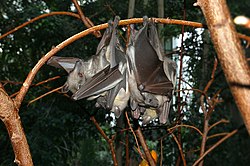
Picture of Eidolon helvum
- Source
- Wikipedia/Commons
- Credit
- Fritz Geller-Grimm
- Licence
- CC BY-SA 2.5
- Commercial use
- the licence allows it

CT scan
- Source
- MorphoSource
- Credit
- AMNH Mammal Collections
- Licence
- not stated by the source
- Commercial use
- cannot be read from the licence given — check the record
- Specimen
- Eidolon helvum helvum · AMNH:Mammals:M-48701
Smithsonian Open Access was not reached for this taxon, so this list is what the others held rather than everything there is.
The description on this site
- Licence
- CC BY-SA 4.0
This is what the site found, which is not the same as what exists.
Keep going
What may have been alongside itEidolon through timeFormations of the PlioceneThe world it lived on
Occurrence data from the Paleobiology Database, CC BY 4.0. Kerr 1792