Barbus
Barbus is a genus of ray-finned fish in the family Cyprinidae. The type species of Barbus is the common barbel, first described as Cyprinus barbus and now named Barbus barbus. Barbus is the namesake genus of the subfamily Barbinae, but given their relationships, that taxon is better included in the Cyprininae at least for the largest part.

Uncredited · via Wikipedia/Commons. May be a photograph of a specimen, or an artist’s reconstruction — an interpretation of a skeleton, since colour and soft tissue are almost never preserved.
On record
Recorded, not inferred- Sits inside
- CyprinidaePBDB
- Diet
- omnivorePBDB, for Cypriniformes
- Life habit
- nektonicPBDB, for Cypriniformes
- Motility
- actively mobilePBDB, for Cypriniformes
- Environment
- freshwaterPBDB, for Cypriniformes
Time the record covers
At least 27 million years on record.
The record covers at least 27.3 Mya to 11.7 ka. No occurrence read is dated outside 33.9 Mya to 0 Mya.
66 occurrences of Barbus on record, most of them in the Pleistocene. The Paleobiology Database records this as a living group. Bar height is expected occurrences, not a count: each fossil is spread across the span it is dated to, so a tall narrow bar means tight dating and a low wide one means loose.
When
66 occurrences- Oligocene2%
- Miocene27%
- Pliocene18%
- Pleistocene49%
- Holocene5%
These are dates about fossils, not the animal: the record can only begin after it arose and end before it died out, so either end may reach further. Shares are expected occurrences: a fossil dated to a span is counted partly in each period it straddles. More on what this infers.
Found in
17 formations
- Koobi Fora Formation17
- Upper Freshwater Molasse Formation · Molasse Group3
- Nachukui Formation2
- Nkondo Formation · Albertine Group2
- Nyabusosi/Rwebeshingo Formation · Albertine Group2
- Shanwang Formation2
Loading coastlines…
The named rock units Barbus has been recovered from, largest first. Drawn where the rock is now, not where it formed. 26 occurrences have no formation on record, which is common for older literature.
Barbus and its relatives
PleistoceneWhere Barbus and its relatives were recorded in the Pleistocene.
Found in the same rock
987 taxa- Synodontis26 sites
- Hydrocynus23 sites
- Labeo sp.18 sites
- Sindacharax sp.18 sites
- Clarias16 sites
- Hominidae16 sites
- Equus14 sites
- Gymnarchus14 sites
- Polypterus13 sites
- Reduncini13 sites
- Dasyatis africana12 sites
- Tragelaphini12 sites
- Alcelaphini11 sites
- Cichlidae11 sites
- Kolpochoerus limnetes11 sites
- Hipparion10 sites
- Kobus sigmoidalis10 sites
- Adenota recki9 sites
- Bovidae9 sites
- Giraffa9 sites
- Hippopotamus amphibius9 sites
- Lates niloticus9 sites
- Leuciscus9 sites
- Tragelaphus strepsiceros9 sites
The Paleobiology Database records 61 sites for Barbus, and this reads all of them. The number is how many of those sites it was catalogued from too. The 24 sharing the most are listed.
This is not a list of everything alive at the time. It is only what has come out of the same ground as this animal and been written down.
Entered from
39 references- Koobi Fora Research Project The Fossil Ungulates: Proboscidea, Perissodactyla, Suidae8
- Paleoecology of Late Cenozoic Fishes from the Turkana Basin, Northern Kenya7
- Late Pleistocene hunter-gatherers at Ishango (eastern Zaire): the faunal evidence5
- Nota sobre la ictiofauna continental de los yacimientos de la cuenca de Guadix-Baza (Granada)3
- Wendorf and Schild, 19763
- Snakes from Griesbeckerzell (Langhian, Early Badenian), North Alpine Foreland Basin (Germany), with comments on the evolution of snake faunas in Central Europe during the Miocene Climatic Optimum2
- Lothagam: the dawn of humanity in eastern Africa2
- Lower Vertebrates (Teleostei, Amphibia, Sauria) from the Karpatian of the Korneuburg Basin - Paleoecological, environmental and paleoclimatical implications2
- A middle stone age worked bone industry from Katanda,Upper Semliki Valley,Zaire2
- Carnivora from Nkondo and Kisegi-Nyabusosi,Western Rift, Uganda2
- Miocene Stratigraphy and mammals of Shanwang, Shandong2
- Scale invariance and hydric behaviour of soils and clays1
Each of the 66 occurrences read was entered from one of these publications, ordered by how many each accounts for. This is not a search for papers mentioning the name. 27 further references are not listed. Entries link to doi.org where the Paleobiology Database holds an identifier, and to its own record where it does not. Relayed as the Paleobiology Database holds them, not checked against what they resolve to.
Media and terms
Media content3

Picture of Barbus
- Source
- Wikipedia/Commons
- Credit
- nobody named on the record
- Licence
- not stated by the source
- Commercial use
- cannot be read from the licence given — check the record
CT scan
- Source
- MorphoSource
- Credit
- AUM Fish Collection
- Licence
- In Copyright
- Commercial use
- cannot be read from the licence given — check the record
- Specimen
- Barbus barbus · AUM:AUM:32176
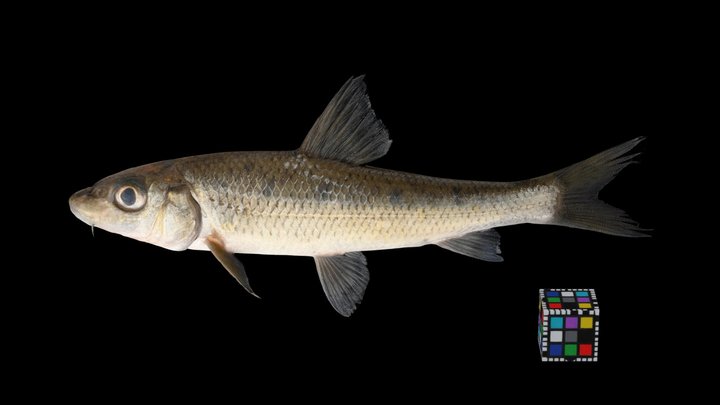
3D model
- Source
- Sketchfab
- Licence
- CC0 Public Domain
- Commercial use
- the licence allows it
Smithsonian Open Access was not reached for this taxon, so this list is what the others held rather than everything there is.
The description on this site
- Source
- Wikipedia, “Barbus”
- Licence
- CC BY-SA 4.0
This is what the site found, which is not the same as what exists.
Keep going
What may have been alongside itCyprinidae through timeFormations of the PleistoceneThe world it lived on
Occurrence data from the Paleobiology Database, CC BY 4.0. Cuvier and Cloquet 1816