Earlandinita
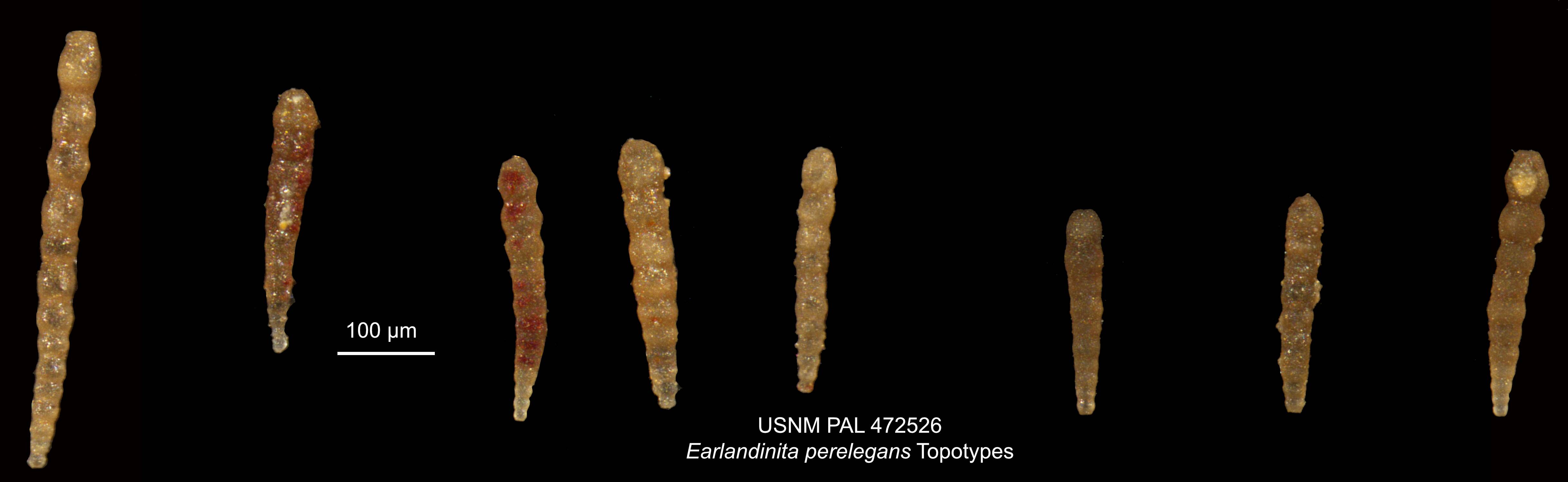
Smithsonian Institution · CC0 · via Smithsonian. May be a photograph of a specimen, or an artist’s reconstruction — an interpretation of a skeleton, since colour and soft tissue are almost never preserved.
On record
Recorded, not inferred- Sits inside
- EarlandinitidaePBDB
- Diet
- omnivorePBDB, for Foraminifera
- Life habit
- semi-infaunalPBDB, for Foraminifera
- Motility
- stationaryPBDB, for Foraminifera
Time the record covers
At least 69 million years on record.
The record covers at least 306 Mya to 237 Mya. No occurrence read is dated outside 312.8 Mya to 233.6 Mya.
34 occurrences of Earlandinita on record, most of them in the Carboniferous. Bar height is expected occurrences, not a count: each fossil is spread across the span it is dated to, so a tall narrow bar means tight dating and a low wide one means loose.
When
34 occurrencesThese are dates about fossils, not the animal: the record can only begin after it arose and end before it died out, so either end may reach further. Shares are expected occurrences: a fossil dated to a span is counted partly in each period it straddles. More on what this infers.
Found in
11 formations
- Wewoka Formation19
- Anshun Formation3
- Schlern 1 Formation2
- Wetterstein Formation2
- Recoaro - Upper Serla Formation1
- Wetterstein Limestone Formation1
Loading coastlines…
The named rock units Earlandinita has been recovered from, largest first. Drawn where the rock is now, not where it formed. 1 occurrence has no formation on record, which is common for older literature.
Earlandinita and its relatives
CarboniferousWhere Earlandinita and its relatives were recorded in the Carboniferous.
Found in the same rock
368 taxa- Ammobaculites21 sites
- Ammodiscus21 sites
- Crinoidea20 sites
- Echinoidea20 sites
- Endothyranella20 sites
- Reophax20 sites
- Euphemites carbonarius19 sites
- Pseudozygopleurids indet.19 sites
- Asteroidea18 sites
- Bathysiphon18 sites
- Plagioglypta18 sites
- Anthraconeilo taffiana17 sites
- Crurithyris planoconvexa17 sites
- Glabrocingulum grayvillense17 sites
- Holothuria17 sites
- Ianthinopsis17 sites
- Meekospira peracuta17 sites
- Nuculopsis wewokana17 sites
- Pseudorthoceras17 sites
- Trepospira illinoisensis17 sites
- Lituotuba16 sites
- Tolypammina16 sites
- Gastrioceras15 sites
- Lindostroemella cf. patula15 sites
The Paleobiology Database records 32 sites for Earlandinita, and this reads all of them. The number is how many of those sites it was catalogued from too. The 24 sharing the most are listed.
This is not a list of everything alive at the time. It is only what has come out of the same ground as this animal and been written down.
Entered from
11 references- Marine Communities of a Portion of the Wewoka Formation (Pennsylvanian) in Hughes County, Oklahoma19
- Recovery dynamics of foraminifers and algae following the Permian-Triassic extinction in Qingyan, South China3
- The reefal margin and slope of a Middle Triassic carbonate platform: the Latemar (Dolomites, Italy)3
- An Anisian Wetterstein reef in north Hungary2
- Dasycladalean green algae and associated foraminifers in Middle Triassic (lower and middle muschelkalk) carbonates of the South-Eastern Germanic basin (Upper Silesia, Poland)1
- Carbonate facies dominated by syndepositional cements: a key component of Middle Triassic platforms. The Marmolada case history (Dolomites, Italy)1
- Evolution of Middle Triassic shallow marine carbonates in the Balaton Highland (Hungary)1
- Anisian (Middle Triassic) buildups of the northern Dolomites (Italy): The recovery of reef communities after the Permian/Triassic crisis1
- Rifforganismen aus "Wettersteinkalken" (Karn?) des Bükk-Gebirges, Ungarn1
- Triassic microfossils from the Korytnica limestones at Liptovska (Slovakia, CSSR) and their stratigraphic significance1
- Fossilien aus dem Wettersteinkalke des Slowakischen Karstes (Lokalitat Silicka)1
Each of the 34 occurrences read was entered from one of these publications, ordered by how many each accounts for. This is not a search for papers mentioning the name. Entries link to doi.org where the Paleobiology Database holds an identifier, and to its own record where it does not. Relayed as the Paleobiology Database holds them, not checked against what they resolve to.
Media and terms
Media content1
Picture of Earlandinita
- Source
- Smithsonian
- Credit
- Smithsonian Institution
- Licence
- CC0 — this site’s default, not the record’s
- Commercial use
- the licence allows it
No 3D scan was found. Smithsonian Open Access, MorphoSource and Sketchfab were all searched.
This is what the site found, which is not the same as what exists.
Keep going
What may have been alongside itEarlandinitidae through timeFormations of the CarboniferousThe world it lived on
Occurrence data from the Paleobiology Database, CC BY 4.0.