Deinosuchus
Deinosuchus is an extinct genus of eusuchian, either an alligatoroid crocodilian or a stem-group crocodilian, which lived during the Late Cretaceous around 82 to 73 million years ago. The first remains were discovered in North Carolina in the 1850s, and the genus was first described in 1909. Additional fragments were discovered in the 1940s and were later incorporated into an influential, though inaccurate, skull reconstruction at the American Museum of Natural History. Knowledge of Deinosuchus remains incomplete, but better cranial and postcranial material found in recent years has expanded scientific understanding of this massive predator.

Source: Jonathan Cutrer Derivative: User:MathKnight · CC BY 4.0 · via Wikipedia/Commons. May be a photograph of a specimen, or an artist’s reconstruction — an interpretation of a skeleton, since colour and soft tissue are almost never preserved.
On record
Recorded, not inferred- Sits inside
- AlligatoroideaPBDB
- Diet
- carnivorePBDB, for Crocodylia
- Motility
- actively mobilePBDB, for Osteichthyes
- Environment
- marinePBDB, for Mesoeucrocodylia
Time the record covers
At most 12 million years on record.
Every occurrence read is dated to somewhere between 83.6 Mya and 72.2 Mya, and nothing in the dating separates them, so that window is what the record shows rather than a span.
19 occurrences of Deinosuchus on record, most of them in the Late Cretaceous. Bar height is expected occurrences, not a count: each fossil is spread across the span it is dated to, so a tall narrow bar means tight dating and a low wide one means loose.
When
19 occurrences- Late Cretaceous100%
These are dates about fossils, not the animal: the record can only begin after it arose and end before it died out, so either end may reach further. Shares are expected occurrences: a fossil dated to a span is counted partly in each period it straddles. More on what this infers.
Found in
9 formations
- Aguja Formation7
- Judith River Formation · Montana Group2
- Aguja Formation2
- Mooreville Formation · Selma Group2
- Kaiparowits Formation2
- Fruitland Formation1
Loading coastlines…
The named rock units Deinosuchus has been recovered from, largest first. Drawn where the rock is now, not where it formed.
Deinosuchus and its relatives
Late CretaceousWhere Deinosuchus and its relatives were recorded in the Late Cretaceous.
Found in the same rock
131 taxa- Hadrosauridae7 sites
- Trionychidae5 sites
- Crocodylia4 sites
- Lepisosteidae4 sites
- Tyrannosauridae4 sites
- Ceratopsidae3 sites
- Goniopholididae3 sites
- Pachycephalosauridae3 sites
- Tyrannosaurinae3 sites
- Angiospermae2 sites
- Basilemys2 sites
- Chondrichthyes2 sites
- Dasyatidae2 sites
- Glyptosaurinae2 sites
- Hybodus2 sites
- Lonchidion selachos2 sites
- Melvius2 sites
- Multituberculata2 sites
- Onchopristis dunklei2 sites
- Ornithischia2 sites
- Osteichthyes2 sites
- Phyllodontidae2 sites
- Ptychotrygon2 sites
- Restesia americana2 sites
The Paleobiology Database records 18 sites for Deinosuchus, and this reads all of them. The number is how many of those sites it was catalogued from too. The 24 sharing the most are listed.
This is not a list of everything alive at the time. It is only what has come out of the same ground as this animal and been written down.
Entered from
15 references- A systematic review of the giant alligatoroid Deinosuchus from the Campanian of North America and its implications for the relationships at the root of Crocodylia4
- Geology and taphonomy of a unique tyrannosaurid bonebed from the upper Campanian Kaiparowits Formation of southern Utah: implications for tyrannosaurid gregariousness2
- First remains of the enormous alligatoroid Deinosuchus from the Upper Cretaceous Menefee Formation, New Mexico1
- Stratigraphy and vertebrate fauna of the lower shale member of the Aguja Formation (lower Campanian) in West Texas1
- An inventory of non-avian dinosaurs from National Park Service areas1
- Paleoecology of the Gaddis Site in the Upper Cretaceous Aguja Formation, Terlingua, Texas1
- Preliminary analysis of a sub-adult tyrannosaurid skeleton from the Judith River Formation of Petroleum County, Montana1
- A Deinosuchus riograndensis (Eusuchia: Alligatoroidea) from Coahuila, North Mexico1
- Bite marks of the giant crocodylian Deinosuchus on Late Cretaceous (Campanian) bones1
- Preliminary report on a Late Cretaceous vertebrate fossil assemblage in northwestern Coahuila, Mexico1
- Vertebrate paleoecology from microsites, Talley Mountain, Upper Aguja Formation (Late Cretaceous), Big Bend National Park, Texas, USA1
- Evidence of a giant tyrannosaurid (Dinosauria: Theropoda) from the Upper Cretaceous (?Campanian) of Montana1
Each of the 19 occurrences read was entered from one of these publications, ordered by how many each accounts for. This is not a search for papers mentioning the name. 3 further references are not listed. Entries link to doi.org where the Paleobiology Database holds an identifier, and to its own record where it does not. Relayed as the Paleobiology Database holds them, not checked against what they resolve to.
Media and terms
Media content3

Picture of Deinosuchus
- Source
- Wikipedia/Commons
- Credit
- Source: Jonathan Cutrer Derivative: User:MathKnight
- Licence
- CC BY 4.0
- Commercial use
- the licence allows it
Laser scan
- Source
- MorphoSource
- Licence
- not stated by the source
- Commercial use
- cannot be read from the licence given — check the record
- Specimen
- Deinosuchus riograndensis · TxVP:43632-1
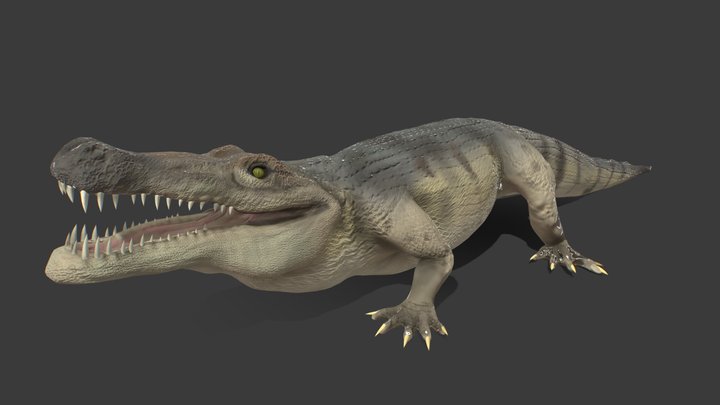
3D model
- Source
- Sketchfab
- Credit
- Paleo Modelist
- Licence
- CC Attribution
- Commercial use
- cannot be read from the licence given — check the record
Smithsonian Open Access was not reached for this taxon, so this list is what the others held rather than everything there is.
The description on this site
- Source
- Wikipedia, “Deinosuchus”
- Licence
- CC BY-SA 4.0
This is what the site found, which is not the same as what exists.
Keep going
What may have been alongside itAlligatoroidea through timeFormations of the Late CretaceousThe world it lived on
Occurrence data from the Paleobiology Database, CC BY 4.0. Holland 1909