Daspletosaurus
Daspletosaurus is a genus of tyrannosaurid dinosaur that lived in Laramidia between about 79 and 74.4 million years ago, during the Late Cretaceous Period. The genus Daspletosaurus contains three named species. Fossils of the earlier type species, D. torosus, have been found in Alberta, while fossils of a later species, D. horneri, have been found in Montana and Alberta. D. wilsoni has been suggested as an intermediate species between D. torosus and D. horneri that evolved through anagenesis, though further research may be required to definitively support the theory.

WehaveaTrex · CC BY-SA 4.0 · via Wikipedia/Commons. May be a photograph of a specimen, or an artist’s reconstruction — an interpretation of a skeleton, since colour and soft tissue are almost never preserved.
On record
Recorded, not inferred- Sits inside
- DaspletosauriniPBDB
- Diet
- carnivorePBDB, for Coelurosauria
- Life habit
- ground dwelling, solitaryPBDB, for Theropoda
- Motility
- actively mobilePBDB, for Theropoda
- Environment
- terrestrialPBDB, for Theropoda
- Length
- 9 mWikidata
- Mass
- 2.5 tonneWikidata
Time the record covers
At most 18 million years on record.
Every occurrence read is dated to somewhere between 83.6 Mya and 66 Mya, and nothing in the dating separates them, so that window is what the record shows rather than a span.
21 occurrences of Daspletosaurus on record, most of them in the Late Cretaceous. Bar height is expected occurrences, not a count: each fossil is spread across the span it is dated to, so a tall narrow bar means tight dating and a low wide one means loose.
When
21 occurrences- Late Cretaceous100%
These are dates about fossils, not the animal: the record can only begin after it arose and end before it died out, so either end may reach further. Shares are expected occurrences: a fossil dated to a span is counted partly in each period it straddles. More on what this infers.
Found in
7 formations
- Two Medicine Formation · Montana Group7
- Oldman Formation · Belly River Group5
- Dinosaur Park Formation · Belly River Group5
- Ojo Alamo Formation1
- Mesaverde Formation1
- Kirtland Formation1
Loading coastlines…
The named rock units Daspletosaurus has been recovered from, largest first. Drawn where the rock is now, not where it formed.
Daspletosaurus and its relatives
Late CretaceousWhere Daspletosaurus and its relatives were recorded in the Late Cretaceous.
Found in the same rock
93 taxa- Hadrosauridae4 sites
- Lambeosaurinae4 sites
- Saurornitholestes3 sites
- Testudines3 sites
- Ankylosauria2 sites
- Ankylosauridae2 sites
- Anura2 sites
- Basilemys2 sites
- Ceratopsidae2 sites
- Chelydridae2 sites
- Hadrosaurinae2 sites
- Mammalia2 sites
- Ornithomimidae2 sites
- Physa2 sites
- Prosaurolophus maximus2 sites
- Achelousaurus horneri1 site
- Alligatorinae1 site
- Alphadon halleyi1 site
- Amiinae1 site
- Amphibia1 site
- Aspideretoides foveatus1 site
- Azhdarchidae1 site
- Bambiraptor feinbergi1 site
- Belonostomus longirostris1 site
The Paleobiology Database records 19 sites for Daspletosaurus, and this reads all of them. The number is how many of those sites it was catalogued from too. The 24 sharing the most are listed.
This is not a list of everything alive at the time. It is only what has come out of the same ground as this animal and been written down.
Entered from
15 references- Tyrannosaurs from the Late Cretaceous of western Canada4
- A new tyrannosaur with evidence for anagenesis and crocodile-like facial sensory system3
- Immature Daspletosaurus sp. specimens from the Dinosaur Park Formation provide insight into ontogenetically invariant tyrannosaurid cranial morphology2
- First occurrence of Daspletosaurus horneri (Tyrannosauridae, Tyrannosaurinae) in the Dinosaur Park Formation of Dinosaur Provincial Park, Alberta (Treaty 7 Territory)1
- A transitional species of Daspletosaurus Russell, 1970 from the Judith River Formation of eastern Montana1
- Baby tyrannosaurid bones and teeth from the Late Cretaceous of western North America 11
- Geology and taphonomy of a unique tyrannosaurid bonebed from the upper Campanian Kaiparowits Formation of southern Utah: implications for tyrannosaurid gregariousness1
- A subadult frontal of Daspletosaurus torosus (Theropoda: Tyrannosauridae) from the Late Cretaceous of Alberta, Canada with implications for tyrannosaurid ontogeny and taxonomy1
- Fossil Vertebrate Collections1
- The nonmammalian vertebrate microfossil assemblages of the Mesaverde Formation (Upper Cretaceous, Campanian) of the Wind River and Bighorn Basins, Wyoming1
- A ceratopsid pelvis with toothmarks from the Upper Cretaceous Kirtland Formation, New Mexico: evidence of Late Campanian tyrannosaurid feeding behavior1
- History of research1
Each of the 21 occurrences read was entered from one of these publications, ordered by how many each accounts for. This is not a search for papers mentioning the name. 3 further references are not listed. Entries link to doi.org where the Paleobiology Database holds an identifier, and to its own record where it does not. Relayed as the Paleobiology Database holds them, not checked against what they resolve to.
Media and terms
Media content2

Picture of Daspletosaurus
- Source
- Wikipedia/Commons
- Credit
- WehaveaTrex
- Licence
- CC BY-SA 4.0
- Commercial use
- the licence allows it
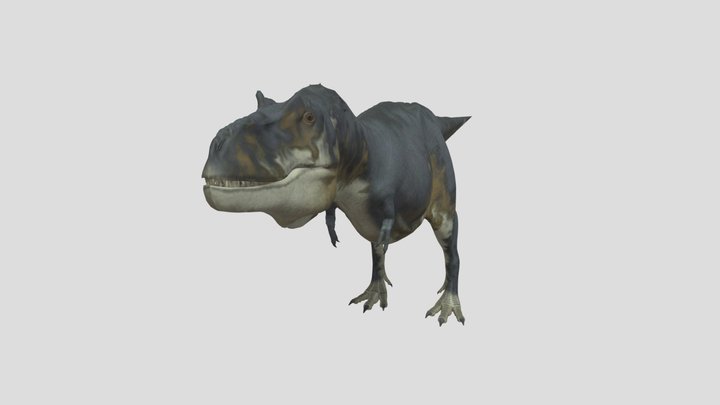
3D model
- Source
- Sketchfab
- Credit
- Nobilis the Palaeovespa
- Licence
- CC Attribution
- Commercial use
- cannot be read from the licence given — check the record
The description on this site
- Licence
- CC BY-SA 4.0
This is what the site found, which is not the same as what exists.
Keep going
What may have been alongside itDaspletosaurini through timeFormations of the Late CretaceousThe world it lived on
Occurrence data from the Paleobiology Database, CC BY 4.0. Russell 1970