Cuspidaria
Cuspidaria is a genus of bivalves in the family Cuspidariidae.

Albano PG, Schnedl S-M, Janssen R, Eschner A (2019) An illustrated catalogue of Rudolf Sturany’s type specimens in th… · CC BY 4.0 · via Wikidata/Commons. May be a photograph of a specimen, or an artist’s reconstruction — an interpretation of a skeleton, since colour and soft tissue are almost never preserved.
On record
Recorded, not inferred- Sits inside
- CuspidariidaePBDB
- Diet
- carnivorePBDB
- Life habit
- infaunalPBDB
- Motility
- facultatively mobilePBDB
- Vision
- blindPBDB, for Bivalvia
Time the record covers
At least 233 million years on record.
The record covers at least 237 Mya to 3.6 Mya. No occurrence read is dated outside 239.48 Mya to 2.58 Mya.
258 occurrences of Cuspidaria on record, most of them in the Late Cretaceous. The Paleobiology Database records this as a living group, and the chart stops with its fossils rather than at the present. Bar height is expected occurrences, not a count: each fossil is spread across the span it is dated to, so a tall narrow bar means tight dating and a low wide one means loose.
When
258 occurrences- Middle Triassicunder 1%
- Late Triassic2%
- Early Jurassic1%
- Middle Jurassic1%
- Late Jurassic2%
- Early Cretaceousunder 1%
- Late Cretaceous52%
- Paleocene13%
- Eocene10%
- Oligocene3%
- Miocene10%
- Pliocene4%
These are dates about fossils, not the animal: the record can only begin after it arose and end before it died out, so either end may reach further. Shares are expected occurrences: a fossil dated to a span is counted partly in each period it straddles. More on what this infers.
Found in
80 formations
- Corsicana Marl Formation20
- Woodbine Formation14
- Kincaid Formation · Midway Group11
- Prairie Bluff Formation · Selma Group8
- Maastrichtian chalk Formation7
- Cook Mountain Formation · Claiborne Group7
Loading coastlines…
The named rock units Cuspidaria has been recovered from, largest first. Drawn where the rock is now, not where it formed. 56 further formations hold fewer occurrences each and are not listed. 63 occurrences have no formation on record, which is common for older literature.
Cuspidaria and its relatives
Late CretaceousWhere Cuspidaria and its relatives were recorded in the Late Cretaceous.
Found in the same rock
3,156 taxa- Nuculana79 sites
- Cymbophora48 sites
- Nucula41 sites
- Syncyclonema41 sites
- Corbula40 sites
- Striarca40 sites
- Dentalium37 sites
- Modiolus37 sites
- Crassatella vadosa34 sites
- Anomia argentaria33 sites
- Turritella33 sites
- Limopsis32 sites
- Ostrea31 sites
- Malletia30 sites
- Cucullaea29 sites
- Nucula percrassa29 sites
- Anomia28 sites
- Crenella serica28 sites
- Inoceramus28 sites
- Vetericardiella28 sites
- Caryocorbula27 sites
- Cyprimeria27 sites
- Exogyra (Exogyra) costata27 sites
- Crassatella25 sites
The Paleobiology Database records 208 sites for Cuspidaria, and this reads all of them. Of that, one read hit the database's own return limit, so every count below is a floor rather than a total. The number is how many of those sites it was catalogued from too. The 24 sharing the most are listed.
This is not a list of everything alive at the time. It is only what has come out of the same ground as this animal and been written down.
Entered from
95 references- Unpublished data on Cretaceous-Paleocene molluscan assemblages36
- Upper Cretaceous (Maestrichtian) larger invertebrate Fossils from the Haustator bilira Assemblage Zone in the west gulf Coastal Plain14
- Larger invertebrate fossils of the Woodbine formation (Cenomanian) of Texas14
- Resilience of marine invertebrate communities during the early Cenozoic hyperthermals12
- Lower Danian bivalves, Stevns Klint, Denmark; continuity across the K/T boundary10
- Upper Cretaceous (Maestrichtian) Mollusca from the Haustator bilira Assemblage Zone in the East Gulf Coastal Plain9
- Patterns of molluscan extinction and recovery across the Cretaceous-Tertiary boundary in east Texas; report on new outcrops8
- The first 2 million years after the Cretaceous-Tertiary boundary in east Texas: Rate and paleoecology of the molluscan recovery8
- Maastrichtian non-cephalopod mollusks: Scaphopoda, Gastropoda and Bivalvia of the Middle Vistula Valley, central Poland8
- Upper Cretaceous (Maestrichtian) larger invertebrates from the Haustator bilira Assemblage Zone in the Atlantic Coastal Plain with further data for the East Gulf6
- Die Fauna des marinen Miozäns von Kevelaer (Niederrhein). Band 2 Bivalvia, Scaphopoda, Cephalopoda, Bryozoa, Annelida, Brachiopoda5
- Paleontology of the Greenhorn cylcothem (Cretaceous: late Cenomanian to middle Turonian) at Black Mesa, northeastern Arizona5
Each of the 258 occurrences read was entered from one of these publications, ordered by how many each accounts for. This is not a search for papers mentioning the name. 83 further references are not listed. Entries link to doi.org where the Paleobiology Database holds an identifier, and to its own record where it does not. Relayed as the Paleobiology Database holds them, not checked against what they resolve to.
Media and terms
Media content3
Picture of Cuspidaria
- Source
- Wikidata/Commons
- Credit
- Albano PG, Schnedl S-M, Janssen R, Eschner A (2019) An illustrated catalogue of Rudolf Sturany’s type specimens in th…
- Licence
- CC BY 4.0
- Commercial use
- the licence allows it
CT scan
- Source
- MorphoSource
- Licence
- not stated by the source
- Commercial use
- cannot be read from the licence given — check the record
- Specimen
- Cuspidaria obesa · USNM:IZ:USNM 448494
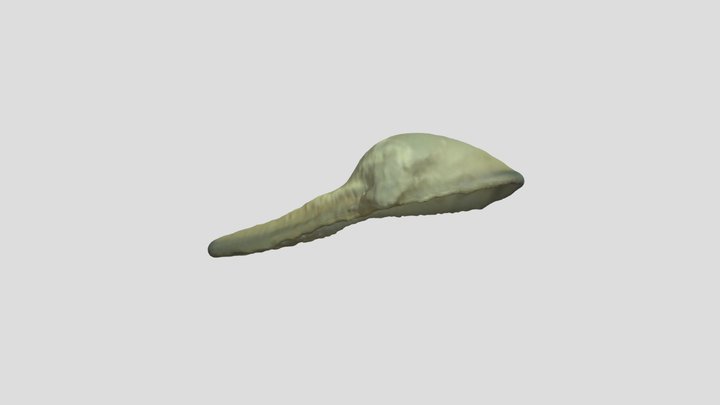
3D model
- Source
- Sketchfab
- Licence
- CC Attribution-NonCommercial
- Commercial use
- the licence does not allow it
Smithsonian Open Access was not reached for this taxon, so this list is what the others held rather than everything there is.
The description on this site
- Licence
- CC BY-SA 4.0
This is what the site found, which is not the same as what exists.
Keep going
What may have been alongside itCuspidariidae through timeFormations of the Late CretaceousThe world it lived on
Occurrence data from the Paleobiology Database, CC BY 4.0. Dall 1886