Corallinaceae
The Corallinaceae are one of the two extant Coralline families of red algae; they are differentiated from the morphologically similar Sporolithaceae by their formation of grouped sporangial chambers, clustered into sori. The Corallinoideae is monophyletic; the other subfamilies form another monophyletic group.

J. McKenna · Public Domain · via Wikipedia/Commons. May be a photograph of a specimen, or an artist’s reconstruction — an interpretation of a skeleton, since colour and soft tissue are almost never preserved.
On record
Recorded, not inferred- Sits inside
- CorallinalesPBDB
- Diet
- "photoautotroph"PBDB
- Life habit
- epifaunal, clonalPBDB
- Motility
- stationary, attached, epibiontPBDB
- Environment
- marinePBDB
Time the record covers
At least 449 million years on record.
The record covers at least 449.6 Mya to 11.7 ka. No occurrence read is dated outside 457.3 Mya to 0 Mya.
863 occurrences of Corallinaceae on record, most of them in the Miocene. The Paleobiology Database records this as a living group. Bar height is expected occurrences, not a count: each fossil is spread across the span it is dated to, so a tall narrow bar means tight dating and a low wide one means loose.
When
863 occurrences- Ordovicianunder 1%
- Silurianunder 1%
- Devonianunder 1%
- Permianunder 1%
- Late Jurassicunder 1%
- Early Cretaceous3%
- Late Cretaceous2%
- Paleocene20%
- Eocene20%
- Oligocene5%
- Miocene24%
- Pliocene6%
- Pleistocene13%
- Holocene6%
These are dates about fossils, not the animal: the record can only begin after it arose and end before it died out, so either end may reach further. Shares are expected occurrences: a fossil dated to a span is counted partly in each period it straddles. More on what this infers.
Found in
105 formations
- Sinjar Formation64
- Sylhet Formation Formation44
- Umatac Formation28
- Guitar Formation Formation25
- Lakadong Formation · Shlhet Limestone Group17
- Pinczow Formation13
Loading coastlines…
The named rock units Corallinaceae has been recovered from, largest first. Drawn where the rock is now, not where it formed. 81 further formations hold fewer occurrences each and are not listed. 363 occurrences have no formation on record, which is common for older literature.
Corallinaceae and its relatives
MioceneWhere Corallinaceae and its relatives were recorded in the Miocene.
Found in the same rock
1,382 taxa- Lithothamnion52 sites
- Lithophyllum46 sites
- Porites41 sites
- Jania40 sites
- Corallina36 sites
- Amphiroa iraquensis35 sites
- Sporolithon33 sites
- Bryozoa31 sites
- Halimeda30 sites
- Polystrata alba28 sites
- Distichoplax biserialis26 sites
- Lithoporella melobesioides26 sites
- Textularia24 sites
- Mesophyllum23 sites
- Serpulidae22 sites
- Amphiroa21 sites
- Gastropoda21 sites
- Lockhartia20 sites
- Cymopolia18 sites
- Discocyclina18 sites
- Echinoidea18 sites
- Rotalia18 sites
- Pyrgo17 sites
- Tarbellastraea17 sites
The Paleobiology Database records 390 sites for Corallinaceae, and this reads 240 of them. The number is how many of those sites it was catalogued from too. The 24 sharing the most are listed.
This is not a list of everything alive at the time. It is only what has come out of the same ground as this animal and been written down.
Entered from
214 references- Fossil and recent calcareous algae from Guam67
- A study of biostratigraphy of Sinjar Formation in selected sections from northern Iraq60
- The Enigmatic Paleocene-Eocene coralline Distichoplax: Approaching the structural complexities, ecological affinities and extinction hypotheses44
- Micropaleontology of four sections south of Qoseir, Egypt43
- Coralline Algae and Benthic Foraminifera from the Long Formation (middle Miocene) of the Little Andaman Island, India: Biofacies Analysis, Systematics and Palaeoenvironmental Implications27
- Facies analysis and paleoenvironmental interpretation of Piacenzian carbonate deposits from the Guitar Formation of Car Nicobar Island, India25
- Dominance of coralline algae in the South China Sea: Insights into their responses to paleoceanographic events over the last 20 million years16
- Stratigraphy and paleontology of Pleistocene submarine volcanic-sedimentary sequences at the northern Kermadec Islands16
- Contribution to the knowledge of the Palaeogene reef-complexes of the Myjava-Hricov-Haligovka Zone (West Carpathians)15
- Calcareous algae from the Lakadong Formation of the South Shillong Plateau, NE India14
- Red algae from the Pinczow limestones (middle Miocene, Swietokrzyskie mountains, Poland)13
- Eocene algae from Isliigaki-shima, Ryukyu-retto13
Each of the 863 occurrences read was entered from one of these publications, ordered by how many each accounts for. This is not a search for papers mentioning the name. 202 further references are not listed. Entries link to doi.org where the Paleobiology Database holds an identifier, and to its own record where it does not. Relayed as the Paleobiology Database holds them, not checked against what they resolve to.
Media and terms
Media content2
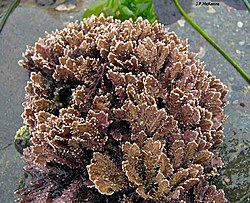
Picture of Corallinaceae
- Source
- Wikipedia/Commons
- Credit
- J. McKenna
- Licence
- Public Domain
- Commercial use
- the licence allows it
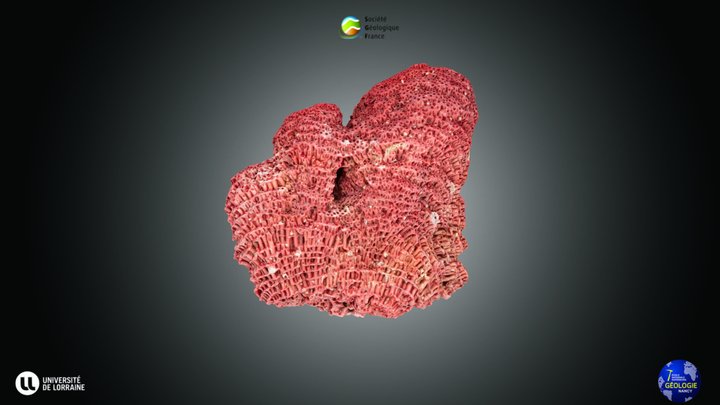
3D model
- Source
- Sketchfab
- Licence
- CC Attribution-NonCommercial-ShareAlike
- Commercial use
- the licence does not allow it
Smithsonian Open Access and MorphoSource were not reached for this taxon, so this list is what the others held rather than everything there is.
The description on this site
- Licence
- CC BY-SA 4.0
This is what the site found, which is not the same as what exists.
Keep going
What may have been alongside itCorallinales through timeFormations of the MioceneThe world it lived on
Occurrence data from the Paleobiology Database, CC BY 4.0. Lamouroux 1816