Coelognathosuchia
Coelognathosuchia is an extinct clade of neosuchian crocodyliforms that includes all taxa more closely related to the family Pholidosauridae than to Bernissartia fagesii or Eusuchia. Martin et al. (2014) named the clade after finding goniopholidids and pholidosaurids to group together in their phylogenetic analysis of crocodyliform evolutionary relationships. In their analysis, Pholidosauridae was monophyletic and Goniopholididae was paraphyletic, being an assemblage of successively more basal taxa within Coelognathosuchia. Coelognathosuchia itself was positioned near the base of the larger clade Neosuchia as the sister group to a clade containing the Early Cretaceous neosuchian Bernissartia and Eusuchia, the group that includes all modern crocodilians and their closest extinct relatives.

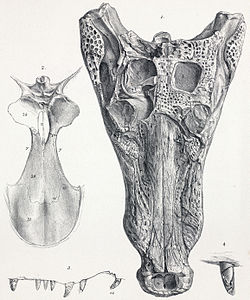
J. Erxleben · Public Domain · via Wikipedia/Commons. May be a photograph of a specimen, or an artist’s reconstruction — an interpretation of a skeleton, since colour and soft tissue are almost never preserved.
On record
Recorded, not inferred- Sits inside
- NeosuchiaPBDB
- Diet
- carnivorePBDB, for Pseudosuchia
- Motility
- actively mobilePBDB, for Osteichthyes
- Environment
- marinePBDB, for Mesoeucrocodylia
Time the record covers
At least 143 million years on record.
The record covers at least 184.2 Mya to 41.03 Mya. No occurrence read is dated outside 199.5 Mya to 33.9 Mya.
409 occurrences of Coelognathosuchia on record, most of them in the Early Cretaceous. Bar height is expected occurrences, not a count: each fossil is spread across the span it is dated to, so a tall narrow bar means tight dating and a low wide one means loose.
When
409 occurrences- Early Jurassicunder 1%
- Middle Jurassic4%
- Late Jurassic21%
- Early Cretaceous34%
- Late Cretaceous20%
- Paleocene17%
- Eocene4%
These are dates about fossils, not the animal: the record can only begin after it arose and end before it died out, so either end may reach further. Shares are expected occurrences: a fossil dated to a span is counted partly in each period it straddles. More on what this infers.
Found in
121 formations
- Morrison Formation54
- Umm Himar Formation21
- Cloverly Formation15
- Hornerstown Formation · Rancocas Group8
- Aguja Formation7
- Cedar Mountain Formation · Dakota Group7
Loading coastlines…
The named rock units Coelognathosuchia has been recovered from, largest first. Drawn where the rock is now, not where it formed. 97 further formations hold fewer occurrences each and are not listed. 65 occurrences have no formation on record, which is common for older literature.
Coelognathosuchia and its relatives
Early CretaceousWhere Coelognathosuchia and its relatives were recorded in the Early Cretaceous.
Found in the same rock
1,635 taxa- Theropoda62 sites
- Goniopholis50 sites
- Testudines47 sites
- Goniopholididae42 sites
- Lepidotes32 sites
- Dyrosauridae30 sites
- Osteichthyes29 sites
- Crocodylia27 sites
- Anura26 sites
- Mammalia26 sites
- Ornithopoda23 sites
- Sauropoda23 sites
- Ornithischia21 sites
- Bernissartia19 sites
- Caudata19 sites
- Glyptops19 sites
- Pterosauria19 sites
- Theriosuchus18 sites
- Hybodus17 sites
- Actinopterygii16 sites
- Lacertilia16 sites
- Bivalvia15 sites
- Gastropoda15 sites
- Pholidosauridae15 sites
The Paleobiology Database records 357 sites for Coelognathosuchia, and this reads 240 of them. The number is how many of those sites it was catalogued from too. The 24 sharing the most are listed.
This is not a list of everything alive at the time. It is only what has come out of the same ground as this animal and been written down.
Entered from
249 references- The longirostrine crocodyliforms from Bolivia and their evolution through the Cretaceous–Palaeogene boundary15
- Vertebrate paleontology of the Cloverly Formation (Lower Cretaceous), I: faunal composition, biogeographic relationships, and sampling13
- Paleoecological analysis of the vertebrate fauna of the Morrison Formation (Upper Jurassic), Rocky Mountain region, U.S.A.12
- Dyrosaurs (Crocodilia, Mesosuchia) from the Paleocene Umm Himar Formation, Kingdom of Saudi Arabia11
- The Umm Himar Formation (Paleocene) of Saudi Arabia and Associated Strata: Stratigraphy, Vertebrate Fauna, and Paleoenvironment10
- Taxonomic revision of the Dyrosaurid Assemblage (Crocodyliformes: Mesoeucrocodylia) from the Paleocene of the Iullemmeden Basin, West Africa9
- Connely, 20028
- Crocodilians from the Lower Cretaceous (Berriasian) Purbeck Limestone Group of Dorset, southern England7
- Les crocodiliens fossiles des depots phosphates du Sud-Tunisien6
- Stratigraphy and vertebrate fauna of the lower shale member of the Aguja Formation (lower Campanian) in West Texas4
- Systematic revision of Sarcosuchus hartti (Crocodyliformes) from the Recôncavo Basin (Early Cretaceous) of Bahia, north-eastern Brazil4
- A new longirostrine dyrosaurid (Crocodylomorpha, Mesoeucrocodylia) from the Paleocene of north-eastern Colombia: biogeographic and behavioural implications for New-World Dyrosauridae4
Each of the 409 occurrences read was entered from one of these publications, ordered by how many each accounts for. This is not a search for papers mentioning the name. 237 further references are not listed. Entries link to doi.org where the Paleobiology Database holds an identifier, and to its own record where it does not. Relayed as the Paleobiology Database holds them, not checked against what they resolve to.
Media and terms
Media content1
Picture of Coelognathosuchia
- Source
- Wikipedia/Commons
- Credit
- J. Erxleben
- Licence
- Public Domain
- Commercial use
- the licence allows it
No 3D scan of Coelognathosuchia was found in Sketchfab.
Smithsonian Open Access and MorphoSource were not reached for this taxon, so this list is what the others held rather than everything there is.
The description on this site
- Licence
- CC BY-SA 4.0
This is what the site found, which is not the same as what exists.
Keep going
What may have been alongside itNeosuchia through timeFormations of the Early CretaceousThe world it lived on
Occurrence data from the Paleobiology Database, CC BY 4.0. (Martin et al. 2013)