Dyrosauridae
Dyrosauridae is a family of extinct neosuchian crocodyliforms that lived from the Campanian to the Eocene. Dyrosaurid fossils are globally distributed, having been found in Africa, Asia, Europe, North America and South America. Over a dozen species are currently known, varying greatly in overall size and cranial shape, though typically with an elongate gharial-like snout. A majority were aquatic, some terrestrial and others fully marine with species inhabiting both freshwater and marine environments. Ocean-dwelling dyrosaurids were among the few marine reptiles to survive the Cretaceous–Paleogene extinction event.

Stéphane Jouve, Mohamed Iarochčne, Baâdi Bouya, and Mbarek Amaghzaz · CC BY 2.0 · via Wikipedia/Commons. May be a photograph of a specimen, or an artist’s reconstruction — an interpretation of a skeleton, since colour and soft tissue are almost never preserved.
On record
Recorded, not inferred- Sits inside
- DyrosauroideaPBDB
- Diet
- carnivorePBDB, for Pseudosuchia
- Motility
- actively mobilePBDB, for Osteichthyes
- Environment
- marinePBDB, for Mesoeucrocodylia
Time the record covers
At least 59 million years on record.
The record covers at least 100.5 Mya to 41.03 Mya. No occurrence read is dated outside 113.2 Mya to 33.9 Mya.
110 occurrences of Dyrosauridae on record, most of them in the Paleocene. Bar height is expected occurrences, not a count: each fossil is spread across the span it is dated to, so a tall narrow bar means tight dating and a low wide one means loose.
When
110 occurrences- Early Cretaceousunder 1%
- Late Cretaceous23%
- Paleocene62%
- Eocene14%
These are dates about fossils, not the animal: the record can only begin after it arose and end before it died out, so either end may reach further. Shares are expected occurrences: a fossil dated to a span is counted partly in each period it straddles. More on what this infers.
Found in
30 formations
- Umm Himar Formation21
- Hornerstown Formation · Rancocas Group8
- Santa Lucía Formation7
- Cerrejón Formation6
- Gafsa Phosphates Formation5
- Maria Farinha Formation4
Loading coastlines…
The named rock units Dyrosauridae has been recovered from, largest first. Drawn where the rock is now, not where it formed. 6 further formations hold fewer occurrences each and are not listed. 30 occurrences have no formation on record, which is common for older literature.
Dyrosauridae and its relatives
PaleoceneWhere Dyrosauridae and its relatives were recorded in the Paleocene.
Found in the same rock
558 taxa- Aetomylaeus dixoni9 sites
- Pycnodus7 sites
- Pycnodontidae6 sites
- Rhabdognathus6 sites
- Siluriformes6 sites
- Agomphus pectoralis5 sites
- Chelonioidea5 sites
- Congosaurus compressus5 sites
- Elasmosauridae5 sites
- Euclastes wielandi5 sites
- Pelomedusidae5 sites
- Taphrosphys sulcatus5 sites
- Acherontisuchus guajiraensis4 sites
- Amiiformes4 sites
- Anura4 sites
- Bothremydidae4 sites
- Cretalamna appendiculata4 sites
- Dyrosaurus4 sites
- Dyrosaurus phosphaticus4 sites
- Elasmobranchii4 sites
- Enchodus4 sites
- Eotorpedo hilgendorfi4 sites
- Hyposaurinae indet.4 sites
- Hyposaurus4 sites
The Paleobiology Database records 91 sites for Dyrosauridae, and this reads all of them. The number is how many of those sites it was catalogued from too. The 24 sharing the most are listed.
This is not a list of everything alive at the time. It is only what has come out of the same ground as this animal and been written down.
Entered from
55 references- Dyrosaurs (Crocodilia, Mesosuchia) from the Paleocene Umm Himar Formation, Kingdom of Saudi Arabia11
- The Umm Himar Formation (Paleocene) of Saudi Arabia and Associated Strata: Stratigraphy, Vertebrate Fauna, and Paleoenvironment10
- Taxonomic revision of the Dyrosaurid Assemblage (Crocodyliformes: Mesoeucrocodylia) from the Paleocene of the Iullemmeden Basin, West Africa9
- The longirostrine crocodyliforms from Bolivia and their evolution through the Cretaceous–Palaeogene boundary7
- Les crocodiliens fossiles des depots phosphates du Sud-Tunisien5
- A new longirostrine dyrosaurid (Crocodylomorpha, Mesoeucrocodylia) from the Paleocene of north-eastern Colombia: biogeographic and behavioural implications for New-World Dyrosauridae4
- New data on the Dyrosauridae (Crocodylomorpha) from the Paleocene of Togo3
- Stratigraphy and Paleobiology of the Upper Cretaceous - Lower Paleogene Sediments from the Trans-Saharan Seaway in Mali3
- Marine vertebrate faunas from the Maastrichtian phosphates of Benguérir (Ganntour Basin, Morocco): Biostratigraphy, palaeobiogeography and palaeoecology3
- The Cretaceous/Tertiary mass extinction event in the North Atlantic coastal plain3
- Présence du Crocodilien Phosphatosaurus (Mesosuchia, Dyrosauridae) dans le Paléocène du Niger et du Mali3
- A New Small Short-Snouted Dyrosaurid (Crocodylomorpha, Mesoeucrocodylia) from the Paleocene of Northeastern Colombia2
Each of the 110 occurrences read was entered from one of these publications, ordered by how many each accounts for. This is not a search for papers mentioning the name. 43 further references are not listed. Entries link to doi.org where the Paleobiology Database holds an identifier, and to its own record where it does not. Relayed as the Paleobiology Database holds them, not checked against what they resolve to.
Media and terms
Media content2

Picture of Dyrosauridae
- Source
- Wikipedia/Commons
- Credit
- Stéphane Jouve, Mohamed Iarochčne, Baâdi Bouya, and Mbarek Amaghzaz
- Licence
- CC BY 2.0
- Commercial use
- the licence allows it
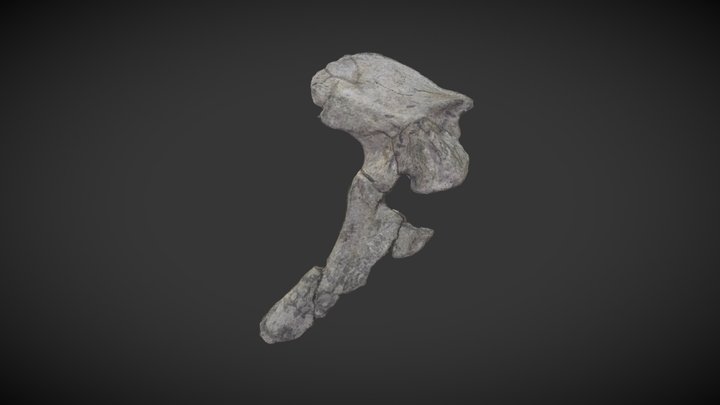
3D model
- Source
- Sketchfab
- Credit
- EDDyLab @ULiege
- Licence
- CC Attribution
- Commercial use
- cannot be read from the licence given — check the record
Smithsonian Open Access and MorphoSource were not reached for this taxon, so this list is what the others held rather than everything there is.
The description on this site
- Licence
- CC BY-SA 4.0
This is what the site found, which is not the same as what exists.
Keep going
What may have been alongside itDyrosauroidea through timeFormations of the PaleoceneThe world it lived on
Occurrence data from the Paleobiology Database, CC BY 4.0. (Stefano 1903)