Pycnodus
Pycnodus is an extinct genus of ray-finned fish from the Eocene period. It is a wastebasket taxon, although many fossils from the Jurassic or Cretaceous are assigned to this genus, only the Eocene species, P. apodus is valid. As its name suggests, it is the type genus of Pycnodontiformes.

User:Haplochromis · CC BY-SA 3.0 · via Wikipedia/Commons. May be a photograph of a specimen, or an artist’s reconstruction — an interpretation of a skeleton, since colour and soft tissue are almost never preserved.
On record
Recorded, not inferred- Sits inside
- PycnodontinaePBDB
- Diet
- durophage, carnivorePBDB, for Pycnodontiformes
- Life habit
- nektonicPBDB, for Pycnodontiformes
- Motility
- actively mobilePBDB, for Pycnodontiformes
Time the record covers
At least 127 million years on record.
The record covers at least 165.3 Mya to 37.71 Mya. No occurrence read is dated outside 168.2 Mya to 33.9 Mya.
112 occurrences of Pycnodus on record, most of them in the Eocene. Bar height is expected occurrences, not a count: each fossil is spread across the span it is dated to, so a tall narrow bar means tight dating and a low wide one means loose.
When
112 occurrences- Middle Jurassicunder 1%
- Late Jurassic9%
- Early Cretaceous21%
- Late Cretaceous23%
- Paleocene12%
- Eocene34%
These are dates about fossils, not the animal: the record can only begin after it arose and end before it died out, so either end may reach further. Shares are expected occurrences: a fossil dated to a span is counted partly in each period it straddles. More on what this infers.
Found in
37 formations
- Korallenkalk Formation8
- Umm Himar Formation7
- London Clay Formation · Thames Group6
- Subathu Formation4
- Lameta Formation4
- Tallahatta Formation · Claiborne Group4
Loading coastlines…
The named rock units Pycnodus has been recovered from, largest first. Drawn where the rock is now, not where it formed. 13 further formations hold fewer occurrences each and are not listed. 32 occurrences have no formation on record, which is common for older literature.
Pycnodus and its relatives
EoceneWhere Pycnodus and its relatives were recorded in the Eocene.
Found in the same rock
1,615 taxa- Albula oweni12 sites
- Ostrea12 sites
- Cylindracanthus rectus11 sites
- Palaeocybium proosti11 sites
- Trichiurides sagittidens11 sites
- Arca10 sites
- Cardium10 sites
- Diplopodia (Pseudodiadema)10 sites
- Dasyatis9 sites
- Egertonia isodonta9 sites
- Eotrigonodon serratus9 sites
- Lepidotes9 sites
- Myliobatis9 sites
- Mytilus9 sites
- Odontaspis winkleri9 sites
- Pholadomya9 sites
- Pholadomya elongata9 sites
- Phyllodus toliapicus9 sites
- Aetomylaeus dixoni8 sites
- Crocodylia8 sites
- Hypotodus verticalis8 sites
- Lepisosteus indicus8 sites
- Stephanodus8 sites
- Turbo8 sites
The Paleobiology Database records 87 sites for Pycnodus, and this reads all of them. The number is how many of those sites it was catalogued from too. The 24 sharing the most are listed.
This is not a list of everything alive at the time. It is only what has come out of the same ground as this animal and been written down.
Entered from
46 references- Jura Vaudois et Neuchatelois13
- Stratigraphy and Paleobiology of the Upper Cretaceous - Lower Paleogene Sediments from the Trans-Saharan Seaway in Mali9
- Ueber die im Korallenkalk des Lindner Berges bei Hannover vorkommenden Ueberreste von Fischen, mit Beschreibung und Abbildung einiger neuen Arten [On the remains of fishes occurring in the Coral Chalk of Lindner Mountain in Hannover, with description and images of some new forms]8
- The Umm Himar Formation (Paleocene) of Saudi Arabia and Associated Strata: Stratigraphy, Vertebrate Fauna, and Paleoenvironment7
- Vertebrate fauna from the infra- and inter-trappean beds of Andhra Pradesh: age implications7
- The English Chalk and London Clay: two remarkable British bony fish Lagerstatten4
- Le Crétacé continental à vertébrés de la bordure sud du plateau de Tinhert: découvertes paléontologiques et considérations stratigraphiques [The continental Cretaceous vertebrates of the southern border of the Tinhert Plateau: paleontological discoveries and stratigraphic considerations]4
- Eocene ichthyofauna from the Subathu Formation, Northwestern Himalaya, India4
- Sur un materiel ichthyologique des "Midra (and Saila) shales" du Qatar (Golfe Persique)4
- La faune ichthyologique de l'Ypresien de la Belgique4
- Taxonomy and biostratigraphy of the elasmobranchs and bony fishes (Chondrichthyes and Osteichthyes) of the lower-to-middle Eocene (Ypresian to Bartonian) Claiborne Group in Alabama, USA, including an analysis of otoliths3
- Casier, 19663
Each of the 112 occurrences read was entered from one of these publications, ordered by how many each accounts for. This is not a search for papers mentioning the name. 34 further references are not listed. Entries link to doi.org where the Paleobiology Database holds an identifier, and to its own record where it does not. Relayed as the Paleobiology Database holds them, not checked against what they resolve to.
Media and terms
Media content3
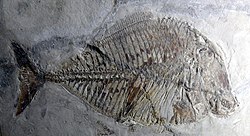
Picture of Pycnodus
- Source
- Wikipedia/Commons
- Credit
- User:Haplochromis
- Licence
- CC BY-SA 3.0
- Commercial use
- the licence allows it
CT scan
- Source
- MorphoSource
- Licence
- In Copyright
- Commercial use
- cannot be read from the licence given — check the record
- Specimen
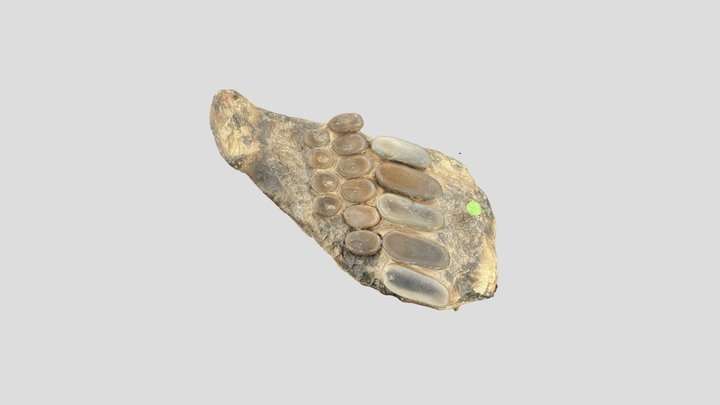
- Pycnodus maliensis · nhmuk:pal:PV P 75894
The description on this site
- Source
- Wikipedia, “Pycnodus”
- Licence
- CC BY-SA 4.0
This is what the site found, which is not the same as what exists.
Keep going
What may have been alongside itPycnodontinae through timeFormations of the EoceneThe world it lived on
Occurrence data from the Paleobiology Database, CC BY 4.0. Agassiz 1833