Chitra indica
The Indian narrow-headed softshell turtle, also known commonly as the small-headed softshell turtle and the Indo-Gangetic softshell turtle, is an endangered species of softshell turtle in the family Trionychidae. The species is native to waterways and rivers of the Indian subcontinent. One of the largest freshwater turtles, it feeds on fish, frogs, worms, crustaceans and molluscs, and even the occasional swimming rodent or other small mammal. C. indica, like other softshell turtles, uses it flexible and leathery shell to dig itself deep into sandy lake and river bottoms; here, it patiently waits, with just its nose, mouth and eyes exposed, for potential prey to swim by. It will also ambush and chase its prey, depending on availability, the time of year, and size of the prey. In the past it was included as a subspecies of Chitra chitra, a species restricted to Southeast Asia using current taxonomy.

User:Shailendra Singh · CC BY 3.0 · via Wikipedia/Commons. May be a photograph of a specimen, or an artist’s reconstruction — an interpretation of a skeleton, since colour and soft tissue are almost never preserved.
On record
Recorded, not inferred- Sits inside
- ChitraPBDB
- Diet
- piscivore, carnivorePBDB, for Trionychidae
- Life habit
- aquatic, solitaryPBDB, for Trionychidae
- Motility
- actively mobilePBDB, for Trionychidae
- Environment
- brackish,freshwaterPBDB, for Trionychidae
Time the record covers
At least 9 million years on record.
The record covers at least 11.63 Mya to 2.58 Mya. No occurrence read is dated outside 15.98 Mya to 0 Mya.
2 occurrences of Chitra indica on record, most of them in the Miocene. The Paleobiology Database records this as a living group. Bar height is expected occurrences, not a count: each fossil is spread across the span it is dated to, so a tall narrow bar means tight dating and a low wide one means loose.
When
2 occurrences- Miocene50%
- Pleistocene50%
These are dates about fossils, not the animal: the record can only begin after it arose and end before it died out, so either end may reach further. Shares are expected occurrences: a fossil dated to a span is counted partly in each period it straddles. More on what this infers.
Chitra indica and its relatives
MioceneWhere Chitra indica and its relatives were recorded in the Miocene.
Found in the same rock
15 taxa- Acrochordus dehmi1 site
- Batagur1 site
- Batagurinae1 site
- Brachypotherium1 site
- Channa1 site
- Claridae indet.1 site
- Gavialis1 site
- Gavialis gangeticus1 site
- Heritiera1 site
- Kachuga1 site
- Lissemys punctata1 site
- Prodeinotherium pentapotamiae1 site
- Protragoceras gluten1 site
- Tomistoma1 site
- Trionychinae1 site
The Paleobiology Database records 2 sites for Chitra indica, and this reads all of them. The number is how many of those sites it was catalogued from too.
This is not a list of everything alive at the time. It is only what has come out of the same ground as this animal and been written down.
Entered from
2 references- Miocene vertebrates from the Siwalik Group, Western Nepal1
- On the occurrence of reptilian remains in the peat bed of Barrackpore, 24-Parganas, West Bengal1
Each of the 2 occurrences read was entered from one of these publications, ordered by how many each accounts for. This is not a search for papers mentioning the name. Each entry links to doi.org. Relayed as the Paleobiology Database holds them, not checked against what they resolve to.
Media and terms
Media content2
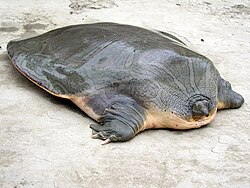
Picture of Chitra indica
- Source
- Wikipedia/Commons
- Credit
- User:Shailendra Singh
- Licence
- CC BY 3.0
- Commercial use
- the licence allows it
CT scan
- Source
- MorphoSource
- Licence
- not stated by the source
- Commercial use
- cannot be read from the licence given — check the record
- Specimen
- Chitra indica · smf:52769
Smithsonian Open Access was not reached for this taxon, so this list is what the others held rather than everything there is.
The description on this site
- Licence
- CC BY-SA 4.0
This is what the site found, which is not the same as what exists.
Keep going
What may have been alongside itChitra through timeFormations of the MioceneThe world it lived on
Occurrence data from the Paleobiology Database, CC BY 4.0. Gray 1831